Moen Jo Daro
Moen-Jo-Daro is located about 20 kilometers away in south of Larkana , Sindh, Pakistan, near Indus river
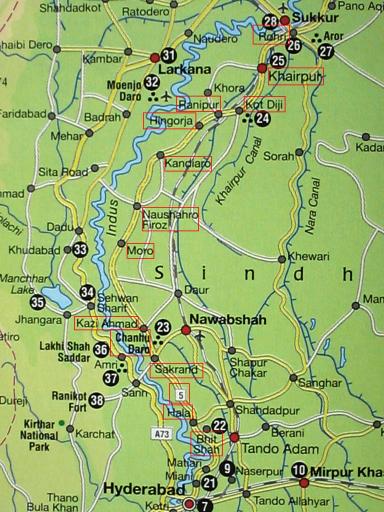
It is observed that all ancient civilizations of the world rose on the banks of rivers. The Mohan-jo-Daro civilization rose on the river Sindhus (Indus). Although the civilization did not leave any decipherable records, the structure tells a highly articulate story.
The excavations of Mohan-jo-Daro bear a living testimony to a highly developed pre-Aryan civilization which was at its zenith between 4000 B.C. and 3000 B.C. Archaeological research tells of a people who were well-versed in the art of dancing, sculpture and arts and crafts. They had attained a high degree of excellence in agriculture taking advantage of the vast tracts of a fertile alluvial soil found on both sides of the Sindhus river.
Among other things, the civilization seems to have been well acquainted with the use of the wheel as well as the use of draught animals for farming. The architectural structures also are a testament to a sophisticated people who developed organized urban structures . The cloth and designs on fabric also attest to a refined culture. Among the discoveries in Mohen-jo-Daro is a seal with a representation of a mastless ship proving that the civilization not only used the Sindhus river but also traveled the sea.
The civilization slowly developed and became very prosperous. At its height it stretched from present day Kashmir to Kutchh. The Sindhus valley civilization paid the price for prosperity. After 2500 B.C. a number of smaller Aryan civilization began to encroach on its territory.
Excavations At Mohen-Jo-daro,
Sindh
The Pottery: With an Account of the Pottery from the 1950 Excavations
of Sir Mortimer Wheeler by George Dales, and Jonathan M. Kenoyer
The pottery of Mohen-Jo-daro, one of the two major urban centers of the Indus Valley civilization (2500-2000 B.C.), is described and documented. The authors survey Harappan ceramic technology and style, and develop an important and unique approach to vessel form analysis and terminology. Included is Leslie Alcock's account of the pottery from the 1950 excavations by Sir Mortimer Wheeler.
"(this volume's) appearance is of extraordinary interest to students of the Indus civilization, since the study aims to achieve a level of analysis quite different from that of any of the earlier published reports on Indus sites . . . there is a clear discussion of the crafts aspects, valuable because so little has been written on this aspect of the pottery of Mohan jo Daro in the past five decades . . . no one can question the meticulous labour that has gone into producing this monumental volume." - Antiquity 1986. University Museum Monograph 53. Hard. xxi + 586 pp., color frontispiece, 45 pls., 115 figs., 11 tables, numerous drawings, Urdu summary, appendices, index. ISBN 0-934718-52-0. Price $149.00
|
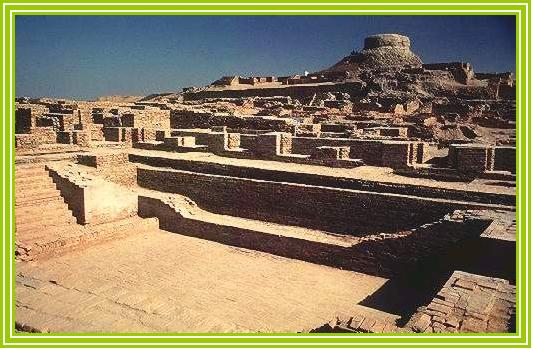
The mound, so-called citadel, is
man-made, built purposefully higher than the rest of the city, so
that the people who lived there, the rulers, could have a clear
view out over their domain. Equally, the citizens living down the
hill could always be reminded that they were subject to a greater
power. |
The Buildings
Several major buildings have been unearthed on
one side of the mound. One of these is a large structure, believed to
be the base of a huge granary. City fathers must have felt that it was
a good idea to have all the grain centrally located under their
watchful eye. There is nothing left of the wooden superstructure.
Another astonishing and most celebrated citadel buildings is the Great
Bath. Steps lead down into the bath at either end. This bath was made
water tight by using gypsum mortar between fired bricks and sealing by
a course of bitumen. The bath was drained through a brick arch about
two meters high and was probably filled from a large well found close
by. Many other great buildings have been excavated, but some of them
are in need of re-excavation.
The Lower City
The lower city of Moen-Jo-Daro, where the
houses, shops and craft workshops were located, is a fine example of
good urban planning. The main streets are about nine meters wide and
run at righ-angles to each other, dividing the town into roughly
rectangular blocks measuring about 360 meters by 240 meters. Between
these main streets run a series of lanes, also at right-angles,
usually about 1.5 to 3 meters wide. There is therefore a sense of
strong administrative control which is reinforced by a number of
small, single-roomed buildings on street corners. These could well
have been the night watchmen or policemen's post.
The overall quality of domestic accommodation was very high. Fired
bricks were used for the construction of the walls. There is evidence
that the internal walls were plastered, though the rendering of the
external wall is not certain. Most houses were equipped with a flight
of stairs which presumably led to either a second storey or at least a
flat roof.
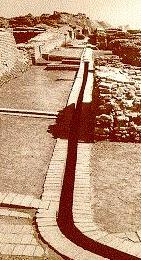
Drainage system
Though the streets were paved and presumably
very dusty, a series of brick drains ran through them, which were not
only of unique quality among contemporary societies, but even today
would be the envy of much of Asia. Clearly these drains were sometimes
subject to blockage, but they appear to have been regularly cleaned to
judge by the brick manholes which were located at intervals along
their length. The pipes came in lengths which slotted into each other
much in the same way as modern drainpipes.
The Fall of the city
Moen-Jo-Daro had been the target of floods
several times. On at least three occasions, the extent of flooding was
so severe that the city was swamped making extensive rebuilding
necessary. There was a general decline in building techniques, as
indeed in the overall planning.
There are various theories explaining the civilization's wild and
sudden downfall. One such theory suggests that wild and war-like
Aryans invaded from the north. But modern dating techniques negate
such a theory because the city fell into decline wel before the Aryans
ever arrived. Another theory suggests that the decline was led by
population boom. Houses became more and more overcrowded;
increasingly, buildings and even courtyards were sub-divided. Space
available for occupation diminished due to the steadily rising levels
of the Indus. However, as the entire population even after a boom may
only have been about 400,000, this seems improbably. Much more likely
is the problem created by recurring and ever-worsening floods. But
evidence from a number of sites suggests a far worse problem than
this. Geologists suggested that movements in the earth's crust had
caused southern Pakistan to become slightly raised, effectively
damming the Indus and preventing it from running down to the sea. The
Indus would have broken its banks and flooded the surrounding plains,
submerging many of the fields. Whatever really happened remains a
mystery and from this point on Moen-Jo-Daro remained quite
uninhabited.
The civilization lasted, at its height, from about 2,500 B.C. to 1,500
B.C. Much of what is left behind is totally unique, particularly in
the fields of architecture and urban planning, setting itself apart
from developments further west.
The Secrets of Sindh
"Civilizations rise and fall, all.
Egypt, Rome, Greece, Babylon, Assyria, Mesopotamia.
Slaves, armies, sieges,
Fiery catapults and captives flayed alive!
Violence by rote,
Conquest by conviction.
Thousands of years of terror,
Millennia of man against man
For ideology or land,
With women and children murdered in the middle.
Is it human nature that tears down
The walls of Jerico or Multan,
Slaughtering all the inhabitants
In the name of religion or obscure cultural allegiances?
Boys are beheaded, their mothers raped
Babies are impaled from Tenochitlan to Taxila.
Desert Prophets,
Regal Monarchs,
Military Rulers.
Imperialistic imperatives
Bringing manacles and massive mayhem.
From time immemorial hate and horror ruled the earth
And guided mankind's interactions.
How then in ancient Sindh were they so confident
In the continuance of their existence
That they built no moats and manufactured no weapons?
3000 years before the common era
In a vast territory the size of Europe
Thrived the Indus Valley Civilization
Where traders and craftsmen and women and children
Worked and played
For more than 20 centuries.
Why were there no weapons?
No ramparts?
No moats?
No fortifications against
Marauding fear?
Why were they so confident?
Given the collective history of the human race.
What was their secret?
How did they order their reality without resorting to arms?
From Persia to Kashmir across the Deccan
Sprawling>br> Interacting
Supplying the world with condiments and cloth.
How they remained thus,
Free from the necessities of warfare,
The bricks, the drains and wells at Mohan -jo-Daro
Cannot tell us.
The recent history of the Indus holds no answers.
But in the soul of Sindh
Beyond all forms of contemporary coercion,
Through the layers of conditioning:
A clearness of intellect holds some primordial clue.
If only the world could understand
The meaning hidden beneath the mounds
In Mohan-jo-Daro."