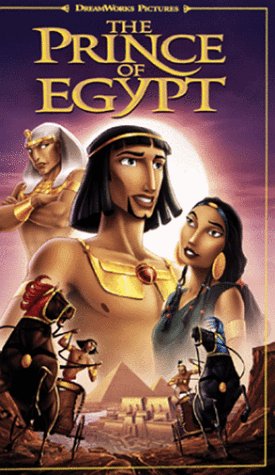
THE PRINCE OF EGYPT features the voices of Val Kilmer as Moses and Ralph Fiennes as Rameses. It also brings together the vocal talents of Sandra Bullock as Miriam, Danny Glover as Jethro, Jeff Goldblum as Aaron, Steve Martin as Hotep, Helen Mirren as the Queen, Michelle Pfeiffer as Tzipporah, Martin Short as Huy, and Patrick Stewart as Pharaoh Seti.
The production team is headed by directors Brenda Chapman, the first woman director of an animated feature, Steve Hickner and Simon Wells; producers Penney Finkelman Cox and Sandra Rabins; and executive producer Jeffrey Katzenberg.
Oscar� winner Stephen Schwartz ("Pocahontas") wrote six original songs for the film, and composer Hans Zimmer, an Academy Award� winner for his work on "The Lion King," created the score.
Over 350 artists, animators and technicians from over 35 different countries devoted four years to bringing THE PRINCE OF EGYPT to the screen. The film breaks exciting new ground in animation with such developments as the state-of-the-art exposure tool, developed by DreamWorks and SGI, which allows for the seamless blending of 2-D and 3-D animation. New approaches in character and production design give the film a look that is distinctly different from other animated films. In addition, award-winning visual effects artists from the world of live-action films joined with traditional animation artists to achieve a new level of special effects for an animated feature.
ABOUT THE PRODUCTION
THE BEGINNING
The idea that would become DreamWorks' THE PRINCE OF EGYPT began to take shape even before the company was formed. Of course, the story has its roots in the biblical book of Exodus, but the inspiration to bring it to the screen as the studio's first traditionally animated feature arose unexpectedly from a conversation between Jeffrey Katzenberg, Steven Spielberg and David Geffen back in 1994.
The three were talking about their ambitions for their as-yet-to-be-announced studio venture. Katzenberg's revolved around a new animation studio, which prompted a question from Spielberg. Katzenberg recalls, "Steven asked what the criteria would be for a great animated film, and I launched into a 20-minute dissertation about what you look for: a powerful allegory that we can relate to in our time; extraordinary situations to motivate strong emotional journeys; something wonderful about the human spirit; good triumphing over evil; music as a compelling storytelling element; and so on. Steven leaned forward and said, 'You mean like "The Ten Commandments"?,' and I said, 'Exactly.'"
However, it was Geffen who brought the concept home, as Katzenberg remembers, "David said, 'What a great idea. Why don't we make that our first animated movie?' And we were off."
Katzenberg acknowledges, "I'm sure there are those who think we're nuts for choosing a Bible story as our first animated feature. But the fact is, this is a great emotional story about a remarkable man who must come to terms with his past, his heritage and his faith. In our telling of the story, we also focus on the extraordinary relationship between two brothers and how the roles in which they have been cast in life draw them into conflict with each other."
THE PRINCE OF EGYPT fulfilled another of Katzenberg's long-held goals, allowing him to take animation into new territory. "In live action," he states, "there is an incredible variety of movies-dramas, comedies, big effects films, intimate romantic comedies. As moviegoers, we demand that kind of diversity from live-action features. I don't see why animation can't be as varied in the types of stories it tells. I hope and believe that we can use animation as a cinematic tool to tell many different kinds of stories that today's animation can be something more than movies for children."
"We do not want to exclude children as an audience, but set out to make a film that we as adults would want to see," producer Penney Finkelman Cox adds. "This part of the Bible touches on sophisticated themes, which set the movie apart from the start. In other words, the story determined what the film would be, as opposed to the technique used to tell it-animation didn't define the movie, the nature of the material did."
For the filmmakers, the fact that the film would be animated made it no less important to try to be accurate in depicting the time and place of the story. Everyone involved in the production became part of a process of exhaustive research in their respective areas-from the story itself to the geography, architecture and clothing of the Egyptian Empire. The filmmakers also consulted with archeologists, historians, theologians, Egyptologists, biblical scholars and religious leaders.
During the early stages of production, key members of the creative team embarked on a trip to Egypt and the Sinai Peninsula. Traveling through the ancient land, directors Brenda Chapman, Steve Hickner and Simon Wells; producers Penney Finkelman Cox and Sandra Rabins; executive producer Jeffrey Katzenberg; story supervisors Kelly Asbury and Lorna Cook; production designer Darek Gogol; art directors Kathy Altieri and Richard Chavez; and songwriter Stephen Schwartz were each inspired in their own way. Schwartz observes, "It's hard to define, but there's an intangible connection that comes from being on the actual spot, seeing the locations and breathing the air. There were times when I was walking through a temple or looking at a giant statue and music would actually come into my head. Several themes in the movie originated that way."
The filmmakers recognized that there were a number of inherent challenges in bringing the Exodus story to the screen. Producer Sandra Rabins offers, "We began by identifying the problems, and then set out to solve them during an 18-month evolution in which we continually honed the story to discover what worked and what didn't."
The first dilemma was how to tell a story of such enormous scope in about 90 minutes. Co-story supervisor Kelly Asbury says, "The challenges were to be as true to the biblical source material as possible, maintain the overall narrative of the story, capture the emotions of the characters, and make a film you could really sink your teeth into-all within the time constraints."
Co-head of story Lorna Cook continues, "It was also important to keep the character of Moses as accessible as possible, because ultimately he was human. That was one thing we wanted to get across: he wasn't just a messenger; he was a man who took on a mission, but not without conflict and sometimes with a lot of fear."
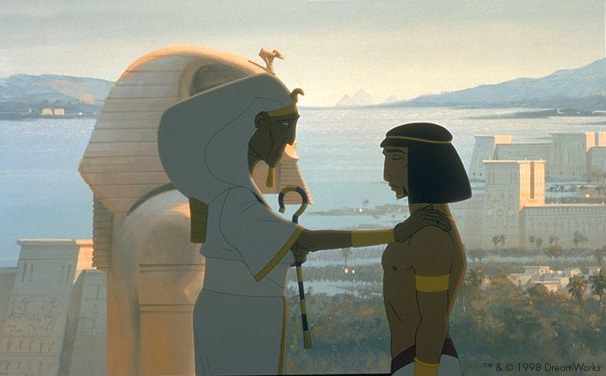
In "The Prince of Egypt," the main conflict faced by Moses becomes his relationship with Rameses, the man he had always known as his brother. "This isn't a traditional animated picture with a conventional hero and villain. It's a much more complex story," director Steve Hickner notes. "In our movie, Moses and Rameses are brothers; from the beginning of the film to the very last moment, they still care for each other."
Val Kilmer, who is the voice of Moses, offers, "We can all identify with having people in our lives who we still care strongly about, even after the relationship has changed."
"They become estranged to the point where they are enemies. But when brothers are enemies, they don't stop being brothers," says Ralph Fiennes, who provides the voice of Rameses.
"In fact, they still love each other very much," director Brenda Chapman states. "Their conflict arises because of the different ways in which they grow-one doesn't grow very much at all; the other grows beyond anything he could possibly have imagined. The relationship between the two brothers evolved out of a storyboard sequence created by story artist Ronnie del Carmen. When we saw what he had conceived, we realized that the story of the two brothers was the heart of the film. To me, it's the key to what made the story work."
As the story developed, so did the concept for the look of "The Prince of Egypt," which was primarily influenced by the work of three very disparate artists. Nineteenth-century French illustrator Gustave Dor� created Bible etchings that, although black and white, are incredibly rich and very detailed. The paintings of Impressionist artist Claude Monet are alive with lush palettes of colour and light. Finally, the filmmakers looked to the work of director David Lean, an undisputed master of epic cinema.
Katzenberg says, "When we were recruiting, people would come in, and I'd show them the Dor� illustrated Bible, a book of Monet paintings and some stills from Lean's 'Lawrence of Arabia.' I'd say, 'These are our inspirations; I hope we can do them justice.'"
REBUILDING A LOST EMPIRE
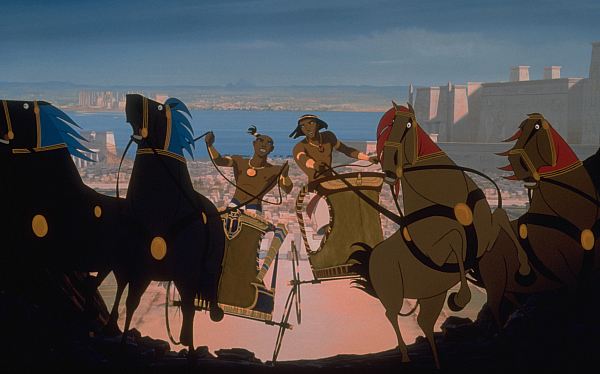
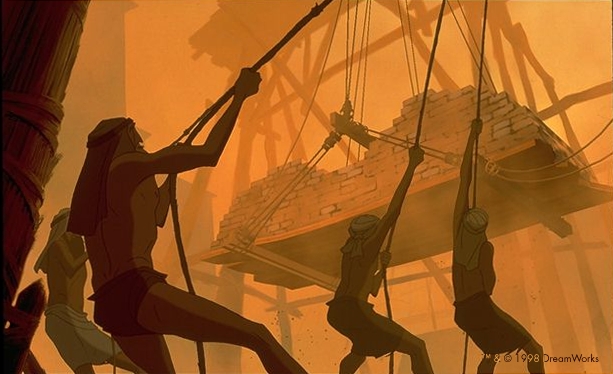
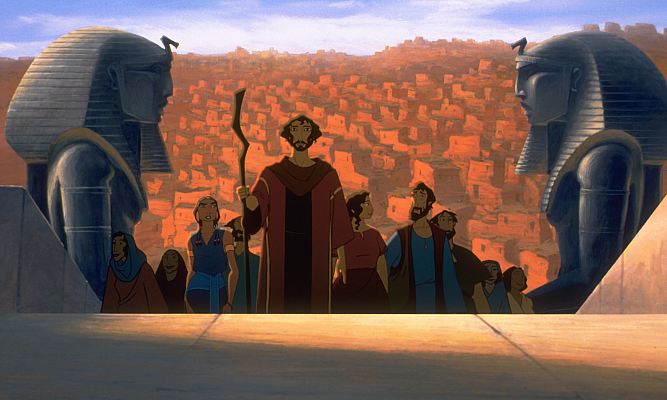
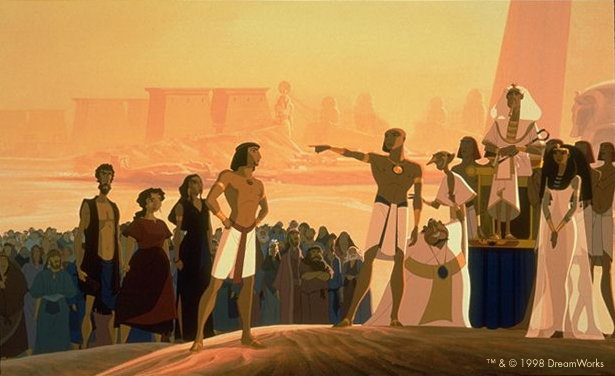
The setting of THE PRINCE OF EGYPT is divided into two major worlds: the majestic empire of the Egyptians, hewn from stone with clean hard edges and sharp angles; and the small, winding, intimate milieu of the Hebrews, made with mud bricks and timber and worn by the elements. This stylistically different approach helped underscore the contrasts between these two cultures.
"I designed the Egyptian world to be larger than life," says production designer Darek Gogol. "When you go to Egypt and stand next to the actual temples, you realize that for ancient people, these were the skyscrapers of their time. What's amazing is that in the 20th century, we're still overwhelmed by this architecture. I wanted to make the buildings bigger than they actually were to capture that sense of scale on the screen."
During his research, Gogol found another way to connote the Egyptian style of architecture. "All the ancient Egyptian drawings I studied are flat; they didn't know about perspective," he remarks. "I thought it would be interesting to take that element and draw the architecture in a very flat way without showing any vanishing points. The columns, for example, have no ellipse. They get bigger or smaller as we get closer or farther away, but they remain flat."
In sharp contrast to the splendour of the Egyptian Empire are the modest dwellings of the Hebrews in Goshen. Art director Richie Chavez notes, "The world of the Hebrews is more organic. We gave Goshen more of a rounded, eroded look because the homes were made of mud brick, which is weathered by the rain, the wind and the sand. The homes are asymmetrical and off-kilter to give them a flow and ebb that the angular Egyptian side didn't have."
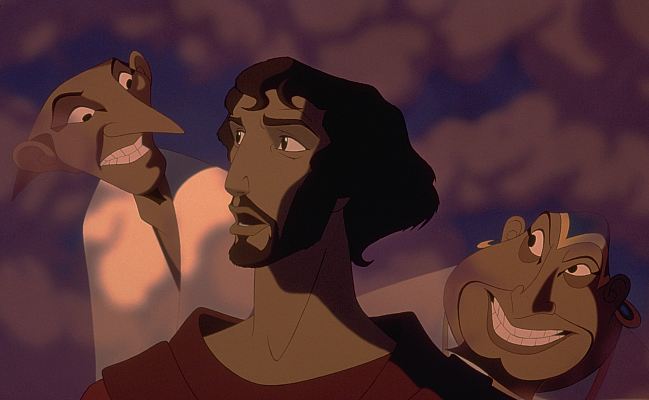
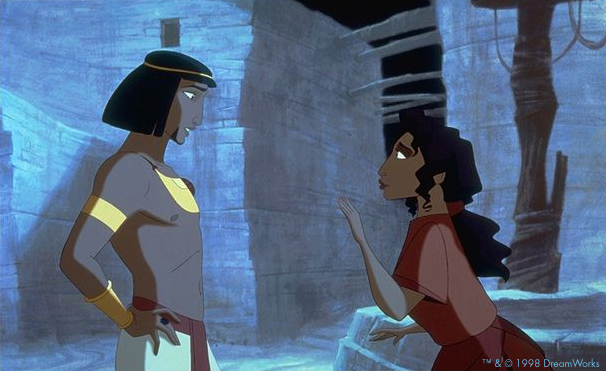
A similar split extended to the design of the people who inhabit these worlds. Character designersCarter Goodrich and Carlos Grangel studied ancient wall paintings and carvings to find a visual language that would help define the two societies. The Egyptian characters are more sculpted in appearance with chiseled features, while the Hebrews are more curved and looser in their shape.
In creating the faces, the character designers, along with lead animator William Salazar, hit on an approach that further set their characters apart from those in other animated films. Standard practice had been to divide the faces into thirds: one third for the eyes and forehead, one third for the nose and cheeks, and one third for the mouth and chin. In "The Prince of Egypt," the familiar 33-33-33% formula was altered to 30-40-30%. Slightly elongating the middle section of the face and shortening the upper and lower ones gave the characters a more realistic and engaging countenance, and allowed the animators to bring out more expression in their faces.
The designers also utilized colour to accentuate the contrasts between the two cultures. The buildings of the Egyptians are in polished white and light pastels, while the homes of the Hebrews are in muted earth tones. Their costumes also reflect these colour separations. The Egyptians are dressed in white with jewelry accents of gold, red and turquoise, while the Hebrews are clothed in natural shades of brown and beige. Only the Midianites, the desert tribe of Jethro and Tzipporah, are dressed in vibrant colours.
THE PRINCE OF EGYPT is the first animated film to employ a professional costume designer. Kelly Kimball worked closely with the character designers to create a "wardrobe" for the characters. She did extensive research, and also experimented with fabrics and natural dyes that were available in the time of Moses. She discovered that the people of the day would have been able to achieve a full palette, which opened up the range of colours that could be used in the costumes.
Colour became integral not only to the look of the film, but the impact of the drama. During the development phase, the filmmakers worked with the art directors to map out what became known as the "emotional beat board," which assigned specific colour schemes to different points of the story.
"There are colour cues we all respond to naturally," art director Kathy Altieri explains. "We played on those throughout the film. The happier sequences, for example, have lighter brighter colours with lots of sunlight streaming through. We applied red and black for more dramatic, scary or violent sequences. We used blue, a soothing colour, in the scene when Moses' basket floats into the Queen's water garden to emphasize that something nurturing and safe is happening."
Lack of colour also came into play. "The sequence of the death of the first-born is almost monochromatic. Whereas we had used colour saturation to fill a scene with life, to express lack of life we literally sucked the colour out. We helped convey the emotions of the story through colour, light and contrast, but it should be very subliminal. If the audience becomes consciously aware of it, we didn't do our job well," Altieri states.
In animation, there is no set, so every sound has to be created from scratch, just like the visual elements. Award-winning sound designers Lon Bender and Wylie Stateman worked for over two years to develop the sounds of ancient Egypt, modulating the frequencies of the background noise in relationship to the action. The Red Sea sequence, for example, demanded that they give volume to the crashing waves without competing with Hans Zimmer's score. They did this by keeping their frequencies out of the range of the music, allowing the sound and the score to be harmonious. In the final step, re-recording mixers Andy Nelson, Anna Behlmer and Shawn Murphy wove together the sound effects, the music and, of course, the voices.