 |
|
|
|
|
|
|
|
|
|
|
|
|
|
|
|
|
|
|
|
|
|
|
|
|
|
|
|
|
|
|
 |
|
|
|
 |
|
|
| Frequently Asked Questions |
|
|
| 1. Why did Val want to do The Prince of Egypt? |
|
|
|
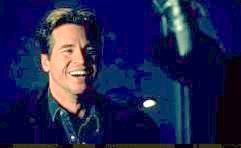
"I did the film for my children." (Mercedes and Jack), says Val. "These movies last longer than most and they are timeless. My daughter loved it and she's definitely not too young for themovie. It's important that younger children know the story of Moses so that they won't be confused. Mercedes goes to Sunday school."
"I love the way the story is framed," the former BATMAN star explains. "It starts with him [Moses] as a teenager and there is an innocence about him, yet something in his core is very truthful. I think it is a very strong way to tell a story. Moses is a very human character."
"It was such a thorough presentation that he [Katzenberg] gave me," Kilmer recalls. "There wasn't much for me to say other than 'Let's go to work.'" |
|
 |
|
|
|
|
|
| 2. How did Val prepare for the role? |
|
|
| "I was lucky that when Jeffrey Katzenberg approached me, I was working on THE SAINT and had the services of a voice coach and we worked hard on finding the right voices for Moses, because he goes from a young man to the saviour of the Hebrews." |
|
|
| 3. How different is POE to any other job Val has done? |
|
|
|
"I am not like some actors who use themselves very well - personality actors like Richard Gere, those actors who don't actually do anything except play themselves. I enjoy developing characters, in that way of meditating and creating the story through various and different ways which made the Prince of Egypt so unusual because it was just the voice. And that was hard. What I tried to do was put the whole character in every sentence." |
|
|
| 4 Was playing Moses intimidating? |
|
|
| "I didn't let myself think about it. I just thought of the immediate scene-by-scene and acting with these other great actors even though we just did voices. We're making up a story that's such a dynamic one and such a human one -- Moses, in my early stories from childhood. The story of Moses really appealed to me because he is so human. He is so passionate and frustrated when he's a young man. He kills a man and it's the same later on when he destroys the first set of tablets, a very passionate man but he's also a very humble man and so those flaws and the things that make him human, I found really attractive in making the story up." |
|
|
| 5. Did Val ever get to work with other cast members, like Ralph Fiennes who supplies the voice of Rameses? |
|
|
"Ralph was in Australia and I was in London," says Val, "so we did all our recording separately in studios halfway across the world."
"The experience was a feeling of weightlessness initially. There's just the microphone and a conversation to get you into the scene. It's like a mosaic or an Impressionist painting, where you really can't conceive of what you're doing until a little bit more gets done."
"In a very odd way we were actually working together: it was a very slow-motion process because that's how the story gets made up. Like a mosaic, or an impressionist painting, where it doesn't really make much sense up close, but give it some distance - when the animation starts getting done - and suddenly it's there." |
|
|
| 6. Why did Val not provide the singing voice of Moses? |
|
|
"I tried," Val explains. "Stephen Schwartz wrote a song that was way out of my range, and they did try to adjust it and I recorded several times with Hans (Zimmer), but it just didn't fit.''
"Val's got a beautiful voice," Katzenberg says, "but the songs are very intricate and in a very high register. And Val was shooting THE SAINT at the time we were recording, and for him to sing that song would take two, three months of training, and that's an awful lot to ask. We're already making demands on these actors as it is, so we couldn't pull it off."
Director Sandra Cox agrees: "Val, who has a wonderful singing voice and is the world's busiest man, just didn't have the time." |
|
|
| 7. Did the animators incorporate any of Val's mannerisms in the character of Moses? |
|
|
"A few," Kilmer admits. "It's a very odd sensation seeing yourself drawn."
"I can see a bit of me in face, but mostly the animators captured some of my mannerisms. Moses has more of my body language than my body." |
|
|
| 8. Who supplies the voice of God? |
|
|
"I play God in the story as well (which means you talk to yourself) "I do. Something actors do quite often in our business." [The role was] "Uncredited. It was in my contract, "I will take no credit for God."
"He plays the different roles," says Katzenberg. "Gift of the voice. He plays two characters in the movie." |
|
|
|
9. Is POE OK for children? |
|
|
| "Of course, it's a family story and it's a family film. I think what you're hearing are people that are saying maybe it's not for toddlers because of the complication in the story, but it's also realistic in a way. There are slaves that are being punished for existing and things that are large, complicated ideas. But my daughter who just turned seven, she saw it and loved it." |
|
|
| THE PROCESS OF CREATING AN ANIMATED FILM |
|
|
| OUTLINE STORY: A basic description of the main events of the story which will later be developed into a complete script much the same as a live-action film. |
|
|
| SCRIPT: The script details scene-by-scene instructions for a film including the settings, action, dialogue between the characters and camera instructions. A script is not always used in an animated film. 'The Prince of Egypt' was written during the development and story process. |
|
|
| VISUAL DEVELOPMENT: During pre-production phase, the producer(s), director(s), production designer and art director(s) decide on how the film should look and feel. This process involves exploring various designs, colour palettes, locations etc. in an effort to define the visual style of the movie. |
|
|
| CHARACTER DEVELOPMENT: Each character in the film is designed to fit in with the story, with the personalities of the actor/actress cast to voice them and also with the overall visual feel of the film. Once the character designs are approved, they are passed on to the lead animators for further refinement. Expression and model sheets are then prepared. |
|
|
| STORYBOARDS: Storyboard artists created drawings which put the script into picture form whilst developing the flow of the individual sequences in the movie. This procedure involves taking each sequence and sketching it out on small panels then putting the panels in sequence thus creating a storyboard. Once an entire sequence is up on storyboards, the artist responsible for the sequence would pitch it to the directors, producers and story team for approval. |
|
|
| EDITORIAL: Once approved, storyboards are shot to film to create a flowing sequence known as a 'story reel.' The story reel represents the first opportunity to see the story on film. It allows the filmmakers to edit and fix the story before send the sequences into production. Once the filmmakers feel the story is working in sequence, the sequence is then sent to layout. |
|
|
| DIALOGUE RECORDING SESSIONS: Actors/actresses are cast according to their vocal range, their ability to identify with a character and their individual personalities. Once the voice talent has been cast, dialogue recording sessions begin. |
|
|
| WORKBOX: The Workbook phase consists the directors, producers, layout artists, art directors and production designers breaking the storyboard drawings down into separate shots to define where wide shots, close-ups and other camera moves will happen. Workbooks act as a guide in creating layouts which define where characters are placed in each shot, where props are, what elements are in the foreground, midground or back- ground, and how the lighting is designed. Every scene needs to be planned out in great detail showing the camera angles required and everything which must appear in the shot. |
|
|
| ROUGH LAYOUT: The main goals of this phase are to establish the composition of each shot in the movie and how the main story points of each scene can be conveyed properly through cinematography. |
|
|
| SCENE PLANNING: This process deals with the actual camera moves. It helps to manoeuvre the camera to get the desired effect and takes care of problems and errors that occur as sequences go through production. These problems are often uncovered in Sweatbox. |
|
|
ANIMATION: The animators handle the key drawings and poses for the characters in each scene. Supervising animators create model and expression sheets for the characters to guide their team of animators. The animators create the performance for each character by carefully reviewing the dialogue and action in every scene.
The supervising animator will draw the key drawings of a sequence, showing the movement of the character. This is drawn very roughly and depending on the speed of the movement may be a drawing every three frames for a very quick movement.
The animator uses an Exposure Sheet (dope sheet) to tell him/her what drawings need to be in each frame and at what level. The columns of the Dope Sheet show the levels of the animation or which drawings go in front of which.
Animating assistants fill in the scenes and help flesh out the character with follow through and overlapping action. |
|
|
| INBETWEENING: The animator's drawing then go on to a rough in-betweener helps to smooth out the action in a scene through inserting 'in-between drawings'. |
|
|
| SWEATBOX: Sweatbox is a process by which a rough animation scene is shot and looked at by the department heads, producers and directors. All the elements in the scene should be working together. This is the final stop for all errors to be corrected before going to final line. Changes to a scene usually involve sending it back to scene planning, though scenes may move back to animation, effects or layout as well. All elements missed must be caught in sweatbox to avoid re-do's. Once this is completed the scene then goes to final line (Clean-up). |
|
|
| CLEAN UP LAYOUT: Layouts remain rough in anticipation of changes along the way. Once through sweatbox, the layout is cleaned-up (drawings are finished) and ready to proceed to Backgrounds. |
|
|
| FINAL LINE [Clean-up]: Also known as clean-up is one of the final stops in which the rough animation is completed to produce the image that is seen on the screen. The finished look of each character is determined in visual development and is relayed to the final line artist to keep the design, drawing style and detail consistent. Positions are: character lead, key assistant, assistants, breakdowners and inbetweeners. |
|
|
| VISUAL EFFECTS: Natural phenomena, such as sand, mist and rain as well as any non-character animation such as props and vehicles are considered effects. Within the effects department is its own set of animators and final line artists that deal with the effects in the film. In "The Prince of Egypt," practically every shot in the film has some sort of effect - either digital or hand-drawn. |
|
|
| BACKGROUND: The Backgrounds department paints the sets/backdrops from the layouts for the characters to play against. The finished and approved backgrounds are checked and then sent to scanning. |
|
|
| CHECKING: The process by which all animation and all other elements of a scene are checked and reviewed for possible inconsistencies. The three levels of checking include: animation check, digital check and final check. Checking happens at each process through the 'back end' of production. The drawings are checked in order to see that all the lines are fully drawn and that the image includes all the elements from the workbook or identified at the braintrust. |
|
|
| SCANNING INTO DIGITAL: All drawings are scanned into a computer so that the various parts of the animation can be put together - the characters placed within the backgrounds. It is much easier for the director to assemble the various levels of a scene - called a composite - by looking at them on a computer. |
|
|
| COLOUR MODEL: A colour palette is selected by the art director and colour models supervisor for each of the characters. The colour palette for the character appears as a strip across the top of the computer screen. The artists use the mouse to click on and select the correct colours for the various areas of the characters. |
|
|
| INK AND PAINT: Ink every line and paint every region of every character and effect of every frame of every sequence in the film. Every pixel is inked or painted digitally before a scene goes to colour models for fine tuning. |
|
|
| FINAL SOUND: Sound and visual elements are edited into the 'work reel' throughout the process, gradually updating the film until the movie is complete. |
|
|
| FINAL COMPOSITE: Once a scene is composited in the computer and is considered final, a large camera is used to photograph each frame of the scene onto 35mm film. |
|
|
|
 |
|
 |
|
|