|
Ecological
Methods of Study
A WebQuest for 9th-12th
Grade (Biology/Ecology)
Designed by
Ryan D. Wayt
[email protected]
Introduction
| Task | Process | Conclusion | Evaluation
| Credits
Introduction
Ecologists use a wide range
of tools and techniques to study the natural systems around them.
Some use binoculars and field guides to observe and collect data on
different species. Others use DNA to identify and study living
organisms. Some use radio tags to track migrating wildlife or use
data gathered by satellites.
Whatever tools they use, scientists conduct modern ecological research
using three basic approaches: observing, experimenting, and
modeling. All of these methods are applications of the scientific
method that guide ecological inquiry.
In this activity you and a partner will use the Internet to become
familiar with how the scientific studies among different ecological
institutions vary. You and your partner will then develop a
table that shows the level of organization, the location, and the
ecological method(s) of study that each group uses. Throughout this
project, you are to consider the
question:
How do
different ecological institutions apply the ecological methods of study?
The Task
At the end of this
activity, your group will have designed a table that shows the level of organization, the
location, and the ecological method(s) of study that three different
ecological institutions use.
This activity meets the following standards:
- Roaring Fork School District Standards for High School
Ecology and Field Biology:
- 1.1.4: Select and use appropriate technologies to gather,
process, and analyze data and to report information related to an
investigation.
- 5.1.1: Demonstrate the interrelationships between science
and technology.
- III A: Students use technology tools to enhance learning,
increase productivity, and promote creativity.
- V B: Students use technology tools to process data and
report results.
The
Process
1) Your
instructor will assign you a partner. You and your partner will
be responsible for researching how different ecological institutions
apply different ecological methods by using the following web
sites:
- Costa Rican Long Term
Ecological Research Network
- This site
provides details of studies being conducted at six different locations
in Costa Rica.
- Ecological Projects
- This site
provides details of studies being conducted at different locations
along Otis Bay.
- Drey Land
- This site
presents a student-centered focus on different ecology studies.
2)
You
and you partner will then work together to develop a table that shows
the level of organization, the location, and the ecological method(s)
of study that each ecological institution uses.
3) After all of the groups have
finished their tables, you will participate in a class discussion about
the different methods of study that various ecological institutions use.
Conclusion
At the
completion of this lesson, you should have a better idea of how the
different ecological methods of study contribute to the scientific
method of investigation in actual ecological studies.
Evaluation
Each group's final product
and participation in class discussion can be evaluated with the Ecological
Methods Rubric - available for the students and teacher
to use.
Credits
Opening
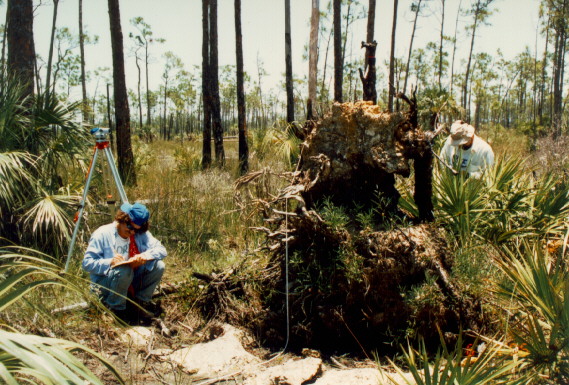
image retrieved from:
http://www.fiu.edu/~serp1/projects/windthrow/tipup01.jpg
Ideas for lesson adapted from Prentice Hall's
"Take It To The Net"
|


