The cures for pornography addiction
Rick Doder
Update if necessary. Last update:
Hi! My name is Rick. If you
are looking for help with pornography addiction, then this is the right place. I
would like to help by telling you about the solutions that are working for me.
Hopefully, these solutions will work for you. If you
are under the age of 18, then read this with parental or guardian guidance for
discussion afterwards.
Practical solutions that
are working for me, and the reasoning used to arrive at the solutions:
Can we
eliminate all sources of pornography as a solution to our addiction? No, because there are too many
sources. Convenience stores and adult video stores that are everywhere. The
Internet is almost an essential tool for communication, education and other
important uses. Internet access is available everywhere (libraries, at work, at
home) and there are free service providers for home use. Pornography blocking
software do not work because they are designed to protect one’s children, not
oneself. However, if you are addicted to Internet pornography at home, then I
recommend using NetZero, an Internet service provider that gives only ten hours
of free Internet service per month. That really helps to cut down on access to
Internet pornography and I found that to be helpful.
Can we
control our sexual cravings effectively through mental training and practicing
better behaviors?
I think we can,
once we make a strong commitment to change no matter what obstacles,
temptations, withdrawal, or suffering we face. Aristotle said that virtues are
about what is difficult. The Dalai Lama wrote that there is a saying in Tibet
that engaging in the practice of virtue is as hard as driving a donkey uphill,
whereas engaging in destructive activities is as easy as rolling boulders
downhill. Not all that are difficult are virtues, but all virtues are difficult
in that they require conscious effort to practice. The
way to freedom includes strong determination to change for the better, an
understanding of reality or what is going on, knowing and practicing helpful
techniques, and put sustained effort in practicing the techniques regularly. Techniques do not help if we are not determined to
change and if we do not practice them. We are made of the same stuff as other
people who are not addicted. Quitting the addiction is possible.
Right
understanding:
proper understanding of what is really going on and seeing the truth helps us
in living happy, non-addicted lives. What is really going on? Notice what is
happening. We have desires because we are addicted to pleasures. We are borne
to like pleasures because they aid survival and reproduction. We get pleasures
by masturbating while watching new pornographic material. After awhile, the new
becomes the old, and we no longer find it to be exciting. We look for new
material. The cycle continues, and we are helpless to stop it. Or are we
helpless? No. Here is the way out. See the truth in what has been described.
Before we have something (e.g. new pornographic material), we want and crave it
and think it is great. After the new becomes the old, we no longer want it and
no longer think it is great. What has changed? The material has not changed;
the movie or the picture is still the same. What has changed is our state of mind. We crave for what we want not
because it is intrinsically desirable or worthwhile, but because it is new,
exciting, and it helps us to give ourselves pleasure. We know it is not
intrinsically desirable or worthwhile because notice that we do not want it
after having it. That is the nature of the mind, the human condition, what is
really going on. Pleasure, suffering, happiness and misery, most of them are
due to our states of mind. Our ignorance of our states of mind as the causes of
craving and suffering is a cause of suffering. What specific states of mind
cause suffering? Not seeing the truth of what is happening.
So what is happening? We
are chasing pleasures that are forever running away from us. The time during
which we are not experiencing pleasure, we are craving and suffering. The time
during which we experience pleasure is short and fleeting. After we get what we
wanted, we get bored with it and no longer want it. We chase after something
else, the new thrill. We get it, get bored, go for something new, go for the
next hit of pleasure, and the cycle of pleasure and pain repeats itself. What
is worse is that sometimes we do not get what we want, and we keep craving and
suffering. We are never satisfied, and this state of being perpetually
unsatisfied, of craving, is suffering, is what is really going on. So we spend
most of the time of our lives craving and being miserable, chasing for fleeting
pleasures which woefully take up so little of our time. Notice all the while
what is happening. What we want and no longer want has not changed. What has
changed is our desire for any particular thing. This desire changes before and
after possession. Before possession, we want it so badly. After possession, we
no longer want or treasure what we previously wanted. This happens with
everything that we have ever wanted. The girls that I wanted to date, the
computer games that I wanted to play, the fancy mountain bikes that I wanted to
own, the pornography that I wanted to watch. Some I got and no longer want,
others I never got but eventually I no longer bother myself with wanting them
because my state of mind changes too. However, it took me a long time to grow
out of cravings without satisfying them. We know this is true just by examining
past experiences with things and circumstances that we wanted. Why do we want
what we want? Because we idealize what we do not have.
Why do we no longer want what we wanted after we get it? Because reality never
lives up to perfection, to what we idealize things to be before we have them
and get to know them as the imperfect things and circumstances that they are
bound to be because this is an imperfect world. Because
of imperfection, nothing can satisfy us for life. Knowing this, what is
the way out of the cycle of pleasure and suffering? The way out is to say to
ourselves that we do not need what we want because we know that after getting
it, we will no longer want it anyway. The way to happiness is to enjoy fully and
be happy with what we have already. Enjoy fully the present moment, what is in
front of us, and do not chase so much after what we do not have. If we are
eating, notice and enjoy fully the taste of the meal. Being able to enjoy the
small pleasures of life means that we no longer need to chase after the big
pleasures of orgasm so much anymore.
We can change our minds and
the right state of mind helps us to be happy. Contentment with what we have
helps us to be happy. What do we need to be happy? Food, shelter, family,
friends, some interests, something to do with our lives, and that sums it up
pretty good. Happiness is a state of mind that can be less dependent on
conditions. Normally, we are miserable because we insist that we must have this
or that in order to be happy. For example, the addict insists that I must look
for new pornography and masturbate to it in order to feel pleasure and be
happy. The insight here is that your mind insists that you need this or that
thing to be happy, when the reality is that probably what you think you need,
you do not really need. Our insistence of imposing
conditions that need to be met before we are happy is a cause of suffering.
Reality is what is really
going on in the universe. Perception is the interaction between the mind and
the external world through the senses and actions of the body. What we see
are perceptions and not reality because seeing reality requires us to know
things as they really are, but we never completely know things as they truly
are. For example, when we talk to others, we see what they want us to see, and
we see what we want to see by choosing to notice certain aspects over other
aspects. Sometimes the mind gets in the way of seeing the truth. For example,
let’s say there is a person who seems nice to people who he knows, but he talks
behind their backs. People who know him perceives him to be nice, but they do
not see the reality and truth that he talks behind their backs. When they hear
from mutual friends who say that this person talked behind their backs, they
cannot believe it because their minds tell them that this person who is so nice
cannot possibly do such a thing. If we were capable of seeing and knowing
everything, then we would have less trouble in our lives because we understand
what is going on.
What does reality versus
perception have to do with pornography addiction? Our minds tell us that we
like pornography, we crave it, and we lose control over it because we enjoy it
so much. Our perception and subjective experience tells us that we have no
willpower over the addiction. What is the reality? Addictions are based on the
release of certain neurotransmitters in the brain. Repeated thoughts and
behaviors that we notice subjectively cause our habits. Objectively, habits are
made of certain neural connections that have been strengthened by repeated
stimulation. That means that quitting an addiction can be thought of as
rewiring the brain and establishing new neural connections that replace the old
ones. This rewiring is done by new understanding of the nature of what is going
on and by cutting the link between the feeling of craving and the response of
getting what is craved. This is done by meditation which is explained further
below.
Our perceptions are not
reality because our minds cloud us with thoughts and feelings that we dwell on
and allow ourselves to get stuck on. Obsessions and cravings are based on
entertaining the same thoughts and feelings over and over again. When we are
obsessed with a woman or pornography or anything else, that obsession is caused
by our seeming inability to stop thinking about them, but there are ways to
stop. Meditation is a good way to break ourselves from getting stuck on certain
thoughts and feelings that we do not want to get stuck on.
Here is another understanding
of insight that leads to detachment from the craved objects and circumstances.
Nothing inherently exists because everything that we sense are aggregates of
smaller parts and these parts are in cycles of breakdown and reformation that
give rise to other things all the time. We do not normally notice this because
some things take a long time to break down and reform, but they do break down
eventually. Seeing everything in your current surroundings, imagine pressing
the "fast forward" button of time and seeing everything around you
break down and become something else. The monitor in front of you will
eventually end up in a garbage dump somewhere and break down. People in your
life will grow old and die. Nothing is forever, so what is the point of wanting
and attaching to things that never last? We only give ourselves heartaches by
doing so. Let go of attachment to possessions, objects and circumstances,
including pornography. That does not mean to throw away everything we own or to
stop wanting anything or anyone or to deny ourselves of pleasures which is the
other extreme, but it means to take the middle way and be moderate in most
things.
Another insight is that we
approach the world from a personal point of view, when reality is that I do not
exist inherently and independently. A personal point of view assigns meaning,
value and significance to things and circumstances that have no intrinsic
meaning, value or significance. The world that we experience is just that, what
we experience. What we do not sense we do not think exist, but how could we
ever know what really exist or do not exist? How could we know that this is not
all just a dream or a synthesis of the mind? We can never know. But I digress.
When we seek pornography, what we really seek is the firings of certain neural
connections in our brains that give us the feeling of pleasure. So what we are
really looking for is not in the outside world, but the pleasure is in our
minds. Our biology imposes unto us conditions that are required to feel pleasure,
but is pleasure, the firings of certain neurons, really important? No. We live
too much in sensual pleasure and blind ourselves from the truth with our
senses. The truth is that we are minds and awareness
imprisoned in the needs and compulsions of our bodies. Knowing this is
another step towards freedom.
When we notice that we are
having lustful thoughts and emotions, we should not entertain the thoughts and
feelings so much by thinking and doing something else. What is lust? Lust is defined as "excessive, overwhelming,
or uncontrolled sexual desire." Why should we not dwell on lust? Because
the consequences of lust are negative. There is nothing wrong with normal
sexual desire, but excessive sexual desire is negative because then we become unthinking,
self-centered, and focused on short-term pleasures without reflections on
long-term consequences and the effects on the well-being of everyone. Upon
reflection, we realize that lust is harmful to everyone. How is lust harmful?
Lustful cravings cannot be satisfied completely and lastingly, so they always
come back to haunt us. Never-ending cravings eventually meet with situations in
which the cravings cannot be satisfied, and unsatisfied cravings are sources of
frustration and suffering. For example, lust for attractive women is a source
of suffering because such a craving is never-ending. One minute we like this
girl’s looks, the next minute we like this other girl’s looks. We are hooked to
the point that we cannot lead healthy lives, and we affect others negatively. A
Buddhist idea of impermanence observes that everything in the world changes and
interchanges all the time and nothing is stable or forever. A girl with the
looks that we like will grow old in time and we will no longer like her if we
like her mainly for her looks. We cannot possibly have sex with all the
beautiful women in the world. Even if we think, "If I can have her or see
her naked, then I would be satisfied," we know from experience that is not
true. We get bored with her easily and we need more. Lust is never fulfilled
completely and is always a source of burning cravings, discontent, heartbreaks,
divorce, restlessness and suffering. As long as we lust, we will continue to
suffer. As soon as we refrain from excessive sexual desires and other
afflictive emotions, be able to stop them once they arise and prevent further
arisings, and cultivate positive thoughts and emotions such as love, kindness,
tolerance, patience, forgiveness, compassion and so on, we stop our suffering
and attain happiness.
On implementing helpful
techniques, when we change our actions, habits and surroundings, we are NOT
only going to make small little changes. We must make many big changes. Why?
Because many causes led to our pornography addiction or present circumstances.
To eliminate pornography addiction, its many causes must be eliminated. How do
I know? I learned it from Buddhist reasoning. The ideas below are paraphrases
from a book called Ethics of the New Millennium by the Dalai Lama. Note
that the sentences below about pornography addiction were not written by the
Dalai Lama. Those sentences are my interpretation and application of the ideas
presented. In Buddhist teachings, the idea of dependent
origination states that:
1.
Complex
webs of numerous causes and conditions lead to the effects and consequences
that we observe. Effects and consequences do not occur without their causes.
For example, think of all the causes and conditions needed to make a car. We
need the mining and shipping of raw materials, employing and training workers,
drafting and planning designs and instructions, purchasing and transporting
machinery required, and so on. Similarly, pornography addiction does not occur
without its many causes. To eliminate pornography addiction, we must eliminate
many causes of the addiction by making many changes to our thoughts, emotions,
attitudes, behaviors, habits, surroundings, activities, practices, actions, and
so on.
2.
Mutual
dependence exists between "part" and "whole". Without parts,
there is no whole. Without whole, there is no concept of parts. In some sense,
there is great complexity in the possibility of infinite parts and wholes. For
example, I am a person (whole), made of many organs (parts). An organ (whole)
is made of many different types of tissues (parts). And so on down to cells,
organelles, molecules, atoms, protons and neutrons and electrons, quarks, etc.
I am only one person (part) out of many people that make up my community
(whole). And so on up to towns and cities, municipalities, regions, provinces,
nations, the world, the Earth, the solar system, the Milky Way, the galaxies,
the universe(s), etc. The point is that the idea of dependent origination means
that "wholes" do not occur without their "parts", and
"parts" are not "parts" without "wholes." Causes
and effects (parts and wholes) can extend infinitely backward and forward.
Therefore, to eliminate our pornography addiction or to change other
circumstances (whole or effect), we must eliminate the many, many causes of our
addiction (parts or causes) that extend infinitely backward.
3.
All
phenomena dependently originated because all lack independent identity. Nothing
exists in and of itself. Everything is connected. A wheel, for example, is made
of smaller things like rubber, and a wheel is part of bigger things like cars.
Cars are not cars without wheels, and wheels are not wheels without rubber.
That means that our present situation has been brought about by infinite causes
that extend backward, and our pornography addiction or other good or bad deeds
are some of the infinite causes that spreads infinitely forward to affect
others. Figuratively and literally, without "you", there is no
"I", and without "I", there is no "you". The
concept of "I" would not exist without the concept of
"you," and vice versa. On another level, how would I live without all
of you working for my survival and well-being? Where would you be without
people working for our survival and well-being? We depend on each other to
survive and live happily. I wear clothes made by others, eat food grown by
others, live in a house built by others, depend on other organisms for
survival, and so on. In turn, I work in an occupation that benefits others and
I do things that benefit others and other organisms. Knowing our lack of
independent identity, there is no real "you" or "I" or
"it". In time we return to dust. We all belong to "us" of
this universe. Knowing the universal impact of our actions as causes that extend
out to affect everyone’s happiness or suffering, we have the responsibility to
eliminate the many causes of our bad deeds and habits, and to ensure that we
become positive causes that affect others in good ways. In doing so, we destroy
the chains of causes and effects that bring about pain and suffering, and we
extend chains of causes and effects that bring happiness and peace to the world
and beyond. We know by experience and reasoning that pornography addiction does
not benefit anyone and harms everyone. In being aware of the universal dimension
of our actions and their consequences for others who are innocent and who want
happiness but not suffering, we muster up the strongest determination possible
to restrain from pornography and to cultivate better actions based on
understanding and compassion.
Are we done with right
understanding? Hardly. This can be a beginning of a life-long pursuit. There is
much more that we need to understand and appreciate in order for us to live
correctly. Mental training is important in realizing truths and understanding
them. Asking many important questions is a key to
wisdom. Socrates said that, "An unexamined life is not worth
living." Life is examined by asking questions. A method that I find
helpful is to reason my way through issues and problems by writing out
questions and thinking about and writing down the possible answers that lead to
more questions. Often, a final or definite answer is not necessary. I find that
asking the question in itself brings awareness to a previously ignored aspect
and a sense of wonder, both of which are beneficial to enlightenment and
changing ourselves to live a happy life. Full awareness is enlightenment.
To help us eliminate,
withstand or control our sexual cravings or our responses to sexual cravings, I
think meditation is very helpful. The
following are excerpts and paraphrases from the book Buddhism: A Very Short
Introduction by Damien Keown. The excerpts explain the usefulness of
meditation against cravings. (Note: the paragraphs below are copyrighted by
Damien Keown. 1. The materials may be used for informational or educational
purposes only. 2. The materials must not be used for commercial purposes. 3.
Any copy of the materials or portion thereof must include this copyright
notice):
There are two kinds of
meditation: calming meditation (samatha)
and insight meditation (vipasannā).
The Buddha developed insight meditation because it provides deep philosophical
insight into the nature of things which is needed for complete liberation (from
craving and suffering). In calming meditation, intellectual activity subsides
at an early stage (to give peace and tranquility). In insight meditation, the
object of the exercise is to bring the critical faculties full into play in a
detailed reflexive analysis of the meditator’s own state of mind. In practice,
the two techniques of calming and insight meditation are normally used
back-to-back within the same session: calming may be used to first concentrate
the mind and then insight to probe and analyze.
"In insight
meditation, the meditator examines every aspect of his subjective experience,
breaking this down into four categories: the body and its physical sensations;
feelings; mood; and mental patterns and thoughts. A typical session might
proceed by extending awareness of the rise and fall of the breath to the rest
of the body. Every minor sensation would be noted such as twinges, aches,
itches and the impulse to move and scratch. The meditator does not respond to
those impulses since the purpose of the exercise is to note with bare attention
how bodily sensations arise and subside without reacting to them in the normal
semiautomatic way. By learning to observe without becoming involved, the
pattern of stimulus-response which underlies much human behavior can be broken.
Little by little the realization dawns that one is free to choose how to react
in all situations regardless which buttons are pushed. The grip of long-standing habits and compulsions is weakened
and replaced with a new sense of freedom. The analysis is gradually
extended to the whole body, the intellectual being wielded like a surgeon’s
scalpel to dissect the various bodily parts and functions. From this the awareness arises that the body is nothing more
than a temporary assemblage of bones, nerves, and tissues, certainly not a
worthy object to become infatuated with or excessively attached to."
"Next, attention is
directed to whatever feelings arise. Pleasant and unpleasant feelings are noted
as they arise and pass away. This sharpens the perception of impermanence and
gives rise to the knowledge that even those things which seem most intimate to
us – such as our emotions – are transient states which come and go. Next, the
subject’s current mood and the constant fluctuations in its overall quality and
tone are observed, and finally the stream of thoughts which passes through the
mind. The meditator must resist the temptation to lose himself in the daydreams
and fantasies which inevitably arise. Instead, he simply observes with
detachment as the thoughts and images follow one another, regarding them like
clouds passing across a clear blue sky, or bubbles floating to the top of a
glass. From this detached observation it gradually becomes clear that one’s
conscious mind is but a process like everything else. Most people regard their
mental life as their true inner essence (one thinks of Descartes’ famous
statement ‘I think therefore I am’), but insight meditation discloses that the
stream of consciousness is just one more facet of the complex interaction of
the five factors of individuality, and not what one ‘really is’."
"The realization that
there is no hidden subject who is the owner of these various sensations,
feelings, moods, and ideas, and that all that exists are the experiences
themselves, is the transformative insight which triggers enlightenment. The recognition that there is ultimately no subject that
‘has’ desires weakens and finally destroys craving once and for all,
making it ‘like a palm tree whose roots have been destroyed, never to grow
again’. Experientially, it is as if a great burden has been lifted: the
clamourings of the ego, with its vanities, illusions, cravings, and
disappointments, are silenced. The result is not some kind of Stoic passivity,
for emotion is not suppressed but merely freed
from the distorting gravitational pull of the ego. Others begin to come more
fully within one’s emotional horizon as the
merry-go-round of selfish craving and gratification slows and stops, to be
replaced by a deep and lasting sense of peace and contentment."
The excerpts and
paraphrases above are far from complete descriptions of the practices involved.
However, let me tell you how to meditate as I understand it. What you do is you
sit in a relatively quiet spot and focus on your breathing. Some people emphasize
the particulars of the technique, such as how to sit during meditation, but I
never got too hung up on that. The main thing is to sit still and focus your
mind on your breathing. Notice when you breathe in and breathe out. Do so
deeply and gently. What you notice when you do this is that random, unsolicited
thoughts, impulses and desires arise. For example, you get an urge to scratch
an itch on your body or you find your thoughts drifting to some personal issue
or something or someone that you want. Notice these thoughts and impulses as
they arise, but do not hold on to them. Focus your attention again on your
breath. The tremendous usefulness of meditation is that the practice allows you
to rewire your brain such that in everyday living, when thoughts and impulses
arise that you know you should not entertain at the moment, you could let them
go just as you have done so during meditation. Also what I found is that after
awhile during meditation, thoughts arise that give insights into my conditions and
problems.
I encourage you to read the
book and learn more about Buddhism because it is not religious in the sense
that no belief of faith or worship is required, and its teachings are practical
and helpful in daily living.
Remember,
meditation or asking questions are practices, not theories. We can all read the above
paragraphs and understand them on an intellectual level, but to experience and
appreciate the teachings on deeper levels require practice. To quote from the
book again, "Meditation is by no means easy to master, since the mind
continually throws up distractions... Learning to meditate is a bit like
learning to play a musical instrument: it requires determination, commitment,
and daily practice."
After some understanding of
meditation and Buddhist ideas that can help us reduce sexual cravings, there
are other shifts of perspective that
might be helpful as well.
Pornography addiction is
characterized by excess and lack of control. If we can keep pornography use to
moderate levels and if we gain some control over ourselves, then that would be
the end of pornography addiction. Elimination of pornography addiction does not
mean that we have to abandon pornography completely. Let us admit the following: naturally, we like sex and
beautiful women, we like to fantasize about them, and there is nothing wrong
with all that. Why should we deny that we like something when we really like
something? We cannot deny that we derived pleasures out of use of pornography.
Different people like different things, and we just happen to like pornography.
The use of pornography by itself is okay. However, pornography becomes a
problem and an addiction when we let our thoughts and emotions get out of
control, when we are compelled to use pornography, and when we hurt others and
ourselves in the process. The good news is that we can modify our attachment to
pornography by mental and physical changes. Of course, monks and priests might
say that even lustful thoughts and feelings are wrong, sinful, full of
suffering, or illusional in the sense that beauty does not last forever and our
attachment to it only hurt ourselves, and they might be correct. However,
unless we want to be monks and priests, let us stick with being good men
attracted to beautiful women and enjoy that attraction but also be able to
control ourselves and to value other aspects of people and life as well beside
sexual matters.
That does not
mean that we must abstain from pornography forever. That is the other extreme, opposite
to out-of-control use of pornography. If we like pornography, then why deny
ourselves? A good analogy is eating ice cream. We know ice cream is fattening
and bad for us. However, if we like ice cream, then why deny ourselves? Eating
ice cream only becomes a problem when we eat tons and tons of it all the time.
An ice cream addict might try to abstain from ice cream forever, fearing that
even thinking about ice cream would set him or her off. That is like a bomb
waiting to go off, to knock us back to old patterns of loss of control. Why do
that when we can live moderately? Having ice cream on the odd occasions does
not harm anyone, and we are happy about it. Of course, if we can abstain
completely from pornography (or ice cream), then that is definitely good for
us. Meditation or asking questions and reasoning might help in that endeavor.
However, let us learn how to walk before we learn how to run. Let us learn how
to go from addiction to moderation first before we learn how to abstain from
pornography completely.
Should we
eventually aim for complete abstinence at all? Is moderation and controlled use
of pornography okay?
Complete abstinence is better than moderate use of pornography because no more
time is wasted on pornography, and we gain control over our lives and a sense
of freedom to pursue better endeavors that we wish we could.
In the beginning, we are
not trying to abstain forever. That might be too hard for us at first.
Initially, relapse into out-of-control behavior is very likely. If we expect
too much too soon, then when we do relapse, we feel very guilty and defeated,
and we do not recognize the progress that we have made along the way. We should
PLAN for moderate use of pornography at first.
We need some
planning. What is
one possible plan for moderation? Work weekdays, play
weekends. In other words, do work that we should do on weekdays and
use pornography on weekends. I am not advocating regular use of pornography. An
ideal is to eliminate use of pornography completely, but we learn control first
before we can gradually approach a comfortable and complete abstinence. The
effect of my suggestion is that on weekdays, we are not so focused on
pornography anymore because we plan to save it for the weekend, we are not
overwhelmed by the feeling that we have to abstain forever, we are not
compelled, and we feel free. What we accomplish here is some freedom to view
pornography (on weekends) as well as some discipline (on weekdays). This
practice of moderation frees up much time that we can spend on appropriate
activities, and our lives become more normal again. What we might find is that
once we commit to abstaining on weekdays, we find the freedom from lust that we
long for as if we are living in a time before the addiction started. In
addition, we might find that if we are able to abstain on weekdays, then we
could do so on weekends as well! Not that we need to because we grant ourselves
permission to use pornography on weekends. In the mean time, on weekdays, if we
feel the urges, then we can deal with it in ways other than using pornography.
Fantasize and masturbate all we want, but no pornography on weekdays. This
decoupling of pleasures from pornography also helps in eliminating pornography
from our lives. We find that we still can have fun without pornography.
Another shift
in perspective is that we can try to think like a non-addict and try to figure
out why some other men do not like pornography. One reason they might not go for
pornography even if they have seen it is because of their opinion of themselves
and/or pornography. They might think they are dignified and that they are too
good for pornography. Pornography is repulsive in its artificiality, with only
the mechanics of sex and the show of pleasures, but it lacks spirit and soul,
without intimacy and love. All of it is just an act, a fake show of sex in
comparison to real love making with a loved one. Sure, beautiful naked women
are arousing, but pornography on a lonely night is just not the same as the
warmth of a real embrace or the comforting words of a loved one. Non-addicts
know they are good enough to attract girls and they do not need pornography
because they believe in themselves. They look down upon dependence on
pornography as a weakness. What we like really depends on how we look at it.
For example, some people love golf, while others do not. Why would some people
dislike golf? Because they see and approach it differently. Sometime ago, I
watched a documentary on Carl Fisher, the man who built the Indianapolis Motor
Speedway and turned a patch of swampland into Miami Beach. He hated golf
because he had poor eyesight. If he hit the golf ball right, it went far and he
could not see where the ball went. If he hit the ball not so far, he could see
the ball but he did not play well and that is no fun! Anyway, my point is that
whether we like pornography or not depends on how we see it.
Some men might not be so
interested in sex and sexual pleasures. Some men might see pornography as a
waste of time. Everyone knows it is, but we who are hooked on pornography
fundamentally see it differently. We really enjoy pornography. How can we shift
our focus so that we do not like pornography so much? Let us approach
pornography from other angles. Pornography prevent us from going after real
girls or developing our own real, existent relationships. It prevents us from
learning how to really have fun with our girlfriend or wife, or it prevents us
from finding a girlfriend. It prevents us from working out, having other
interests, and developing into more attractive and wise men. It prevents us
from finding more rewarding activities that are pleasurable and good for the
mind and soul. The time spent on pornography could have been spent on getting
into better shape, having better health, developing a better mind and other
interests, becoming stronger men physically, mentally, spiritually,
financially, and so on, things that make life meaningful and that women like in
men. Pornography is for those who want things to be easy, who fear change and
growth, who deny ourselves of our own unexplored potential and indulge in the
fake world when we could lead bold, interesting lives. Pornography is too easy
and not challenging enough. Sure, no images of naked women would reject us or
our pleasures, but what is the fun in that? Where is the thrill of the chase
and conquer of finding and building real relationships? Where is the joy of
maintaining a real relationship by exploring deeper into the relationship and
gain more sexual discovery and intimacy? Where is the warmth of a real embrace,
a shared moment, two lives lived together? Where are the friendship, the jokes,
the joys, the laughs, the poetry of love? Why settle for pornography when every
one of us is capable of leading more fulfilling, exciting, and interesting
lives than sitting in front of the monitor or TV or magazines for hours on end,
numbing our spirits, wasting away our minds and bodies?
The real and most desirable
women are not necessarily the best looking ones. What kind of social values led
to this stupid belief? No, really desirable women are those who really care for
us, who hold us tight when we are down and out, who share in our triumphs and
defeats, who knows us inside out, who shares or shared her beauty with us when
she is or was young, who keeps us warm at night, who provide for our need of
being needed, who we get along with really well, and who we would not trade for
anyone else in the world, even into old age, sickness and death. Pornography is
none of those things. Pornography is all about youth and the physical and what
is appealing on the outside, and if that is all that we focus on and love, then
our lives are empty indeed of deeper and soulful love, the kind that turns men
into heroes, the stuff of legends and fairytales, the happily-ever-afters and
till-death-do-us-part’s.
Some men do not have
problems with pornography because they just do not put as much an emphasis on
sex and pleasures as we might. We become what we
think about and do most of the time. If we make a habit out of
thinking about sex often, then we are bound to be addicted. Become interested
in and think about something else, and we are bound to change. How can we make
changes and develop other interests? I thought about that, observed what I like
and dislike, and came up with the following model.
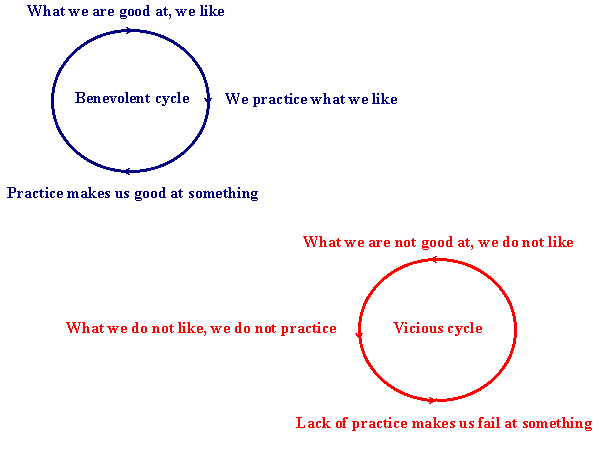
Benevolent
cycle
- What we are good at, we like
(e.g. talent, positive and encouraging people, along with successful
experiences with an activity bring us into the benevolent cycle)
- What we like, we practice (e.g.
for some reason we like an activity. We might not be good at it, but we do
it anyway because for some reason we find the activity enjoyable)
- Practice makes us good at
something (e.g. we might not like an activity to begin with, but for some
reason we practice it, and the more we practice it, the better we get at
the activity, and the more likely we are to grow to like the activity)
Vicious cycle
- What we are not good at, we do
not like (e.g. experiences of perceived failure with an activity make us
not like the activity because we fail at it. Failure does not feel great
and we avoid the activity)
- What we do not like, we do not
practice (e.g. avoidance of an activity ensures that we do not practice,
we do not get good at it, and we have no chance to like the activity)
- Lack of practice makes us fail
at something (e.g. this reinforces our belief that we are not good at an
activity, we do not like it, and we do not want to do it)
We like pornography because
it is intrinsically interesting and likable to us and we use it. One of the
ways out is to like some other activity better than viewing pornography. As
outlined above, we can develop that activity by practice. Even if we do not like
what we should do at first, practice makes us good at it and helps us to like
it and have less aversions to it due to reduction of uncertainty and anxiety.
Find new things to do and play. How much or whether or not we like something
depends on our experiences with it and our attitudes toward it developed by
thinking. We can change future experiences by trying something new and
practicing.
We can focus on other
things and get out of addiction. We need not be driven by desires and pleasures
only. All of us have a conscience, the inner distinction between right and
wrong, all of us can learn, and all of us can practice thinking and reasoning,
asking questions, to get ourselves out of problems. Be driven by conscience and
reason in addition to desires and pleasures. Look for love, truth, justice and
wisdom. We could spend our lives on the happiness of living correctly and doing
good for the world. We do not need to be slaves to our desires and habits.
Physical
activity: playing
sports or bodybuilding help in lessening our sexual desires. Endorphins are
released during exercise, and they help us feel good. We might observe that
after playing sports we have little or no sexual desire because we are already
high on endorphins. That is like the refractory period after orgasm. Besides
helping us feel good and keeping us away from pornography, appropriate and
regular exercise keeps us physically healthy. I encourage you to try doing
pushups daily because that can be done virtually anywhere anytime, with no
special circumstances or equipment required. Start with doing just one pushup
each day and increase the number of repetitions gradually. Do sets of
repetitions at each session and pause to breathe in between sets. The number of
repetitions done in each set can be increased as you get stronger. What I do is
I breathe in, do a set of a number of pushups while I breathe out, pause to
breathe in, and then do another set. When you are strong enough, at each
session, do sets of pushups until you cannot do anymore. Pushing to the limit
is the way to build muscles, and you feel good afterwards with heart pounding
and you feel your blood and warmth flowing to your shoulders and head. It feels
kind of like the afterglow of an orgasm. You also build self-confidence as you
begin to see the results of your workouts. You feel good because you can do now
what you cannot do before, namely you can do more pushups than before and you
feel stronger. This instills the feeling of potential and the belief in your
ability to grow and better yourself.
How we see
and know about ourselves are often false. We were not destined to be pornography addicts the
minute we were borne. I realized recently through reading and asking questions
that each of us have more potential and possibilities than we ever knew. I
always fixed myself into an immutable image of myself, believing that I am
this, I am that, and I cannot do this or that. However, how could I know until
I really try? Beliefs do not make things true. I can believe that I am
unlovable, but that does not mean that no one could find something to love in
me or that I cannot become more lovable. I can believe that I am a pornography
addict, but that does not mean that something intrinsic in me forces me to be
an addict or that I could never change. The truth is that we can always achieve
more than what we believe we can achieve, and change is the only constant in
life. You do not have to be an addict if you don’t want to be one.
The Dalai Lama gave this
advice his daily reflections book: "As far as
your personal requirements are concerned, the ideal is to have fewer
involvements, fewer obligations, and fewer affairs, business or whatever.
However, so far as the interest of the larger community is concerned, you must
have as many involvements as possible and as many activities as possible."
Stop focusing on lust so much and start focusing on others more. Lust leads to
cravings and suffering of self, whereas compassion leads to caring about others
which leads to actions that benefit everyone. I highly recommend doing volunteer work in your community. I do that now
every weekend. When I help others, I focus on them and for that short time I
forget about my own problems and suffering, and I feel really good helping
others on a spiritual level that is much more rewarding than a guilt-ridden
orgasm to pornography.
In our battle against lust,
we need love, need to know what love is
and how it is different from lust and infatuation. I hope the paragraphs below
would be helpful in answering that perplexing question of "What is
love?" and help in curing pornography addiction as well as to help you
find love in your life.
Love or
infatuation (from an Ann Landers column)
Infatuation is instant desire. It is one set of glands
calling to another. Love is friendship that has caught fire. It takes root and
grows - one day at a time.
Infatuation is marked by a feeling of insecurity.
You are excited and eager but not genuinely happy. There
are nagging doubts, unanswered questions, little bits and pieces about your
beloved that you would just as soon not examine too closely. It might spoil the
dream.
Love is quiet understanding and the mature acceptance of
imperfection. It is real. It gives you strength and grows beyond you - to bolster
your beloved. You are warmed by her presence, even when she is away. Miles do
not separate you. You want her nearer. But near or far, you know she is yours
and you can wait.
Infatuation says, "We must get married right away. I
can't risk losing her."
Love says, "Be patient. Don't panic. Plan your future
with confidence."
Infatuation has an element of sexual excitement. If you are
honest, you will admit it is difficult to be in another's company unless you
are sure it will end in intimacy. Love is the maturation of friendship. You
must be friends before you can be lovers.
Infatuation lacks confidence. When she's away, you wonder
if she's cheating. Sometimes you check.
Love means trust. You are calm, secure and unthreatened.
She feels that trust, and it makes her even more trustworthy.
Infatuation might lead you to do things you'll regret
later, but love never will.
Love is an upper. It makes you look up. It makes you think
up. It makes you a better person than you were before.
What is love?
(from an Ann Landers column)
Love is friendship that has caught fire. It is quiet
understanding, mutual confidence, sharing and forgiving. It is loyalty through
good and bad times. It settles for less than perfection and makes allowances
for human weaknesses.
Love is content with the present, it hopes for the future
and it doesn't brood over the past. It's the day-in and day-out chronicle of
irritations, problems, compromises, small disappointments, big victories and
working toward common goals.
If you have love in your life, it can make up for a great
many things you lack. If you don't have it, no matter what else there is, it's
not enough.
Twelve rules
for a happy marriage (from an Ann Landers column)
1. Never both be angry at
once.
2. Never yell at each other
unless the house is on fire.
3. Yield to the wishes of
the other as an exercise in self-discipline, if you can't think of a better
reason.
4. If you have a choice of
making yourself or your mate look good - choose your mate.
5. If you feel you must
criticize, do so lovingly.
6. Never bring up a mistake
of the past.
7. Neglect the whole world
rather than each other.
8. Never let the day end
without saying at least one complimentary thing to your life's partner.
9. Never meet without an
affectionate welcome.
10. Never go to bed mad.
11. When you've made a
mistake, talk it out and ask for forgiveness.
12. Remember, it takes two
to make an argument. The one who is wrong is the one who will be doing most of
the talking.
Sex and
cheating
Would you ever cheat on your girlfriend or wife? Love means
loving one's mate more than yourself and being willing to sacrifice yourself
for her. What would you do if your mate cheats on you? If your mate apologizes
and wants to stay, forgive her and still love her. What would you do if your
mate loses all interest in sex? Go to therapy with her, but if that fails, love
comes first before sex. For those who really love, sex is the spice, something
secondary. Who is most worthy of this kind of love, selfless and forgiving? If
you are not married yet, the one who wants to do the same for you is worthy of
this love. If you are married, of course your wife is the one most worthy of
this love.
Love or lust
Lust and attachment are focused on physical appearance.
Love closes its eyes to physical beauty that fades away with time anyway and is
focused on who the person is inside, her caring and kindness, her goodness of
heart and optimism, and how well you get along together. In relationships,
beauty encourages attraction, but it is not everything and one should move
beyond the initial sexual attraction as the relationship progresses. For
long-term relationships, one needs to focus on who the person is inside because
everyone grows old and ugly with age without fail. Learn to think pass
appearances and one would be much more rational and calmer inside. When you
think about your beloved, do not always think about what she looks like. Think
about the good things that she does and the good things that she says. That is love.
Lust is focused on sexual attraction, sex and sexual pleasures for oneself.
Love is focused on friendship, companionship and being together. Ask yourself
if you would love and stay with your beloved even if you can never have sex
with her again for some reason. If you choose to stay, then you truly love her.
Lust demands reciprocity. Love is being kind, caring, considerate, forgiving
and loving WITHOUT EXPECTING ANYTHING IN RETURN. Lust leads to insecurity,
jealousy, cravings and suffering. Love is unselfish in ASKING FOR NOTHING IN
RETURN and is therefore calm, peaceful and fearless because even if she leaves
or cheats, one still forgives and loves her. That is love to the highest
degree, the kind of love that everyone can strive for. Once you practice that
kind of love, you can love fearlessly and life becomes beautiful. If everyone
can love without expecting anything in return, then the world would be so
beautiful. Lust looks out for the self first. Love looks out for others first
and remembers the good deeds of others. Never marry for the sex and lust
because that marriage is doomed to fail. Lust is easily tempted to cheat. Love
is not easily tempted to cheat because love is focused on the person inside, is
considerate of one's mate's feelings and is not easily swayed by physical
attraction. Marry for love because love makes the marriage work and not the
other way around.
Pornography is damaging to
love because pornography encourages men’s already inborn focus on physical
appearance and prevents us from developing our emotional and relational
capacity beyond lust.
1 Corinthians
13:4-8 of the Bible:
Love is patient, love is kind. It does not envy, it does
not boast, it is not proud. It is not rude, it is not self-seeking, it is not easily
angered, it keeps no record of wrongs. Love does not delight in evil but
rejoices with the truth. It always protects, always trusts, always hopes,
always persevere. Love never fails.
The
paragraphs below are older material of the web page. They outline some actions that can
be taken to eliminate pornography addiction. An important key here is not to
only read what this web page or what other web pages offer but to practice and
implement whatever we find helpful. In addition, do not only read and learn
from others but also think for ourselves and come up with techniques to help
others and ourselves.
* * * * *
If we cannot eliminate
sources of pornography, then we must be able to deal with our thoughts and
behavior. How can we do that? What triggers the acquisition and use of
pornography? The withdrawal, the empty feeling, the sense of unease, and
lustful craving compel us to pornography. How can we deal with these feelings?
That craving and compulsion almost always succeed in forcing us to act out and
get porn. We know from experience that the cravings compel us irresistibly. Plain abstinence without refined training and techniques
does not work. Even if one can reach abstinence by very hard effort
through willpower, relapses can occur easily, and there is much suffering
involved in strict self-discipline without right understanding.
If unrefined
self-discipline and stubborn abstinence do not work, then what is the solution
for us? Although we are borne to love sex, through reading, careful observation
and thinking, we realize that our natural sex
drives are only triggered under some circumstances and not others.
We recognize that once the sex drive kicks in, resistance is very difficult. A key to freedom is to prevent our sex drive from being activated
in the first place.
How can we prevent the activation of our
sex drives? Under what circumstances are our sex drives turned off? When we are
in public places and engaged in wholesome conversations, we can still be
tempted by attractive people around us or by our own thoughts, but decent
social activities displace our sex drives, occupy us, and prevent us from
acting out. In darkness and in private we go on being addicted. In sunlight and
in public we are naturally freed. Being open and being in public is a natural
state for social creatures like human beings. In addition, being in public view
serves as a deterrent to shameful acts. Therefore, stay in public view as much
as possible as a way to fight lust. Open our curtains and doors. Move the computer
to a shared place in the house or apartment, or where it can be seen by people
outside. Go to bed earlier and leave our curtains open to be greeted by
sunlight in the morning and start the day in the light. Engage more in
wholesome social activities. Volunteer, volunteer, volunteer! Help others, and
there are always people who need help. Most
importantly, stay out of the house and away from private places as much as
possible. Let us be in full view of others and do good deeds. I know
from experience that the more time I spent away from pornography, the easier it
gets to stay away from it.
In a book that I read, the
Dalai Lama compares the mind to the lake. A storm can stir up mud and make the
lake opaque. After the storm, the lake returns to its undisturbed state. In the
right inner mental state and outer environment, our minds stay clear and clean.
Is the cure that simple, to live in the public and in the light?
Unfortunately, no. Private occasions are inevitable, and as long as we are not
really old yet our hormones and sex drives are still high, waiting to be
triggered. Changing our physical and social environments is only the first step
towards our cure. Much thinking is required to realize truths, techniques,
proper self-restraint and the correct thinking and attitudes that lead us to
full recovery. Truths and techniques can be learned from many different
sources. I recommend to you some books that have information that I found
helpful.
These books are based on or
about Buddhism, but anyone with any or no religious beliefs can read them
because Buddhism is compatible and inclusive to all religions and all secular
beliefs. One book is called Buddhism: A Very Short Introduction by
Damien Keown, published by Oxford University Press. The book explains among
many things how one kind of meditation is used to train self-control of our
thoughts and feelings, by focusing on one aspect (i.e. our breathing) and bring
our attention back to that aspect when we find our thoughts drifting to other
issues. The other book is called Ethics for the New Millennium by His
Holiness The Dalai Lama, published by Riverhead Books. The book teaches ethics
and how we can restrain from unethical practices. In fact, any book by the
Dalai Lama is very good. A third book is called The Book of Wisdom: The
Heart of Tibetan Buddhism by Osho. This book explains the sutras taught by
Atisha to Tibetans in the past. The sutras are very good for gaining wisdom
that leads to a more awared way of life. For example, one idea is that truth does
not need to be believed in. Truth is, regardless of what we believe. Beliefs do
not make things true. What is true is true. Truth is. Truth is all around us,
just as water is all around a fish, but most of the time we do not see the
truth, just as the fish does not see that it is surrounded by water because
water is all that the fish knows. Truth can be known, can be seen, and belief
is not required because we know and see the truth. One does not need to believe
that there are clouds in the sky; one can see and know that there are clouds in
the sky. To know the truth is to become free.
"We of the free world
can still be slaves to ourselves, enslaved by desires, cravings and
attachments, and living in constant conflict between doing what is right and doing
what our cravings demand. More freedom is attained when we become more aware of
the truth and understand ourselves by learning and asking questions."
--Rick Doder
Help others
with their problems and you will get better! Feel free to write to me at [email protected] if you have constructive comments
and suggestions. I would also appreciate corrections of any grammatical or
spelling errors as well as suggestions on other improvements.
Remember, DO NOT put yourself down when you have cravings
or give in to them. As long as you do not give up in your fight, sooner or
later you will succeed! I am thinking of you and wishing you success in your
struggle for freedom.
Causes of
pornography addiction (updated November 4, 2001): the next page contains updated but
old material of this web page. If you would like to know possible causes of
pornography addiction, or to read about the consequences of pornography
addiction, then visit the next page!