"It's on the barge, man"
Tour of U.S. Naval Station Guantanamo Bay, Cuba 1996-97
Click on any picture to enlarge.
My tour at U.S. Naval Station Guantanamo Bay, Cuba, started April 16, 1996. I have to admit that at the time, I wasn't relishing the idea of going there. I had just finished up a spectacular tour in Sasebo, Japan, where I had my own house, my own morning radio show, and a wonderful girlfriend, all of which I was leaving behind. At the time, my plans were pretty sharp in my mind: I would complete my one year of obligated service I had left, get out of the Navy, move to Green Bay, Wis., and start working in the news media, either on TV or radio. At the time, I had not even been to Green Bay, but I knew that was where Jackie was going to be, so I would be as well. Her mom and step-dad owned a house there, so I was going to move into it. The future seemed pretty obvious to me. All I had to do was survive 12 months in Cuba.
But even from the start I should have known things weren't going to go as planned. Due to a paperwork error, my tour was extended two months (instead of wrapping up in October 1997, it would be December). I could have gotten it fixed, but I let it slide. As I got further into my job, I started to have reservations about getting out. I debated over the issue a lot, feeling like I might not be able to make it in the civilian world. That's a story for another day, however.
Even though the base is in the Western Hemisphere, you still felt like you were a million miles away. Weekly shipments from a barge out of Jacksonville, Fla., were the base's principal lifeline for goods, food and creature comforts. The phrase, "It's on the barge, man" became a standard reply to any question concerning the availability of scarce items at the exchange or commissary.
After a few quiet months, learning the ropes of my job, I
was unexpectedly put into a position that, at the time I hated, but I look back
on now as 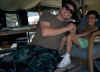 being a unique experience. One of the functions of the naval
station is a holding point for Cuban asylum seekers. While the INS decides
what to do with these folks, they were housed in a remote area of the base away
from the regular population. The place was called Camp 11. Folks
from every department on base, specifically the Security Department, provided
guards who would escort the migrants, make sure they were fed, clothed and
otherwise cared for. We took them to the exchange, to the hospital, to the
beach. I was a watch commander for one of the day watch sections. I
had three days on, three days off. It was good downtime to study for my
college classes, and it let me meet some interesting people.
being a unique experience. One of the functions of the naval
station is a holding point for Cuban asylum seekers. While the INS decides
what to do with these folks, they were housed in a remote area of the base away
from the regular population. The place was called Camp 11. Folks
from every department on base, specifically the Security Department, provided
guards who would escort the migrants, make sure they were fed, clothed and
otherwise cared for. We took them to the exchange, to the hospital, to the
beach. I was a watch commander for one of the day watch sections. I
had three days on, three days off. It was good downtime to study for my
college classes, and it let me meet some interesting people.
Like I said, I wasn't happy at the time that I had been selected for the job. My boss, then-Chief Journalist Doug Coulter, sent me over other people in the shop because he felt that it would be too difficult to teach me to do one of the other people's jobs. The part that bothered me the most was there was a guy in our shop who would have been ideal to send and in fact, had been originally selected to go. The only problem was Doug was always trying to "save" people, whatever the cost. Doug believed that this person could make it in the Navy, although the person had been in trouble several times in the past. "If I send him," Doug told me, "we'll lose him forever." So off I went.
The Cubans I met there were friendly, although extremely (and understandably) apprehensive. We were briefed not to come off as too forceful with the migrants because Cubans, like many Latinos, pride themselves on their "machismo" or manliness. Fights had broken out in the camp before because a guard challenged a Cuban (sometimes in front of his wife or other women) and the Cuban felt like he had no choice but to rebel. Yet at the same time, these people were incredibly gifted, with great talent for art and creating utensils and objects out of almost anything. All the things you see on "Gilligan's Island" they probably could have made.
After nearly three months at Camp 11, I returned to
the PAO, and just in time, too. The base was about to undertake a major
migrant operation called MARATHON. It would involve a joint task force
consisting mainly of U.S. Marines from Camp Lejeune, N.C., and was in response to the
capture of 109 Chinese migrants who were being smuggled into the United
States. The U.S. Coast Guard intercepted the boat and escorted it to
Cuba. The Seabee battalion deployed to the base, as well as the public
works office, spent an entire weekend constructing holding facilities near
Windmill Beach. They worked night and day on the project. My
contribution to the operation consisted of writing a couple press releases,
snapping some photos, and releasing hometown news releases on the Marines.
For this one day (most of an afternoon actually), I received the Joint Service
Achievement Medal, presented to me personally by then-Secretary of the Navy John
Dalton. I felt odd receiving this award partially because I did very
little to earn it, but mostly because the Seabees that had worked so hard during
that weekend received nothing. A paperwork error by the public works admin
office held up their awards. They eventually got Navy and Marine Corps
Achievement Medals, but not for several months, and not by the secretary of the
Navy. The medals are worth the same amount of points, but the fact those
guys sat there and watched myself and a bunch of "admin types" receive
awards from a big shot is not something of which I am proud.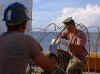
A few months later, in February 1997, the base went through the migrant deal again with Operation PRESENT HAVEN. This time, about 80 or so Chinese were involved and it lasted longer than a few days. I got to conduct interviews, write almost "hard" news releases and take photos. The operation lasted about two weeks.
After that, the rest of the tour sort of moved along at its own pace. I did a weekly radio show, held Jewish services on Friday nights, and just lived for the base newspaper, the Guantanamo Bay Gazette and the base website. I was planning my marriage to Jackie with most of my free time, and worked on my college degree. I eventually earned a Bachelor of Applied Science in Human Resource Management from Troy State University.
On Dec. 11, 1997, I was re-enlisted in one of the cleared
minefields on the perimeter of the base.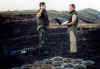 A great many of my friends were there to watch as the base commander Capt. Larry
Larson administered the oath. I also pinned on my new first class petty
officer crows in the field. I was quite happy because I would be leaving
the base in a few days, going home and flying to to Green Bay to marry Jackie.
A great many of my friends were there to watch as the base commander Capt. Larry
Larson administered the oath. I also pinned on my new first class petty
officer crows in the field. I was quite happy because I would be leaving
the base in a few days, going home and flying to to Green Bay to marry Jackie.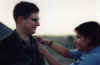 We would then move back to Norfolk, Va., where I would start my next tour of
duty with the pre-commissioning unit for USS HARRY S. TRUMAN (CVN 75).
We would then move back to Norfolk, Va., where I would start my next tour of
duty with the pre-commissioning unit for USS HARRY S. TRUMAN (CVN 75).