
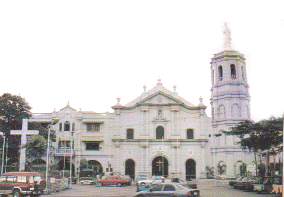
 Location.
The town of Malolos is situated by one of the estuaries
of the same name, whose waters often flood the surrounding
areas reaching as far as Paombong. The Paombong bounds
it on the north; Sta. Isabel and Barasoain on the
south; Bulacan on the west.
Location.
The town of Malolos is situated by one of the estuaries
of the same name, whose waters often flood the surrounding
areas reaching as far as Paombong. The Paombong bounds
it on the north; Sta. Isabel and Barasoain on the
south; Bulacan on the west.
The Christianization of Malolos.
After the Spanish missionaries evangelized Pampanga,
the Augustinians went to Bulacan, starting with Calumpit.
Fray Diego Ordoñez de Vivar and his companions
landed in Kanalate in 1580 where they built a small
chapel. Fray Diego Ordoñez us recorded as having
established the first Christian communities. Later
they moved further in land and build a bigger chapel
in Kaingin. The Augustinians Chapter of June 11, 1580
accepted Malolos as a house of the Order. The parish
was established. The construction of the stone church
was started when the barrios of Atlag and Pinagbakahan
were being born; and bridges connected the barrios
of Atlag, Mambog, Santiago and Liyang to each other.
The Construction of the Church.
The first convent and church, probably built of light
materials, were finished in 1591,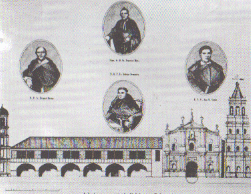 as the Catalogo attests. Fr. Roque Barrionuevo reconstructed
and enlarged the buildings in 1691. In 1707, the principal
of the town petitioned Governor General Doming Zabalburu
de Echevarri to free the inhabitants of Malolos from
rendering personal service and to allow them instead
to work in the reconstruction of the church. Fr. Fernando
Sanchez reconstructed the buildings with strong materials
in 1734; Fr. Juan de Meseguer completed the construction
in 1740; and Fr. Manuel Baceta applied the finishing
touches in 1744.
as the Catalogo attests. Fr. Roque Barrionuevo reconstructed
and enlarged the buildings in 1691. In 1707, the principal
of the town petitioned Governor General Doming Zabalburu
de Echevarri to free the inhabitants of Malolos from
rendering personal service and to allow them instead
to work in the reconstruction of the church. Fr. Fernando
Sanchez reconstructed the buildings with strong materials
in 1734; Fr. Juan de Meseguer completed the construction
in 1740; and Fr. Manuel Baceta applied the finishing
touches in 1744.
The construction and the convent,
therefore are two regularly constructed edifices.
But a fire destroyed these edifices in 1813. Fr. Melchor
Fernandez started reconstruction work in 1819. He
constructed the bridge connecting Malolos with Barasoain.
He also restored the convent and added some arches
to the front and one more story to the belfry to accommodate
the installation of the clock. It was consecrated
by Francisco Alban, bishop of Nueva Segovia (Vigan)
on October 18, 1826. At that time, it was the only
church consecrated in the archipelago. The buildings
were severely damaged during the earthquake of 1863;
the walls cracked and the church and convent collapsed
from the middle downwards. Fr. Ezequiel Merino restored
them between the years 1859 to 1872. The convent was
damaged again during the earthquake of 1880 and Fr.
J.M. Tombo restored it in 1883. Fr. Felipe Garcia
completed its restoration.
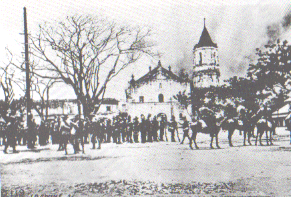 The
Convento becomes the Presidential Palace.
It was on the noon of September 10, 1898 when General
Emilio Aguinaldo and his men arrived at the town of
Malolos. From then on until March 29, 1899, when they
were forced to evacuate to Gapan, Nueva Ecija, General
Aguinaldo used the convent as the Palacio Presidential
(presidential palace) of the first Philippine Republic.
On March 31, 1899 (Good Friday), while Gen. Aguinaldo
and his men were fleeing from the Americans, he ordered
Gen. Antonio Luna to set the convent and the church
(including its silver altar) on fire as part of their
strategy called "scorched-earth policy,"
where everything will be rendered useless. The town
was captured after a bloody fight.
The
Convento becomes the Presidential Palace.
It was on the noon of September 10, 1898 when General
Emilio Aguinaldo and his men arrived at the town of
Malolos. From then on until March 29, 1899, when they
were forced to evacuate to Gapan, Nueva Ecija, General
Aguinaldo used the convent as the Palacio Presidential
(presidential palace) of the first Philippine Republic.
On March 31, 1899 (Good Friday), while Gen. Aguinaldo
and his men were fleeing from the Americans, he ordered
Gen. Antonio Luna to set the convent and the church
(including its silver altar) on fire as part of their
strategy called "scorched-earth policy,"
where everything will be rendered useless. The town
was captured after a bloody fight.
The Church Rises Again.
During the American occupation, the cathedral and
the convent were rebuilt gradually from 1902 to 1936.
When Msgr. Pedro Abad became parish
priest, the cathedral underwent a renovation. The
windows were enlarged and lowered, arañas were
installed and the patio was spruced up. Through the
efforts of Ignacio Adriano, the baptistery was built
under the supervision of Engr. Alfredo Aldaba and
the late Cardinal Rufino Santos, blessed it on February
28, 1954. The pews were acquired through the efforts
of Msgr. Marcelino Montemayor in 1957. The roof was
replaced and a steel rafter was installed during the
time of Msgr. Francisco Domingo (1955-61).
The Church becomes a Cathedral.
The church underwent further renovations and repairs
in preparation for its inauguration as the Diocesan
Cathedral, and the installation of its first Bishop,
Most Rev. Manuel del Rosario D.D. on March 11, 1962.
In the advent of the reforms brought by Vatican II,
the old altar was torn down and Msgr. Virgilio Soriano
commissioned a new one in 1967. A statue of the Immaculate
Conception donated by Amparo Bautista-Julian was also
placed at the top of the bell tower. Stained glass
windows, crafted by Krautt, were also installed in
the upper part of the cathedral's facade: the Immaculate
Conception patterned after Murillo's painting; the
driving away of Adam and Eve from Paradise; and the
Annunciation. The communion rail was also dismantled
and the sanctuary was renovated when the cathedral
was consecrated during the tenure of its second residential
Bishop, Most Rev. Cirilo Almario, Jr. D.D. on December
4, 1976. Stained glass windows with the images of
the Blessed Virgin of Lourdes and the Miraculous Medal
were also place at the opposite windows in the sanctuary.
Celing Marasigan, a religious painter from nearby
Paombong, also improved the paintings of the four
evangelist. The old convento which by this time was
only half the size of the original, was reconstructed
and expanded to accommodate the Bishop's residence,
Chancery office and parish convent. This reconstruction
of the historic Malolos convent was chaired by Dr.
Johnny Reyes in preparation for the 400 years Christianization
of Malolos.
