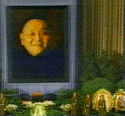
* 1979: Deng Xioaping abolishes the Democracy Wall, a place where ordinary Chinese had had the opportunity to �freely� discuss political and cultural issues.
* March 1989: Hu Jintao suppresses pro-independence demonstrations in Lhasa, Tibet.
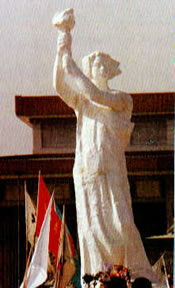
* June 4, 1989: The government of Deng Xiaoping opens fire on thousands of pro-democracy activists in Tiananmen Square, Beijing.
* Deng Xioaping had taken a hard-line position on dissent, brooking almost none within or outside a party that he termed �the crux of the country.� Deng never did renounce the infrastructure of political control that Mao had established, as he had been one of its crucial architects as Mao�s right-hand man prior to his death.
* May 31, 2002: In a speech, Jiang Zemin calls for the creation of a �political civilization� of innovative and experimental approaches to China�s dilemmas and prospects. He avoids the use of the word �reform� due to the connotations of protests and dissent it creates.
* Democracy has been evolving at the local level. Since 1987, for example, direct election of village officials has been a nationwide practice. People at the grass-roots level are becoming aware of the advantages of a system of elections as they vote people into office who are best equipped with sound management principles. Many young entrepreneurs have found themselves in the position of village chief and act on their own judgment, sometimes even without any Communist Party affiliation.