
A Journal for Western Man-- Issue III

Part I
G. Stolyarov II
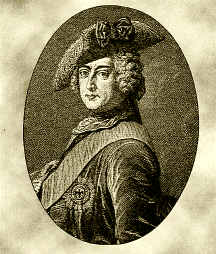
The birth of Frederick the Great in Potsdam occurred on January 24, 1712. From the beginning, as the heir to the throne of a father, Frederick-Wilhelm, who had already seen two of his children die, he was stringently monitored and guarded by the militaristic monarch, who wished to make of him his conception of the ideal ruler. Unfortunately for Frederick, his father was of an abnormally limited perspective, fully submerged in the discipline of warfare but unable to see beyond it. Frederick-Wilhelm was a fervent Germanic patriot and resented any manner of foreign influence entering the Prussian realm, including fine musical theories from Italy, and Enlightenment ideology from France. His young son, however, was captivated by these and sought to escape the rigid and monomaniac control of his obsessive parent. He undertook the studies of philosophy, poetry, architecture, art, agriculture, economy, and politics, played and composed music with his personal orchestra, and obtained knowledge of various foreign languages, most notably French.
The tyrannical Frederick-Wilhelm, however, was an admirer of the common man instead of the refined aristocratic ideologue. He rapidly proceeded to deprive Frederick of fine food, clothing, books, and culture and sought to raise his son in the manner of an ordinary lower-class citizen, with all the crudeness and disadvantages of such a mundane position. Having this plebeian existence thrust upon him sparked immense disgust and loathing within the young prince for his father. He wished once again to relish the high Western culture that so fascinated him. However, his father was uncompromising and inflicted physical violence upon his son for displaying such inclinations. The youth was driven to the point of contemplating suicide, but instead developed a plot to escape the realm of Prussia to France and, from there, the country of his grandfather, King George I of Britain. Alas, he was detected and detained for two years at K?strin while his associate in the scheme, Lieutenant Hans Hermann von Katte, was viciously put to death. Prince Frederick was directed to observe the execution and threatened by his father that a similar fate would await him. Only a reluctant oath of obedience saved his life, after which he consented to a forced marriage with Elizabeth-Christine of Brunswick-Bevern. In order to avoid encountering his father and falling under his dominance, Frederick requested a favor to which he was confident the King would consent, to send him to the battlefield to study strategy from a master of war, Prince Eugene of Savoy, who led the Austrian Army in a war against France for the Rhine territories. Frederick was thus freed from the ever-watchful eye of his parent while obtaining both the military expertise essential for the future ruler of such an unstable nation as Prussia and the cultural upbringing that he so desired. Eventually, in 1736, Frederick-Wilhelm granted his son a palace at Rheinsberg, where the latter was given free rein to grow and prosper as he would.
Frederick assumed the throne on May 31, 1740, and at once began to seek initiatives that would forge Prussia into a global power from a minor and turbulent principality. He comprehended the need for the creation of national solidarity and stability, the greatest prospects for which would come from expansion. He thus exploited the first opportunity that he had obtained, the death of Holy Roman Emperor Charles VI, to invade the Austrian province of Silesia, utilizing one of the sole advantages that Prussia possessed, its superior military, to claim victory at the key encounter at Mollwitz in April of 1741, while negotiating an anti-Austrian alliance with Spain, France, and Bavaria that intimidated Empress Maria-Theresa into surrendering Silesia to Prussian control. Tensions with Austria mounted once more as the armies of the Holy Roman Empire scored victories against France and Bavaria and obtained support from Poland and Russia. This prompted Frederick's invasion of Moravia in 1742, where he triumphed at Chotusitz (May), Bohemia in August 1744, and Saxony in 1745, where his victory was assured by the battles of Hohenfriedberg (June) and Soor (September). All these gains were secured by the Treaty of Dresden on December 25, 1745.
The war against Maria Theresa elevated Prussia to a formidable standing in the global community. Its borders secure for the time being, Frederick could focus his attention on the qualitative aspects of his people's lives. The actions that the new sovereign undertook on the domestic front are manifestations of his immense love, pity, and support for the Prussian people. He inherited an internally weak nation, rocked by starvation, economic poverty, a semi-developed agrarian level of advancement while its neighbors had already developed complex manufacturing industries. To correct these wrongs, he rejected the hereditary system of administration and imposed a rational meritocracy, placing individuals from various backgrounds into crucial positions of government provided they possessed the qualifications, experience, and skill. This was a radical alternation that a vast majority of individuals held in great esteem. Philosophers, artists, musicians, poets, architects, political scientists, economists, painters all flocked to Potsdam Palace to live and work in the welcoming environment of the Philosopher King. Frederick maintained a written correspondence with Francois Marie Arouet de Voltaire, composed fugues together with Johann Sebastian Bach, and, most importantly, established legislation throughout the realm that would guarantee the spread of Western culture and ideology to his less fortunate subjects. He forbade any physical torture of criminals and instituted an environment in which death penalties would be dealt quickly and humanely, with a minimum of victim suffering. He bestowed upon the people a religious freedom, since he himself tolerated a diversity of thought from which he knew his realm would benefit. Learned individuals of various backgrounds presented input that assisted Frederick in devising his decisions. However, the power of the final word always remained within the monarch, who held strong convictions of the validity and necessity of a single absolute leader. Indeed, this presented the optimal form of governance for Prussia since Frederick, after obtaining every side of the story, would institute a decisive change that resulted in progress, an action impossible if there were no arbiter to mediate the disagreements of ideologically differing factions. Historical evidence suggests that Frederick's reforms are a product of two influences, the humanist thought of the Enlightenment, and his own early experiences (forced upon him by his father) of the miseries that a majority of commoners faced daily. Given such a painful realization of truth and a compassionate mental framework that would ameliorate the situation, Frederick was able to work wonders with the Prussian people.