A Journal for Western Man-- Issue III
Part II
G. Stolyarov II
A final period of instability arrived in 1756, when France and Russia, driven by powerful anti-Prussian sentiments from their monarchs and key government figures, allied with Maria-Theresa for an imminent declaration of war against Prussia. In order to avoid being caught by surprise, Frederick resolved to conduct a bold offensive into the southern realms of Saxony and Bohemia, which gained him significant ground before the bulk of the three enemy armies could be unleashed against Prussia. Fortunately, Frederick possessed an ally, his uncle, George II of Britain, whose navy prevented a sea-based invasion of Prussia while he distracted a large portion of French troops in the New World, during the French-Indian War, and prevented them from assailing their primary opponent. The British also provided Frederick with much-needed finances that enabled him to field a formidably equipped force and construct defensive fortifications throughout Prussia. The war intensified when Sweden entered the anti-Prussian coalition, accompanied by minor German states the rulers of which feared assimilation into the continually expanding Prussia. By sheer weight of numbers, Frederick was expelled from Bohemia while France pressed from the west, Austria from the south, and Russia from the east. Diverting nearly all domestic funds toward the war effort, he managed to score key victories against combined enemy armies at Leuthen (1757), Rossbach (1757), and Zorndorf (1758). He also triumphed over the Austrian Army in 1760 at Liegnitz (August) and Torgau (November). However, the superior enemy numbers and resources continued to plague Prussia, especially following the victory of Russian Fieldmarshal Saltykov as Kunersdorf in August of 1759. The Russians twice occupied Berlin itself and relentlessly grabbed territories until the Prussian Army was pinned in a tiny corner of northwestern Germany. British coastal raids, finances, and reinforcements from Hanover (of which George II was the elector) permitted Frederick to gradually regain ground and score several minor gains, however it was to be a twist of circumstance that ensured Prussia's victory in the Seven Years' War. In January of 1762, the fiercely anti-Prussian Empress Elizabeth of Russia met her demise and was succeeded by her nephew, the German prince, Peter III, whose admiration of Frederick was nearly fanatical. Peter withdrew from the war and signed a military alliance with the Prussians, instituting in Russia many of Frederick's military and domestic reforms. This enabled Frederick to concentrate upon his remaining foes. In 1763 Quebec in the New World fell to the British while Hanoverian troops scored gains in a renewed offensive against France. In the meantime, Frederick initiated a final push into Austria, regaining Silesia, Bohemia, and Saxony, and forcing Maria-Theresa, now without allies, to sign the Treaty of Hubertusburg (February 15, 1763), which signified the conclusion of the bloody Seven Years' War.
Frederick extracted a valuable lesson from this experience and became determined never again to place his nation in such jeopardy. He secured an alliance with Russia that lingered until 1780, even following the deposition of Peter III by his wife, Catherine, whose attitude toward Frederick was one of neutrality. He participated in the division of Poland amongst three powers, Austria, Russia, and Prussia in 1772, which permitted Prussia's territory and population to expand along with Frederick's influence. Contrary to the Austrian and Russian portions of Poland, in which the populace were tyrannized and deprived of freedoms by the petty hereditary aristocracies that governed there, Frederick established a tolerant and centralized system in Poland that would only be enhanced after the reforms of Napoleon within that nation. A minor struggle ensued from 1778 to 1779 against Joseph II, Emperor of Austria, over the Bavarian Succession, but this was quickly resolved following several military triumphs and a diplomatic agreement at Teschen (May 1779) to favor the Prussian claims and secure for several decades the potent realm that Frederick had developed from the puny and wretched state that he had inherited.
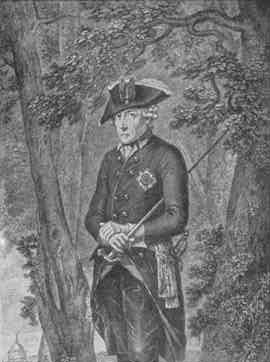
Frederick's legacies encompass an impressive variety of contributions. Under his governance, his realm emerged as one of the leading nations on the planet, its population tripled to approximately six million inhabitants, many of the most educated and industrious peoples of Europe. He established a proud military tradition in Prussia, involving strict discipline, rigorous training, and heroic loyalty of his troops. These soldiers were trained not only in the art of war, but also in that of ideas to grant them a comprehension of the liberties and social structure that they were employed to defend. The creation of such forces enabled Frederick and his successors to score triumphs against opponents that outnumbered them three to one (namely, at the Battle of Leuthen, where France, Austria, and Russia's elite forces were decimated by 7000 Prussians). Frederick's own cunning, resourcefulness, and efficient use of troops led to the inception of a reformation in strategy that would be studied and extrapolated upon by the great Bonaparte. Yet Frederick the Great must be remembered also for his thirty books on politics and philosophy, which include, most notably, a theory on leadership that opposes Machiavelli's manipulative politics and advises a genuine appeal to the interests and welfare of one's subjects. He was a gifted poet, economist, and composer of music, whose smorgasbord of interests enabled him to become the well-rounded administrator that bestowed upon Prussia a national dignity and an ideological foundation. Today, he is regarded as a hero by the German people and his ideals of tolerance, rationality, individual appreciation, and meritocracy are virtues for all to consider.