
A Journal for Western Man-- Issue III

Part I
G. Stolyarov II
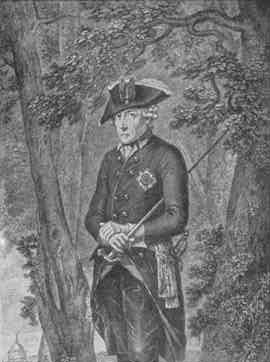
Frederick the Great, King of Prussia, was a man for whom all should hold a renowned spot within their personal pantheons, where examples of right behavior are contained that they may extract from them the necessary actions that will lead to the betterment of their lives. This man seems to have been a dilettante into such a vast array of fields as would instill in cultured persons immense awe and reverence. He was the most capable strategist of his time, with tiny forces defeating combined armies of great powers adverse toward him. He wrote works of philosophy, retained correspondences with other reformers of thought, and could rightly be called one of the most progressive Enlightenment thinkers, certainly the equal of Mr. Locke, M. de Voltaire, Mr. Jefferson, or Mr. Franklin. He was a comrade of Herr Johann Sebastian Bach and composed fugues for the latter to create variations from. Aside from the fields of military strategy, philosophy, and music, Frederick possessed profound interests in ballistics, mathematics, the sciences, architecture, and poetry. His realm was a haven of culture, with impressive minds from all corners of Europe flocking to Prussia to contribute to the treasures of the world in an environment that welcomed such enhancements, for it was governed by one of the most forward-thinking, radiant men that had ever the fortune of treading the surface of our Planet Earth. Berlin became a new Rome under Frederick, and the legacies of our Classical heritage became secured in Prussia in the form of monumental architecture on the outside and the fineries of the mind on the inside. Frederick was certainly one to fit into the category of Herr Nietzsche's "supermen." What caused this remarkable man to flourish? Simply put: he knew beauty.
The following question had puzzled sages for millennia and produced little systematic response: What is beautiful? Herein the author shall guide the reader toward comprehending what matters may be truly classified as beautiful in order to distinguish between two forces within our society, one, its glory, the other, its downfall, art and savagery. In order to discern true magnificence from the deceitful and illusionary, we must locate a common base, a foundation for all things of high culture.
Let us for a moment investigate the root of Frederick's activities. He was best known for his exploits in the art of war, that intricate science of logistics, formations, equipment, and, of the utmost importance, roles on the battlefield. A strategist must deliberate for extensive periods of time over his tools of the trade, his maps and subordinate reports, constantly presenting himself with probable developments in the campaign or the particular battle, a statement beginning with "If...". From his knowledge of the advantages and disadvantages of every approach and every aspect of his forces and, preferably, those of the enemy, he may devise a "Then..." clause, pondering afterward on whether or not the act is desirable. If so, then the "Then..." becomes an "If..." and another "Then..." will be created as the next link within the logical chain. This is much reminiscent of a direct geometric proof, with the given conditions being the present situation of the conflict. Indirect proof is also a base for a strategist's reasoning. When presented with inconclusive evidence, he analytically attempts to bridge the information gap. "Assume that a circumstance is not present within the matter in question. Then..." If a link in a chain thus begun seems absurd or violates known given conditions, then the strategist may conclude that the circumstance does exist, after which he may establish his course of action, based on the direct proof, in order to gain himself the upper hand. His work involves also numerous arithmetical calculations as to the number of troops, the amount of dead, wounded, and deserters, and the distances traveled by his men as well as the effect of such on their physical state. An able commander must have intimate familiarity with ballistics and topography in order to calculate the efficiency of his artillery and possible uses of the terrain on which the conflict is fought. To summarize, a strategist is one whose work is founded upon mathematical regularities, patterns, and logic.
What of a philosopher? Would a logical coherence not be required for a complex system of thought to be expressed? After all, a philosophy intrigues us by relating itself to our existences and inspiring us to lead our lives in such a manner so as to bring about the greatest possible advantage and the minutest harm. Would the arguments be much compelling had they not made sense, had they been inconsistent or violated known given conditions of the present, or been incomprehensible as the statement, "If a plague befalls a nation, then it is for the best" would be? Thus, in order for a mode of thought to be a mode of thought, not a haphazard jumble of impulses, in must be perceived in a form transformable to that of a two-column proof, a chain of logic, a web of reasoning, or whatever other metaphors one may concoct. And logic is founded, once again, upon mathematics, only addressing the qualitative notions of congruency, similarity, and parallelism instead of numerical, quantitative elements, although such may be involved in its applications to particular situations where exact data is available. In a valuable philosophy one can pinpoint a single clause of logic, a single link in the chain, and follow in one's mind the means by which a plethora of such indivisible arguments may form the grand whole that impresses through its magnitude and profundity.
On to the foundation of musical works. It is a well known doctrine of physics that every object vibrates at a fundamental frequency and its whole number multipliers, the "harmonic series." A certain established relationship between two harmonic frequencies of, for example, a string, will produce sounds that vary an octave. Upon this knowledge the Music Theory was devised, a most impressive discovery of the mathematical base of beautiful sounds. Notation was invented to record these relationships and transmit them to other musicians that they may re-enact them on their instruments. Music is a world of pattern and mathematical precision. A sound off-tune, therefore of an irregular frequency in relation to those of the other sounds in a musical piece, is a strain on the mind, a broken link in the chain. The author himself is a player of the piano, and he will with confidence state that works of greatness that he had learned to represent on his instrument all had a logical scheme not only due to the clarity of sounds, inevitable where a properly functional musical tool is concerned, but also because of the patterns present within the piece as a whole, the repetitions of notes, or a "regularity of change", (A certain rhythm may be replicated, for example, with each note a tone higher), the complex but coherent structures of chords, etc. All this has been forged by theorists into a coherent whole. Based on mathematical relationships between various waves of sound, they have been able to determine what is congruent with what else. Any combination that deviates from this mathematical base results in repulsive cacophony.