
A Journal for Western Man-- Issue III

Part II
G. Stolyarov II
Having mastered a language, men become capable of doing wonders with it. The novelist is the linguistic equivalent of the symphonic composer, who spins as vast a web with numerous characters to substitute for instruments, moods and settings for particular sounds, and the structure of the plot and its various subdivisions, initiation of problem, development, climax, and solution, amazingly reminiscent of the four movements in a symphony. From the author's personal experience in having read works of literature and undertaken their construction himself, every element, every word of a complex story must contribute to the whole and establish such a purposeful position within it that its absence will lead to the failure of the entire piece. Another branch of beauty from the root of language is poetry. If there is no logical coherence within a poem, then it is not such, for a poet must concern himself with smaller works, but driven to perfection in far many more areas than mere ideological consistency. There must be present a unifying rhythm, or a pattern in the change of rhythms. An ingenious poem will also contain an identifiable rhyming scheme, where the end of one line, and, upon a truly magnificent occasion, even other portions of it, will coincide with the end of another, a perfect mathematical congruency between series of clear and rationally structured waves that are so as a result of frequency patterns. Such a creation is indeed mathematics within mathematics within mathematics, a fitting tribute to the awesome capacities of man.
A most commonly encountered mode of beauty is the building, the architectural endeavor. These are ubiquitous in any civilized setting, and have become works of art instead of mere shields from the elements beginning with the efforts of a radiant mind, Imhotep of Egypt. Ever since this superior thinker devised an eternal monument to King Djoser, a six-step "pyramid", each layer geometrically related to the last, a building of precision surpassed only by the structures that had come afterward, their designs inspired by the ingenuity of the first Saqqara pyramid. Imhotep was of a learned class of Egyptian priests whose engineering skills were unrivaled in their time. His knowledge later spread to Mesopotamia, Palestine, Greece, and Rome, and in those regions were soon constructed edifices as impressive and formidable. What set the Pyramid of Djoser apart from its chaotic precedents? Instead of being a mere haphazard collection of matter, it was planned, its form calculated precisely, every block refined to the intended dimensions, then placed in a pre-determined position crucial to sustaining the structure of the whole. Before the winds of the desert had taken their toll on it, one may imagine the majesty of the building, six squares each piled atop the next that if a corner of every square were connected by a diagonal, it would be of a unified slope throughout. This was but the first and simplest building of mathematical basis, a creation unimaginable and non-existent prior to the advent of intelligent man. It was a threshold into the construction of far more intricate works that, however complex, can be traced down to their simplest elements, everything planned and designed, based upon patterns and regularities of mathematics. Over time physical laws emerged to assist architects in constructing buildings to best suit their purpose. If anything, this merely increased the precision involved, for now formulas of various sorts would be taken into account when assigning particular figures to a certain element of the structure. The beauty and elegance of these works, their appeal to the human mind, emanate from their mathematical correctness. This can be most visible in the column, the crowning achievement of Ancient Greek architecture. From a simple cylinder of marble, the forebears of Classical Culture have sculpted the essence of visual beauty, every crevice and curve and ornament calculated to the most miniature extent possible, every smallest bit of it crucial and magnifying its grandeur.
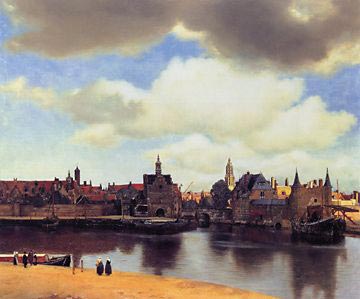
A painter is the amplifier of yet another recognized category of artistic accomplishment. When creating a visual masterpiece, he must utilize principles of perspective, scale, and the size of objects relative to their distance from the foreground. For all these, mathematical principles have existed since the times of Ancient Greece, rediscovered by the masters of the Renaissance. Without their careful implement, a painting is grotesquely skewed, hurtful to the eyes due to the distortions present within its image, the whimsical irregularity that is neither precise nor identifiable in its essence. But if we examine such works as those of Signor Masaccio, Signor Leonardo, Signor Titian, Master Vermeer, and Master Rembrandt, we shall spot wonderful consistencies. These artists had so mastered mathematics that they had obtained the capacity to accurately represent the precise interactions between light and shadow. This leads us onto another aspect of paintings, color. Every color is, like a sound, a wave of a certain frequency, and the relationships between these have been structured into a theory as intricate and astoundingly precise as the Music Theory. The Color Theory provides the already commonly encountered reason for aesthetic merit, patterns in the quantitative relationships between frequencies. A proper painting is as comprehensible and possesses the same repetitions and "regularities of change" visibly as a commendable musical composition does audibly. This is also evident in the logical bonds between every small speck of color that combine them all into one scene, one depiction of far greater accuracy and appeal than nature can ever furnish. A painting is to the wilderness of reality that is untouched by man, as a Classical sonata is to the distorted cries of an aesthetically untrained seagull.
There exist other far more complex and perhaps less conspicuous examples of beauty that must nevertheless be taken into account when creating our definition. For example, it may seem odd at first glance to classify a game of chess into the same category as a song, but, in actuality, both are founded upon the same elements. A song is a combination of musical and linguistic intricacy, the extrapolation upon frequency manipulation by the voice. It possesses the same underlying root of the tree of beauty and is an offspring that begins where the above two branches merge once again into one. A chess game is the art of military strategy condensed into a board with circumstances far more fortunate than reality thus granting the player definite ability to accurately judge every circumstance given sufficient expertise. Every piece possesses precise capacities, and its commander must construct lengthy mental proofs in order to determine the logical benefit that these aspects would bring him. This bears an obvious similarity to the activities of a war leader, and numerous geniuses of battle, including Saladin, Napoleon, and our most esteemed mentor, Frederick the Great, utilized it to assist them in developing their talents. In recent times the emergence of another technological wonder, the computer, has permitted for the creation of games of ever-increasing complexity and style, yet all possessing the same essence as those of Chess, Backgammon, Checkers, Battleship, and others, contributing to the amplification of the thought abilities of an ever greater number of individuals. A well-played game, with the long-term and short-term consequences of every move toward the grand whole is a complex web of logic, similar to the overall qualitative structure of the song. It can be related to every other of our previous examples. This web is spun by a philosopher, a novelist, a composer, and an architect. These recognized persons of artistic prowess have brethren whose work is of the same base, the students of the sciences. This foundation is far more easily recognized in their efforts, and therefore identifying it is not as difficult a task. The mathematician, obviously, produces works of beauty in his theorems, postulates, and formulas, the mechanical engineer in his machinery, the chemist in his compounds, the physicist in the discovery and formulation of precise natural laws, the medical professional in his cures, the chef in his intricate dishes. Now, the author may with confidence state that the unifying element of our term of discussion is evident. Beauty may thus be defined as a creation of man composed of precise quantitative mathematical relationships united by qualitative mathematical concepts.