Historical Background
Historical Background
Most people are aware of the fact
that when Bram Stoker penned his immortal classic,
Dracula, he based his vampire
villain on an actual historical figure.
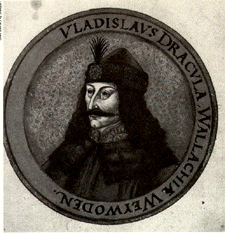
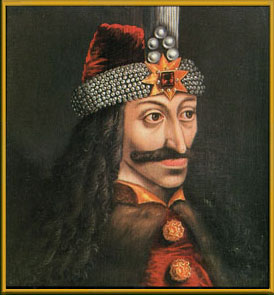
Stoker's model was Vlad III Dracula
(call Tepes, pronounced tse-pesh);
a fifteenth century voivode or
prince of Wallachia of the princely House of Basarab. Wallachia is a province
of Romania bordered to the north by Transylvania and Moldavia, to the
east by the Black Sea and to the
south by Bulgaria. Wallachia first emerged
as a political entity during the
late thirteenth century from the weltering confusion left behind in the
Balkans as the East Roman Empire slowly crumbled. The first prince of Wallachia
was Basarab the Great (1310-1352), an ancestor of Dracula. Despite the
splintering of the family
into two rival, clans some member
of the House of Basarab continued to govern Wallachia from that time until
well after the Ottomans reduced the principality to the status of a client
state. Dracula was the last prince of Wallachia to retain any real measure
of independence.
In order to understand the life
of Vlad Dracula it is first necessary to understand something about the
nature of Wallachian society and politics. The throne of Wallachia was
hereditary but not by the law of primogeniture; the boyars or great nobles
had the right to elect the voivode from among the various eligible members
of the royal family. As with most elective monarchies
during the Middle Ages the power
of the central government tended to be dissipated among the nobility as
various members of the ruling family vied for the throne. Wallachian politics
also tended to be very bloody. Assassination was a common means of eliminating
rivals and many of the voivodes ended their lives violently and prematurely.
By the late fifteenth century the House of
Basarab had split into two rival
clans; the descendants of Prince Dan and those of Prince Mircea the Old
(Dracula's grandfather). These two branches of the royal house were bitter
rivals. Both Dracula and his father, Vlad II Dracul, murdered rivals from
the Danesti upon reaching the throne. The second ascendant fact of fifteenth
century Wallachian political life was the influence of
powerful neighbors. In 1453 Constantinople
and the last vestiges of the Byzantine or East Roman Empire, which had
blocked the Islam's access to Europe for nearly one thousand years, succumbed
to the armed might of the Ottoman Turks under Sultan Mohammed the Conqueror.
Long before the fall of the Imperial City the Ottomans had penetrated deep
into the Balkans. Dracula's grandfather, Mircea the Old, was forced to
pay tribute to the sultan early in the fifteenth century. The Hungarian
Kingdom to the north and west
of Wallachia reached the zenith of its power during the fifteenth century
and assumed Constantinople's ancient mantle as defender of Christendom.
Throughout the fourteenth and
fifteenth centuries the princes of Wallachia attempted to maintain a precarious
independence by constantly shifting allegiances between these powerful
neighbors. Dracula ruled as Prince of Wallachia on three separate occasions.
He first claimed the throne with Turkish support in 1448. On this occasion
he ruled for only two months (November-October) before being driven out
by a Danesti claimant supported by Hungary. Dracula dwelt in exile for
several years before returning to Wallachia to kill the Danesti prince,
Vladislav II, and reclaim the Wallachian throne with Hungarian support.
Dracula's second regnal period stretched from 1456 to 1462. It was during
this time that Dracula carried out his most famous military exploits against
the Turks and also committed his most gruesome atrocities. In 1462 Dracula
fled to Transylvania to seek the aid of the King of Hungary when a Turkish
army overwhelmed Wallachia. Instead of receiving the
assistance he expected Dracula
was imprisoned by the Hungarian king. He remained a prisoner of Matthias
Corvinus of Hungary for several years. For most of the period of Dracula's
incarceration his brother, Radu the Handsome, ruled Wallachia as a puppet
of the Ottoman sultan. When Radu died (ca. 1474-1475) the sultan appointed
Basarab the Old, a member of the Danesti clan, as prince. Eventually, Dracula
regained the favor and support of the Hungarian king. In 1476 he once again
invaded Wallachia. His small force
consisted of a few loyal Wallachians, a contingent of Moldavians sent by
his cousin Prince Stephen the Great of Moldavia, and a contingent of Transylvanians
under their prince, Stephen Bathory. The allies succeeded in driving Basarab
out of the country and placing Dracula on the throne (November 1476). However,
after Dracula was once again in control, Stephen Bathory returned to Transylvania
taking most of Dracula's army with him. The Turks soon
counterattacked with overwhelming
force. Dracula was killed fighting the Turks near Bucharest in December
of 1476. His head was sent to Constantinople where the Sultan had it displayed
on a stake to prove that the terrible Impaler was really dead.
~BACK~