Adam & Ruth’s
DFE Ascender III-C Flight Testing Logbook
Our aircraft building logbook is now complete. Please feel free to have a look at it!
The last entry in this Flight Logbook is 11 October 2003
03 August 2003 – The Ascender is ready for its first flight – and that means that we need a test flying plan. As most test pilots will tell you - you can’t just go and fly the aircraft and hope to remember to check everything – you need to “plan the flight and then fly the plan”.
So, as we wait for the weather to improve enough for a first flight we did our test flight planning. It is a simple aircraft, so the test card is fairly short. Here is what the test card items look like:
Date________ Pilot__________ Reg_________
Temperature___C PA______ DA_____Wind________
Hobbs Start_____Stop____ Total_____
Air Time up_____ down ______ total______
Preflight checks
Logbook c
Radio c
GPS c
Vario c
External inspection c
Fuel_________lbs c
Oil_________lbs c
Taxi checks
Engine response c
Control response c
Brakes c
Take-off checks
Control Response c
Lateral trim c
Engine instruments c
Level Flight checks
Trim Speed c
Engine instruments c
Stall Speed c
Vne check c
Radio c
Landing Check
Control authority c
Post flight check
Leak check c
Hopefully we will get a chance to fly our first flight soon!
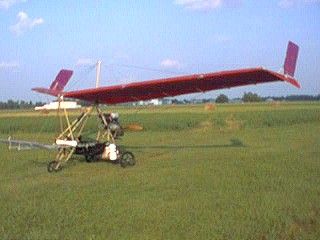
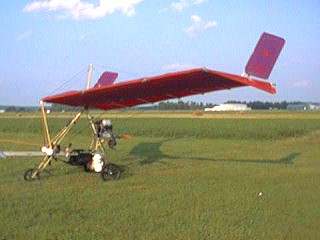
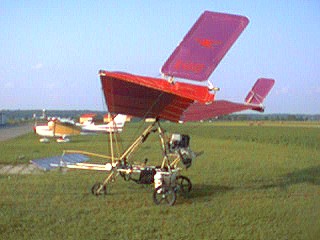
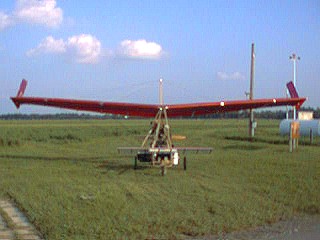
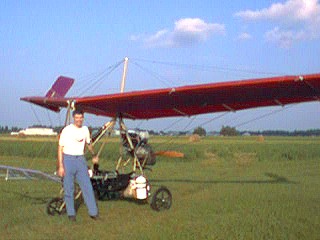
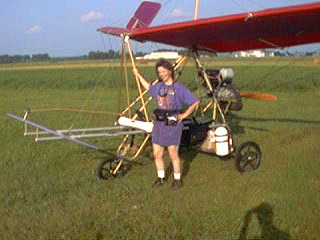
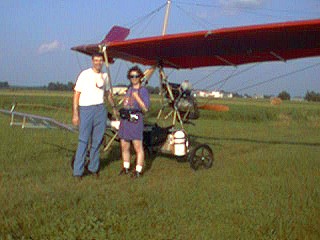
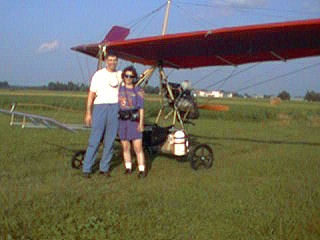
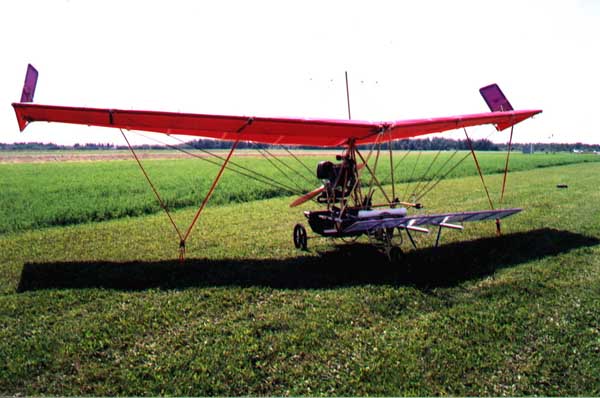
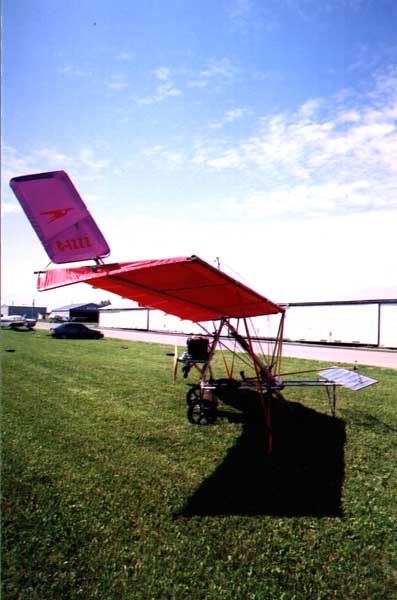
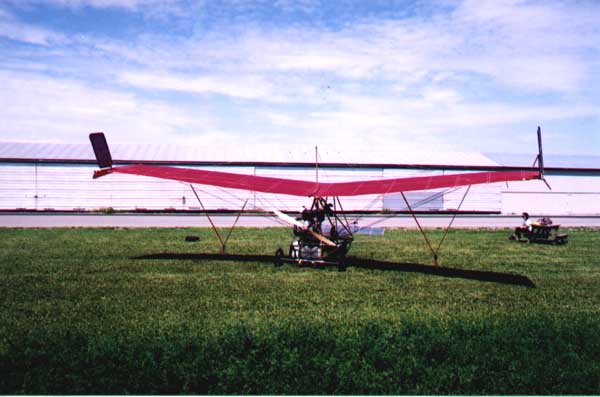
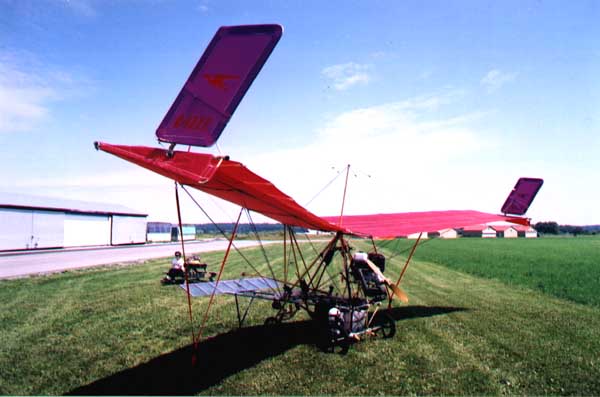
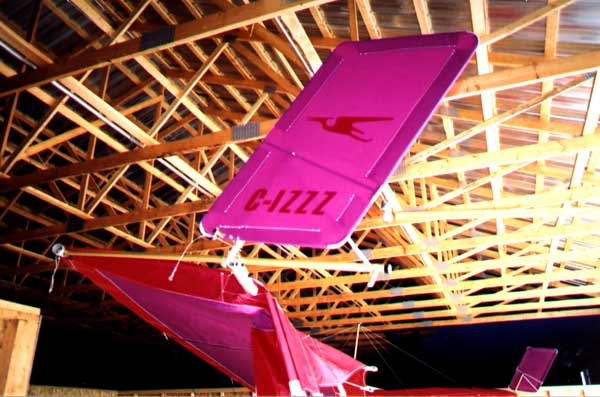
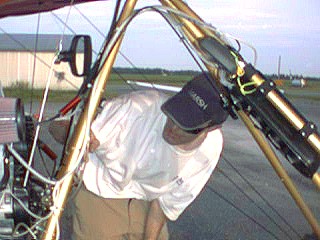
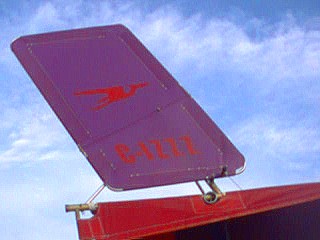
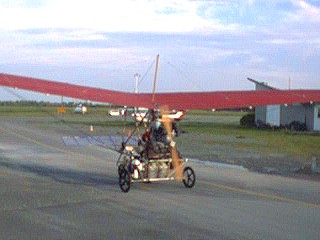
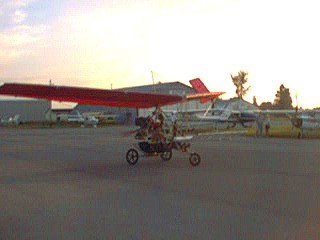
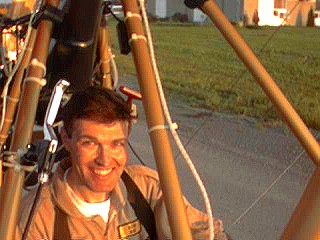
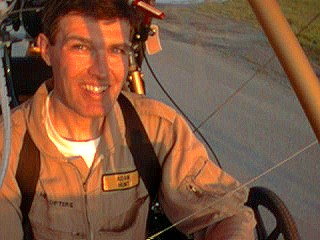
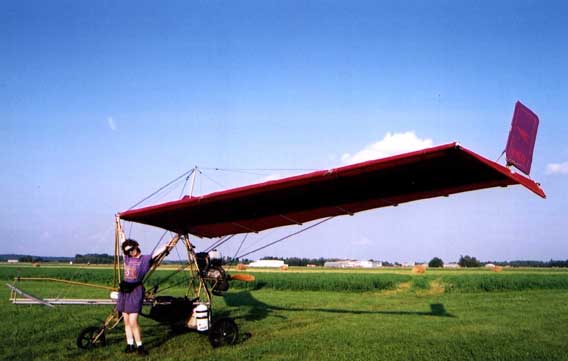
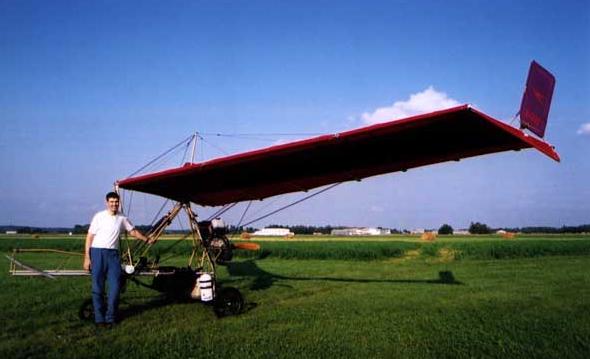
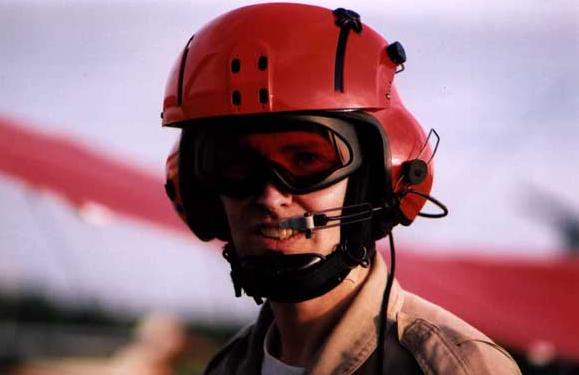
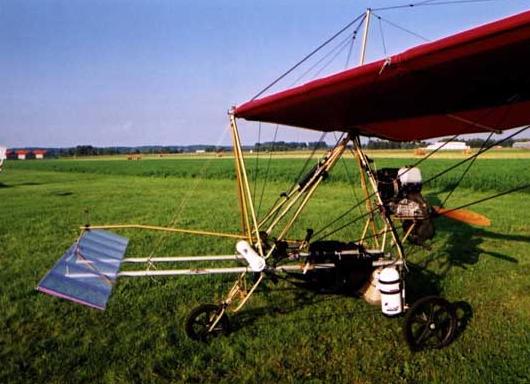
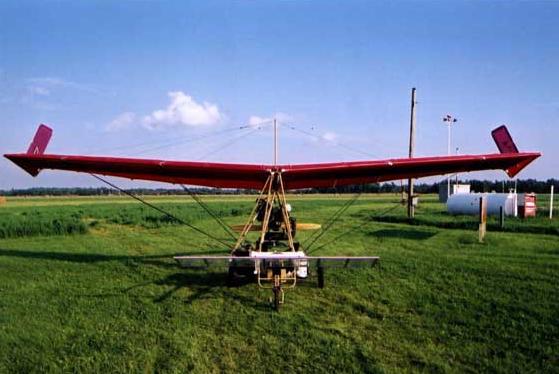
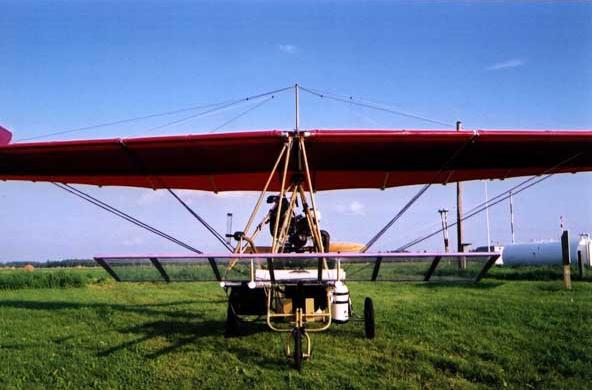
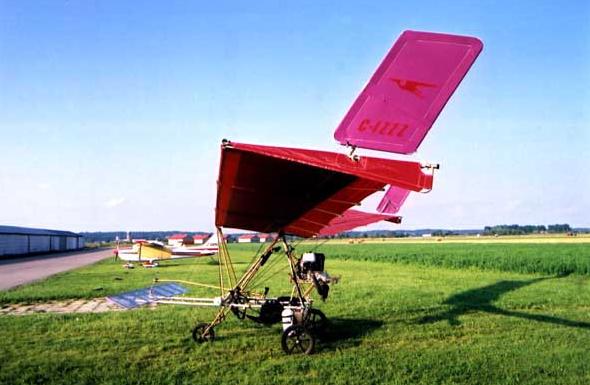
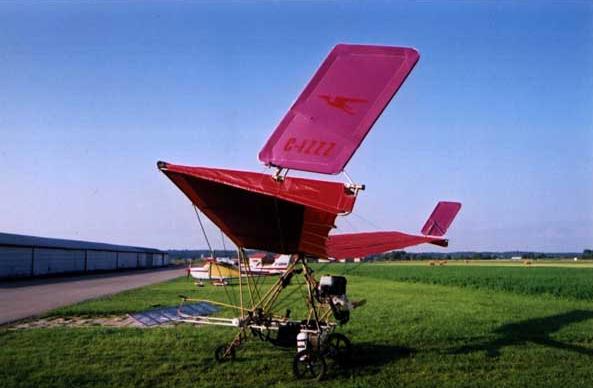
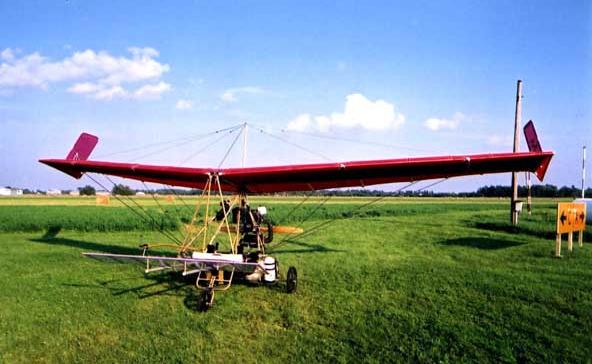
Here are some photos from our pre-flight photo session:
New large photos:
12 August 2003 – Well after an incredible week and a half of really bad weather we finally got the first flight of C-IZZZ in. The last week and a half has really been notable for August in Ottawa – lots of Maritime Tropical weather with morning fogs that last until the thunderstorms start. At last a cold front blew through late in the day on 11 August and cleared it all out. The weather was worth the wait as the evening of 12 August was really nice with nearly clear skies and light winds and even a clear horizon for reference.
I will admit that I was nervous – this first flight has been a long time in the making, but it went as smoothly as any post-production test flight I have ever done at Bristol Aerospace or elsewhere.
Ruth and I got to the airport around 1730 hrs and spent some time taking care of a few minor items that needed cleaning up. Our hangarmate, Gord Dyck, showed up along with a couple of other people, to see the plane fly. Not too big a crowd for a first flight. I did a careful pre-flight inspection from the new checklists and then got dressed in flying gear. The engine took a few attempts to get it started (I think I over-primed it). The wind was almost nil, about 1 knot from the NE, so I opted to use Runway 10. It is 3995 feet of asphalt and has the best cleared areas off the end along with a circuit that is over the airport itself. The infield had been recently mowed, so there were lots of place to put down, should that be necessary.
Take-off was smooth and accomplished by setting the power at 5000 rpm, which is 35 hp and about 70% power. The Ascender just levitated off the runway after a short roll, with a little bit of backpressure on the canard. Like last time I did over-control slightly in pitch and roll on take-off – nothing serious as I was ready for it – but the aircraft is very light and responsive in both axes! It quickly settled down at 40 mph indicated and I climbed out at about 500 fpm at that power setting.
I departed the circuit and did some turns and handling checks. The aircraft was well balanced laterally and did not tend to turn hands off. It trimmed out at 40 mph IAS. I climbed up to 2000 feet and did a couple of stalls. As it stalled the left wing dropped (possibly due to engine torque as it was completely at idle) and I tried picking it up with right winglet application. The aircraft auto-rotated left and stabilized in that configuration. I lowered the nose and it recovered after a 30-degree bank excursion and a loss of 300 feet. The left wing drop became a right wing drop in the recovery. The stall happened at a surprisingly high 35 mph IAS. The prototype I had flown before stalled under 30 mph and just bobbed the nose slightly. I tried it again with the same results. A Vne check was successful, although it took a lot of down-pressure to get the aircraft to 55 IAS and the wind noise was appreciable.
I returned to the circuit, set up left hand down wind for Runway 10 and flew the final fast at 42-45, given the stall performance. I elected to land rather than do some circuits until it could be investigated. The landing was flown with part power and resulted in a smooth touchdown on the asphalt of runway 10. There was about 1 knot of crosswind, which was easily dealt with. The first flight lasted for 22 minutes air time, with 0.6 flight time added to the Hobbs.
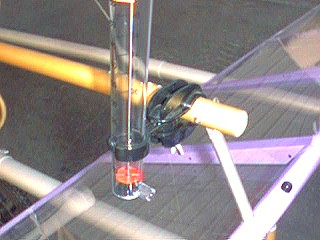
During the debrief I considered that the ASI might be poorly placed. I have it located behind the canard control post connection. A check of the photos of the prototype indicate that it has its ASI mounted forward of the post and it may be in cleaner air there. It is possible that this “position error” and subsequent aerodynamic interference is causing the ASI to over-read at low airspeeds and under-read at high airspeeds, thus giving the effects noted of a high stall speed and large forces to reach Vne. I will talk to Dave about that. It is also possible that me use of winglet deflection caused the stall behaviour by increasing the angle of attack on the low wing and thus causing an incipient spin! At least the aircraft took it well! More to talk to Dave about!
Overall the flight was successful. After all this time of preparation, building and waiting it seemed rather anti-climactic. I take that as a good thing. The interesting part will now be tweaking the aircraft and getting more comfortable with how it flies.
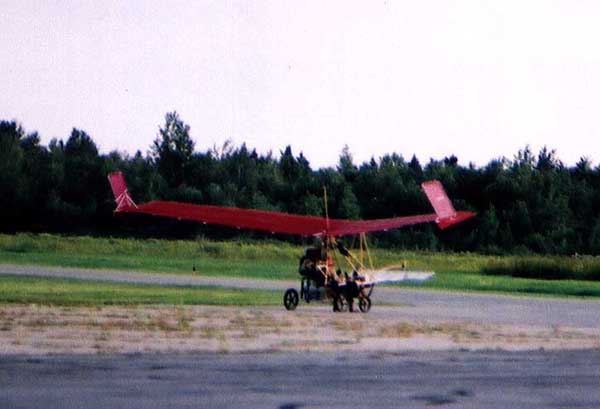
Photos:
Flight completed taxiing back in
Happy to have the first flight completed!
13 August 2003 – I talked to Dave tonight and he confirmed that the ASI needs to be further forward to read properly, so I will fix that for next flight.
The stall characteristics have Dave a bit baffled. He was happy that it was controllable, but it isn’t stalling like most Pterodactyls. It is possible that we have an aft C of G situation. The cruise checks with the ASI in the right place should tell the story. If it is really cruising quite slowly then the C of G needs to come forward. If it is actually cruising fast then the C of G could come back. A forward C of G is unlikely to be the problem in this case. More test flying is required to find out what the story is.
18 August 2003 – Tonight I completed a second flight in the aircraft with the ASI repositioned. It reduced the cruise speed from 40 down to 36-37 mph. I didn’t do any more stalls, as I want to bring the C of G forward before I attempt more of those. I expect that the indicated stall has reduced to 31 or so, however.
I just got some new 35mm photos back from the developer and scanned them in here. These were intended as “before first flight” portraits and were shot before the first flight occurred.
Photos:
07 September 2003 – Well it has been a while since the last flight – going away camping for a week really didn’t help get the test flying done!
Yesterday morning I finally got the third test flight done. We had previously repositioned the engine to bring the C of G forward. The engine had been in position 3 and is now in position 1 – a change of two inches forward. According to our re-weighing that moved the C of G forward about 0.3 of an inch. It did help, as the stall characteristics were definitely tamer than they were last flight.
The cruise speed is now trimmed at 40 mph, which is okay for solo flight. The pitch stability is very positive and the aircraft definitely wants to keep flying at trim speed. It takes a good bit of pressure on the stick to get it to speed up from there.
I did investigate the pitch trim at different power settings as I had a suspicion that the thrust line was influencing the trim speed and not just the C of G. This turned out to be the case as the trim speed was 40 mph at 4800 rpm or so and only 36 mph at 3000 rpm! Obviously the thrust line is above the centre of gravity and so a reduction in power results in a slight pitch up. This is not entirely unexpected as it is common in pushers, just due to the high thrust lines. There really isn’t any means to lower the thrust line anyway, as the B gearbox is already in the “down” position and the prop clearance at minimum. I think it is just going to be a characteristic that the pilot will have to know about and be ready for. It isn’t a strong tendency, but is most noticeable on decent in the circuit. It takes more and more forward stick pressure to keep up a good speed for landing as the power is reduced.
The engine needs a small adjustment too. At 4500 rpm (a common cruise rpm) the #1 EGT is right up on the redline of 1200 F. I will check with Daniel, but I suspect that he will tell me to adjust the jet needle one more notch richer.
The only other snag is with the seat side attachment belts. They are slipping though the buckles, which is a bit unnerving! I will try sewing on a bit of lengthening material, which will also provide a stop for them. If that doesn’t work I will have to find a new kind of positive buckle that will do a better job.
The Hobbs now has 2.7 hours on it and the aircraft has actually been in the air for 1.1 hours. The test flying is coming along well and I think that the C of G is good enough right now to leave it where it is, at least until I can see where the cruise speed ends up with two people on board.
13 September 03 – We went to the airport with the hopes of getting in the fourth test flight this evening, but it didn’t happen. The clouds were gathering and the rain started some 8 hours ahead of forecast. The wind was up, too, some 4 hours ahead of the TAF, which I think all adds up to the weather system bearing down on us getting here a bit early!
I did fit the new seat side strap buckles and they seem to work okay. The ones supplied by Great Salt Lake Sails were a stamped steel tri-glide type buckle, but of quite thin steel. They started to bend on the first flight and on the third I had to adjust them twice before take-off. On landing one had slipped considerably – not a good thing as they take some of the pilot’s weight on them. They just weren’t doing the job, so I picked up some Delran Fastex 2” tri-glide buckles at House of Canvas this week and they seem to do the job – they just need to be test flown to be sure!
The throttle continues to slip and will not hold in place in flight. So once again tonight I tightened the screw and nut that holds it in place. It just seemed to spin and not hold tension, so I pulled it all apart - naturally the eight thin plastic washers all fell out – they are fun to try and re-install! But at least I found the source of this ongoing snag! The screw that was used in the throttle I identified as an AN525-832R10. It had a nut supplied and installed that is an AN364-1024A, which is an AN3 type shear elastic stop nut. You guessed it – the nut has a 10-32 thread and the screw has an 8-32 thread – the nut is too big for the screw. I found an AN3-6A bolt in my spares box and reassembled the throttle assembly with it and an AN365-1032A full nylock stop nut. It holds torque just fine and should allow me to get the throttle tension just right for flight! Yes another test flight is required.
So the next flight will be a test flight for three things – throttle tension, the seat buckles and the EGT at 4500 rpm. I have a week off work, hopefully the weather will not be as bad as the forecasts look and so I will get a few flights in!
15 September 2003 – Well so much for getting in any flying in on my week off work!
My original plan was to take advantage of any flyable weather this week and get some hours on the plane, but apparently this was not to be. Today I went out to re-install the throttle assembly and Locktite the swivel in place – it needs a bit of cure time anyway and the weather was not good with a cold front coming through.
When I reinstalled the throttle quadrant I naturally checked the carb adjustments – it all looked good. Then I checked the oil injection adjustment. It didn’t look good – at idle it was nowhere near the idle mark - the lever was rotated 45 degrees off the mark! The throttle couldn’t even be opened fully. After some playing with it to see if the cables were routed poorly I determined that the problem was that the oil actuation cable was hanging up – getting stuck – inside the cable splitter. The unit is sealed and cannot be opened. Obviously it was U/S.
I ended up calling the manufacturer, Aero Controls of St Albert AB (http://www.aerocontrols.ca/), and talked to Bob Robertson there. He said that they occasionally have these kinds of snags with the units and offered to send me a replacement one right away. He also wants the faulty one back for analysis, which is a good QA policy. The service from them was good. The only problem is that I am now grounded for my week of flying, as I probably won’t get the new assembly until week’s end, just in time for Hurricane Isabel to hit Ottawa.
19 September 2003 – Lessons In How Not To Get Any Test Flying Done - Well, Aero Controls were superb – they got me the new throttle cable assembly in record time – I received it Wednesday. The only factor that kept me enjoying the wonderful flying weather on Thursday was catching the flu. Needless to say this has not been a good week off work, which I took specifically to do some flying! Between the throttle cable snag, four days with the flu (so far) and now the hurricane, I haven’t got in any flying at all.
Hurricane Isabel (downgraded to a Tropical Storm by the time it got to Ottawa) was a bit of a non-event for Ottawa-dwellers. We got a few spits of rain in the morning and then a bunch of wind under mostly clear skies. Environment Canada says we will get some 50-knot gusts yet this afternoon and that will be it for here. Compared to the southern US, which had lots of damage, and even Toronto, which had lots of rain, we got off pretty lightly here!
10 October 2003 – Well it has been an incredible month – awful weather, the flu, trips for work, all of which interfered greatly with getting the 4th test flight done. Finally after some truly bad weather days recently we have a few days of official “Indian Summer” and I was able to get a Friday afternoon off work (!) and get the flight in.
The test flight was to check a number of things:
1. The new throttle cable assembly including a balky oil cable
2. The side buckles (newly replaced with Fastex Delran buckles)
3. The EGTs at cruise speed
4. Throttle tension (since it was rebuilt)
The flight went well, with a crosswind of 3-4 knots on the runway. I was able to handle it okay, with a bit of planning. The test items were all good – except the side buckles, which are still slipping. I will sew on additions to them tomorrow, which should solve the problem (hopefully). I’ll try it out on the pilot’s side first and then if that works do the co-pilot’s side afterwards. This is fairly minor snag to fix!
I had one other problem as the rubber seal on the instrument panel started coming off in flight! I couldn’t reach it well enough to secure it until I got on the ground. I will keep an eye on it and see if it is going to do that again. If so I will remove it!
The skies over Carp were busy tonight as everyone was intent on getting in some flights. I ended up in the circuit ahead of a Cirrus SR-20. He didn’t see me at all and flew his circuit bigger than mine. I ended up on final with him a mile behind me, so I did a 360 to the left and rejoined, letting him go by my. The Ascender’s slow speed on final was a boon as he had time to get down and backtrack to clear before I got there. The Ascender’s lack of speed is a bit of hindrance in avoiding other traffic.
I am planning to use tomorrow, perhaps our last decent day of Indian Summer before the cold front on Sunday, to get in a bunch more flying on the plane. This may turn out to be the end of the season for open-cockpit planes and I do want to actually log some flying time in the machine before it gets put away for the wintertime.
0.6 flown on the Hobbs today.
11 October 2003 – Today was a beautiful day. I think we reached 24C! I went to Carp on my own and our next-door neighbour there, Mitchell offered me a Cirrus flight. It was a good trip, over to CYOW for an ILS approach and then blasting back at 175 knots!
I also got a 0.6 flight on ZZZ as well. The evening was nice and calm and the plane was actually free of snags! It flew very well. I did five touch and goes with my final landing on the rough grass of the infield. It handled the bumps really well, too. For the first time, now on this fifth flight, I feel comfortable with the plane. That is a good sign! I just need more practice flying the Ascender to gain more confidence in what it can do. Hopefully we have some time left before the winter sets in.
My next test-task is to fly another person and see how it handles that. I am very curious to see what kind of cruise speed it turns in and how the stall characteristics are. With winter coming on soon that will probably have to wait until next year.