HISTORY
-
 Koalas
or koala-like animals probably first evolved on the Australian continent
during the period when Australia began to drift slowly northward,
gradually separating from the Antarctic land mass some 45 million years ago.
Fossil remains of koala-like animals have been found dating back to 25
million years ago. As the climate changed and Australia became drier,
vegetation altered until what we recognize as eucalyptus, or gum trees,
evolved and koalas became dependent on them for food.
Koalas
or koala-like animals probably first evolved on the Australian continent
during the period when Australia began to drift slowly northward,
gradually separating from the Antarctic land mass some 45 million years ago.
Fossil remains of koala-like animals have been found dating back to 25
million years ago. As the climate changed and Australia became drier,
vegetation altered until what we recognize as eucalyptus, or gum trees,
evolved and koalas became dependent on them for food.
-
- Aborigines are thought to have arrived in
Australia 60,000 years ago or more. Koalas, like all Australian animals,
were an important part of Aboriginal culture and feature in many of their
myths and legends. They were a readily available source of food, but, koalas
remained abundant over their range before the arrival of Europeans with the
First Fleet in 1788. John Price was the first European to record koalas. He
described them in his account of a journey into the Blue Mountains near
Sydney in 1798. The koala was given its scientific name, phascolarctos
cinereus, meaning 'ash grey pouched bear' in 1816. Subsequently, it was
discovered that the koala was not a bear at all, but a member of a
specialised group of mammals called 'marsupials', which give birth to
immature young and carry them in a pouch. Today, most marsupials are found
in Australia and Papua New Guinea.
- 'Koala' is thought to mean 'no drink' in the
Aboriginal language, although there are many different languages spoken by
Aboriginal people throughout the country. The name for koala appears in
diverse forms in the written accounts of early settlers as cullewine,
koolewong, colo, colah, koolah, kaola, koala, karbor, boorabee, and goribun.
- As the new colony progressed, the clearing of
forests for farmland began, and with it the beginning of the loss of habitat
to the native animals. European settlers identified the koala as a source of
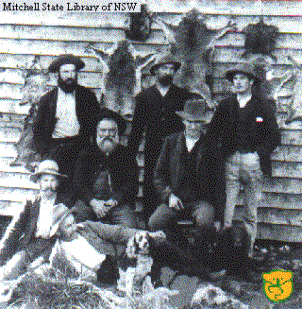
fur to trade, and in the ensuing years up until the 1930's, millions of
koalas were shot for their pelts.
- By 1924 koalas were extinct in South Australia,
severely depleted in New South Wales and estimates for Victoria go as low as
500 animals. At this time, the focus of the fur trade moved north to
Queensland. In 1919 the Qld Government announced a six month open season on
koalas, and in that period alone, 1 million koalas were killed. Although the
season officially remained closed until 1927, when the season re-opened,
over 800,000 were killed in just over 1 month. Public outrage at the killing
forced governments in all states to declare the koala a 'Protected Species'
by the late 1930's. However, no such laws were brought in to protect the gum
trees upon which koalas rely for their food and shelter. Except for some
recently implemented laws in NSW, this remains the case throughout the
koala's range.
 [ Home ] [ HISTORY ] [ HABITAT ] [ CURRENT SITUATION ] [ WHAT ARE PEOPLE DOING TO HELP ] [ WHAT YOU CAN DO TO HELP ] [ FUN FACTS ]