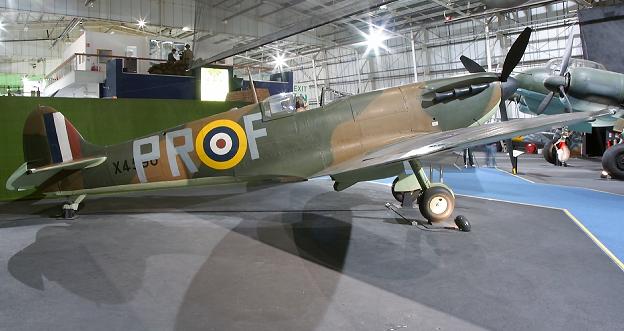
The Supermarine Spitfire has faired better than most. While some aircraft, like the Halifax, essentially no longer exist, and others like the B-17 Flying Fortress were scrapped in such mass numbers after the war, that both static and flying examples are rare, a fairly large number of the the legendary Spitfires have survived. Many would-be airplane racers bought them on the cheap after the war hoping to compete with them in airshows. At the same time, foreign governments purchased large numbers of them for their own post-war air forces and used them well into the 1960s in some countries, much like Spain's fleets of Messerschmitt 109s.
Still, many of these were the later models naturally. Mechanical survivors of the conflict tend to be the last few off the assembly line, some of which never saw action, like many of the aforementioned B-17s. The Spitfires of the Battle of Britain, known as the MKIs, are rare indeed, as most met their fate in the air defending their home.
Amazingly, of the six that still survive, two of them are veterans of 609 Squadron, home of the first Eagles. Both of these planes are preserved and on display in two of the most prestigious war museums in Britain.
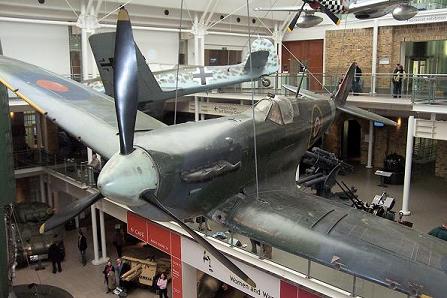
Delivered to 609 Squadron on July 11, 1940, this Spitfire saw combat in the Battle of Britain. It was given to the Imperial War Museum on August 26, 1946 and placed on display in the main gallery in 1993 as shown in the photo.
It is sporting post-Battle of Britain colors as it saw continued service after 1940.
I often wonder if Red Tobin, Andy Mamedoff, or Shorty Keough ever took this Spit' for a spin...