A piezoelectric earphone
The most difficult part of building a crystal radio is building an efficient earphone that can convert the tiny electrical signals into tiny sounds that our ears can hear. Our first radio used a telephone handset for an earphone, and that works quite well. But another type of earphone is available that fits in the ear so you don't have to hold it. It is also more sensitive than the telephone handset.
In order to convert very faint electrical signals into sound, we need a very sensitive earphone. The kind of earphones used in transistor radios or CD players will not do. Those are meant to be driven by a signal loud enough to drive a speaker, and are not sensitive at all.
For now, we will just say that a sensitive earphone has a very high impedance, which is measured in ohms. A speaker has a low impedance, usually about 8 ohms. A sensitive earphone built around an electromagnet (we will build one of these later) might have 2,000 ohms. The telephone handset earphone is of this type, although it has only a few hundred ohms of impedance, and will not be as loud as a more sensitive device.
The crystal earphone we will play with in this section has over a million ohms of impedance, and is very sensitive.
A crystal earphone (more properly called a piezoelectric earphone, pronounced pee-zo) is made of a material that changes its shape when connected to a source of electricity. Some crystals such as quartz, and Rochelle's Salt are piezoelectric. Some ceramics (such as those made with barium titanate) are also piezoelectric. Our piezoelectric earphone is made of a disk of brass that is coated with barium titanate ceramic. When electricity is connected to it, the ceramic bends the brass disk, and we can hear the vibrations this causes in the air.
To demonstrate just how sensitive a crystal earphone is, try this experiment: with the earphone in your ear, touch the two wires together. You will hear a sharp click as electrons move from one wire to the other. If the earphone came with a jack on the end instead of two bare wires, you will need a piece of metal such as a spoon to connect the two metal parts of the jack.
One detail about such a very sensitive earphone is important in building a crystal radio. A sensitive earphone does not use very much current to create the sound. Another way of saying this, is that not much current is going through the earphone. Our radio needs a certain amount of current to flow through the diode in order to work.
When substituting a piezoelectric earphone for an earphone made with a coil of wire, we must provide a way for some current to bypass the earphone. We do this by putting a resistor or a coil in parallel with the earphone (parallel means that the resistor or coil is attached to the same two places that the earphone wires are attached).
The resistor can be anything in the range of 1,000 ohms to 100,000 ohms, and can be a piece of graphite out of a pencil, or a couple hundred coils of fine wire around a nail.
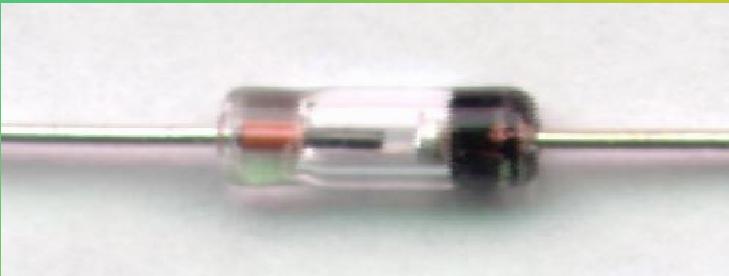
A Germanium diode detector
The second part of our radio, after the earphone, is the detector. A detector is something that picks the audio frequencies out of a radio wave, so they can be heard in the earphone. We will learn more about how they work in the scientific part of the chapter later on.
Our first detector will be store-bought. Later we will replace it with detectors we build ourselves out of things we find around the house, like lead pencils, baking soda, razor blades, rocks, all kinds of things.
The detector we will use first is a Germanium diode. The diode we want is called a 1N34A by the people who name diodes. This diode has some properties that make it particularly suited to our purpose, namely that it works at lower voltage levels than most other common diodes. Since the voltage in our radio comes from weak little radio waves, we need all the help we can get.
Radio Shack used to carry them, but they no longer have them in their stores.