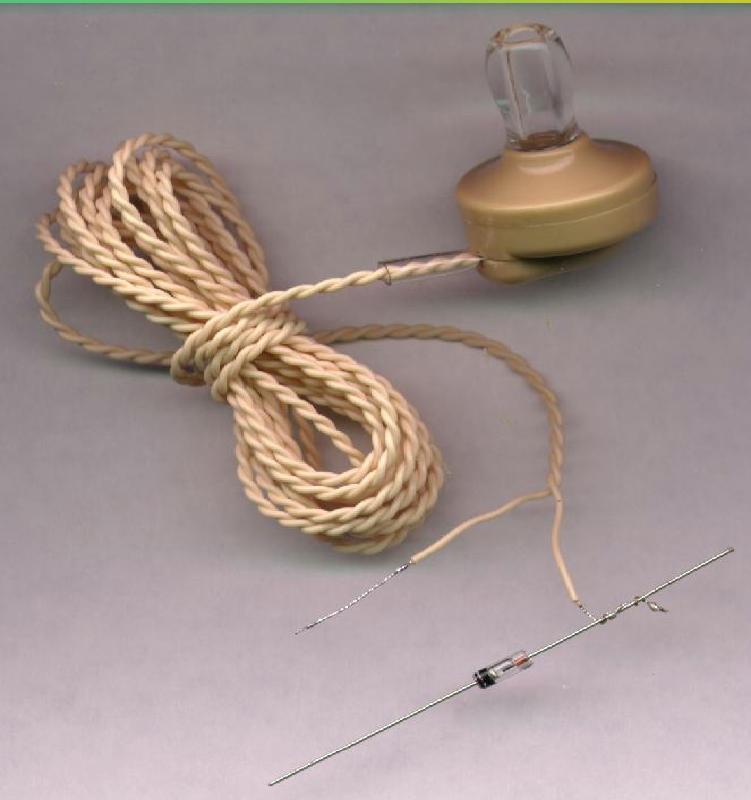
Another simple radio with two parts
Our simple radio has two main drawbacks. One is that the signals are very faint, and can only be heard if you are close to a radio station's transmitting antenna. The other is that you hear all of the strong stations at once, and it is hard to pick out just one song or voice from the mixed up jumble. The first problem is called the 'sensitivity' of the radio. Our radio is not very sensitive. The second problem is called the 'selectivity' of the radio. Our radio is not very selective.
We can solve both problems by using a trick called resonance.
Resonance is a way of taking a little bit of energy, and using it over and over again, at just the right time, to accomplish a big task. We use resonance when we push someone on a swing. It would take a lot of work to lift someone several feet in the air, but we can do this easily on a swing by giving a little push over and over again at just the right time. Timing is important: if we push at the wrong time, the swing can actually lose energy instead of getting higher.
When an opera singer uses her voice to shatter a wine glass, she is using resonance. Her voice gives the glass a little push at just the right time, over and over again, until the glass is moving so far that it shatters. In a similar way, we can slosh all the water out of a bathtub by moving a hand in the water at just the right back and forth speed. Each time the hand moves, the water climbs a little higher, until it is over the top of the tub.
Radio waves can act like the sound waves of the singer's voice, or like the waves in the bathtub. Radio waves can cause electrons to move back and forth in a wire, just like the water in the tub. If the radio waves are moving back and forth at the right frequency, then the electrons in the wire will just be crowding towards one end of the wire when the radio waves start moving them back to the other side. Just like the water in the tub, the electrons will crowd higher and higher at the ends of the wire. These electrons can do work, like moving the brass disk in the earphone to create sound.
We can use resonance to build a radio that can pick up only one station at a time, and make a louder sound in the earphone. This radio will also have some drawbacks (for one thing it will be over 1,000 feet long!) but we will solve these problems in the next radio we build.
Suppose we pick a local radio station we want to hear. For this example we will choose 740 kilohertz on the AM dial. We now need to figure out how long the wire must be to resonate at this frequency. Radio waves travel at the speed of light. This radio wave is going back and forth 740,000 times per second. This means the wave needs to go about a quarter of a mile in one direction, then turn around and go back again, over and over. The actual formula for figuring out how long the wire should be is 936 feet Frequency in Megahertz or, for our example: 936 feet .740 or about 1264 feet.
To make our radio, we take half of the wire (632 feet) and attach it to one end of the diode. We attach the other half of the wire to the other end of the diode. We attach one earphone wire to one side of the diode also, and the other earphone wire to the other end. We put the long wire up in the air by attaching each end to a tree (the trees must be about 1264 feet apart). Then we put the earphone into our ear, and listen to the radio.
Now I can think of a couple problems with this radio. It is not the most portable radio. Also, in order to change the station, we need to make the wire longer or shorter.
One solution to the portability problem is to coil the wire up by winding it on a box or a cylinder. Then we can solve the tuning problem by attaching the diode and earphone to the coil at different places (easy to do now that the whole wire is in one small place).