Adding a capacitor (or three)
As you tried different antenna lengths, you may have noticed that you had to move the tap on the coil in order to get the station at its loudest. To understand why this happens, and how we can use an understanding of it to improve our radio, we must first understand capacitance and how it affects the tuning coil.
A capacitor is simply two pieces of metal with an insulator between them. If a capacitor is connected to a battery, the battery will push electrons onto one piece of metal (called a plate) and draw electrons from the other piece of metal. If we remove the battery, the electrons can't go anywhere, so one plate of the capacitor will have more electrons than the other plate.
If we connect the two plates together with a wire, the electrons will rush from the plate that had too many (because electrons have the same charge, and thus repel each other like the north poles of two magnets) to the plate that had fewer electrons. As the electrons rush from one plate to the other, we can make them do work, such as light a light bulb. In this way, the capacitor seems to store the electricity from the battery, for use at another time when the battery isn't there.
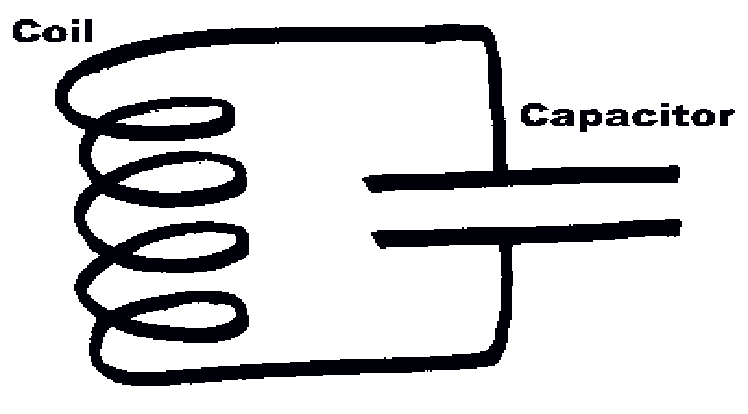
Now suppose we connect a coil and a capacitor together like this:
Suppose also that the capacitor has been charged by a battery so the top plate has more electrons than the bottom plate. When we connect the coil, the excess electrons in the top plate immediately start traveling through the coil to get to the plate that has a shortage of electrons.
As the electrons travel through the coil, they create a magnetic field, (remember 'coil' is just another word for 'electromagnet'). The magnetic field grows until the plates on the capacitor have equalized. At this point you would think the current would stop flowing in the coil. But the magnetic field that built up when the current flowed through the coil now starts to collapse.
Just as moving a magnet past a coil will generate a current, a collapsing magnetic field around a coil creates a current too. The current is in the same direction as it was when the magnetic field was created, so the coil ends up pushing electrons onto the bottom plate of the capacitor, and stealing them from the top plate.
By the time the magnetic field around the coil has completely collapsed, the bottom plate of the capacitor has a surplus of electrons, and the top plate has a deficit. You can guess what happens next.
The electrons start flowing back into the coil, this time from the bottom plate to the top. The coil starts building up a magnetic field again, but since the current is now going the other way, what used to be the north pole of the magnetic field is now the south pole, and vice-versa.
The field grows until the capacitor has equalized, then it collapses, and pumps electrons into the top plate of the capacitor. We are now back where we started, and the whole process starts over again!
The coil and the capacitor are resonating, just like the child on a swing, or the water in a bathtub. In fact, this circuit is called a 'tank circuit', like a tank full of water that sloshes back and forth.
We can control the frequency of the oscillations in two ways. We can make the coil larger or smaller, or we can make the capacitor larger or smaller. The coil we built for our radio has taps, which have the effect of making the coil shorter or longer, depending on which tap we connect to the antenna.
Our radio has a coil. But it doesn't have a capacitor. Or does it? Actually, the antenna itself is acting like a capacitor. The capacitance of the antenna is reacting with the inductance of the coil to resonate at the frequency of the radio station.
When we change the length of the antenna, it is like changing the size of the capacitor. This is why changing the length of the antenna changed the tuning of the radio, forcing us to move to a different tap on the coil in order to listen to the same station.
There is another way to change the capacitance of a capacitor. We can change the distance between the two plates. If the plates are closer together, the excess electrons on one plate are attracted to the other plate, because when the negatively charged electrons were removed from that plate, it was left with a positive charge.
Because the electrons are attracted to the positive charge, we can pile more of them together, storing more energy. In a similar fashion, when we make a capacitor with the plates farther apart, the positive charge is farther away, and can't help to pull as many electrons onto the negative plate. Thus the amount of energy we can store is less, and we say the capacitor has less capacity
We can combine capacitors to raise or lower the capacitance, now that we know how capacitors work. If we put two capacitors together in parallel, we can increase the capacitance, because the top plates are connected together, and the bottom plates are connected together, it is just as if we had one capacitor with large plates.