Building a crystal radio out of household items.
Power from radio waves -- hooking up a meter to measure the voltage and current
It is useful at this point to be able to measure the effects of changes we make to the radio. We can just use our ears and try to remember how loud it used to be, but it is easier to read a meter, and remember a number. With a meter connected to the radio we can adjust the tuning for the highest meter reading, or make other adjustments as we add new components or replace purchased components with ones we make ourselves.


The meters must be sensitive to very small changes in the amount of electricity flowing in our radio. We will be measuring current mostly, but we will add a voltmeter as well, so we can calculate the total amount of energy we are receiving.


Current is the flow of electricity through the circuit, and it is measured in amperes, or amps for short. Voltage is the pressure that pushes the current through the wires. If electicity were water, current would be the amount of water flowing (gallons per minute), and voltage would be the water pressure in pounds per square inch.


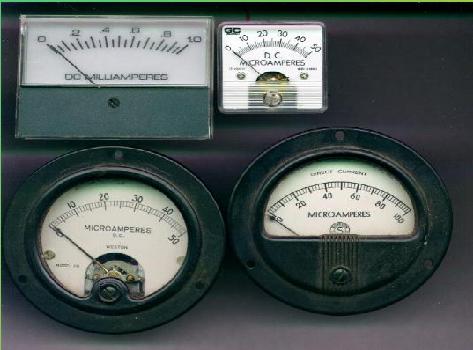
Since the amount of current is very small, we will use a meter that measures current in micro-amperes, or at most small fractions of a milliampere. Some examples of microammeters and milliammeters can be seen in the photo below:
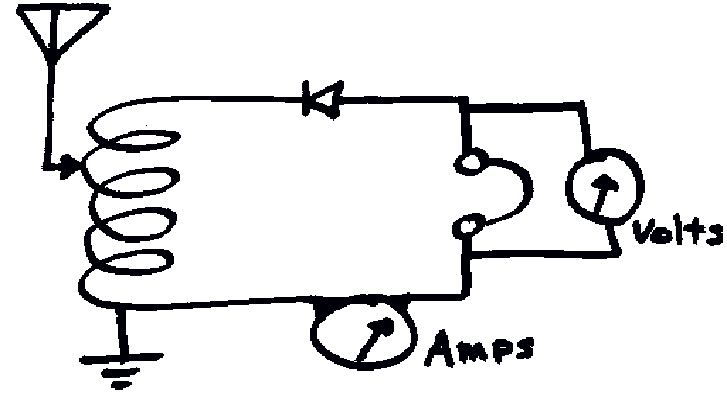
To measure the current in our radio, we will need to have the current flowing through the meter. To do this, we connect the microammeter between the earphone and the ground connection, so that any electricity that is going to flow throught the earphones to make noise is going to have to flow through the meter also. The meter can be connected in two ways, one is forward and one is backward. If the meter is connected backward, the needle will start reading below zero. If this happens, just reverse the connections, so the needle reads above zero.


To measure the voltage, we connect the meter to both of the earphone wires. The schematic diagram now looks like this:
If you have a good antenna, or a strong radio station nearby, the ammeter might read more than 50 microamps. If you have a short antenna, you might get only 5 microamps and still be able to hear the station clearly in the headphones. I put up a 200 foot antenna between two trees over my house, and tuned to a 50,000 watt station about 30 miles away, and now I get 175 microamps of current through my meter. I put the earphone to the mouth of a cone (like a megaphone) and I can clearly hear the radio from across the room when the house is quiet. It doesn't sound as nice and clear as it does with the earphone right up to my ear, but I can follow a conversation easily (it's an all-news station).


The voltmeter in the same radio reads 125 millivolts. Since watts (the measure of how much power we have) is the voltage multiplied by the amperes, we have 0.000175 times 0.125, or 0.0000218 watts, or about 22 microwatts. The station is putting out 50 killowatts, and we are receiving one ten billionth of that power, yet we can hear it across the room.


Try different lengths of antenna, and watch the current go up as the longer antennas catch more of the power from the radio station. Try more that one antenna. Try connecting the ground wire to different things that are connected to the ground, such as pipes, metal fences, etc. As you try each test, make sure you tune the radio again, because your changes may affect the tuning.
Hosted by www.Geocities.ws

1