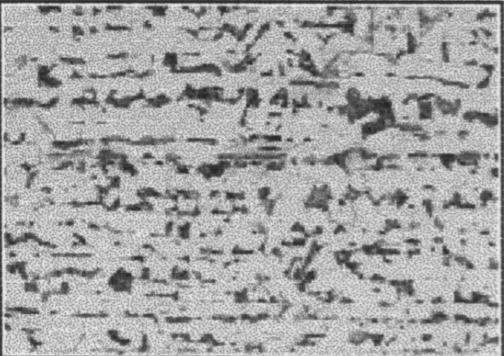
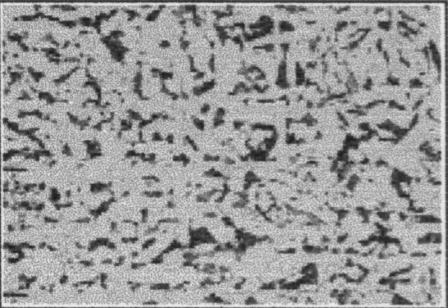
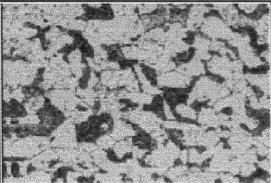
This is an analysis of the information shown in the previous table. The table showed the precise amounts of each element that made up the Titanic hull plate, and compared it with values for two other types of steel. The table shows that all three steels had very low nitrogen contents. This suggests that they were not made by the Bessemer process, in which carbon and silicon, etc. are removed from molten pig-iron by passage of air, thus converting it to a material suitable for steel making. Steel produced in this way would have had a high nitrogen content that would have made it very brittle, particularly at low temperatures. In the early 20th century, when Titanic was built, the only other method for making structural steel was the open-hearth process. The fairly high oxygen and low silicon content, particularly in 'Lock Gate Steel' and ASTM A36, means that the steel has only been partially deoxidised, yeilding a semikilled steel. The phosphorus content in Titanic's steel is significantly higher than normal, while its Mn:S ratio of 6.8:1 is a very low ratio by modern standards, which is shown by ASTM A36 having a much larger ratio of 14.9:1. The presence of relatively high amounts of phosphorous, oxygen and sulphur in Titanic's steel have a tendency to embrittle the steel at low temperatures.
Professer Henry Baumgartner at the university of Missouri-Rolla formed conclusions about how these chemical findings are significant as to why the Titanic sank. He concluded that excess oxygen in the steel can form precipitates that can embrittle the steel. The steels Mn:S ratio was very low, and Baumgartner concluded that without sufficient manganese, the sulfur reacts with the iron to form iron sulfide at the grain boundaries. This creates paths of weakness for fractures. Sulfide particles within the steel that are under stress can ease the formation of microcracks. With further loading, these will become larger cracks. Baumgartner found that it was this method of crack formation that had caused the failure in the shell plating of the Titanic.
At the time when the Titanic was constructed, about two thirds of the open-hearth steel produced in the UK was done in furnaces that had acid linings. Therefore there is a high probability that the steel used in the Titanic was produced in an acid-lined furnace, which accounts for its fairly high phosphorus and high sulfur content. The lining of a basic, none acid lined furnace would react with phosphorus and sulphur to help remove these two impurities from the steel. It is likely that 'Lock Gate Steel' and ASTM A36 were produced in a none acid-line furnace, as they have significantly lower phosphorus and sulphur contents that the Titanic steel. |