| CHEMICAL ANALYSIS |
 |
 |
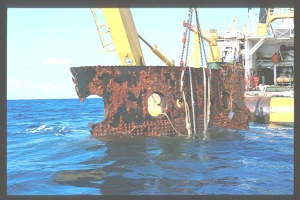
| 'The Big Piece', being recovered from the ocean floor during the 1998 expedition. |
| 'THE BIG PIECE' |
| In 1985, when the Titanic wreckage was first found, it was in two major parts, lying about 600m apart. Between them was a debris field containing broken pieces of steel hull and bulkhead plates, rivets that had been pulled out, and other debis. At the time, the small pieces of hull steel were not much use to metallurgists wishing to study them, as they had been exposed to bacteria, sediment abrasion, salt and acid corrosion and iron-eating microorganisms on the ocean floor, and were far too small to survive this. |
| During the 1998 expedition, a recovery was made that would be a major breakthrough into the metallurgical analysis of Titanic hull steel. 'The Big Piece', weighing 20 tonnes and measuring approximately 4 metres high by 7 metres wide, it was only a small part of the 250m hull, but it was large enough to allow detailed chemical tests to be carried out on the hull steel, that would determine whether a metallurgical failure caused the disaster. |
| COMPOSITION |
| The steel was brought to the University of Missouri-Rolla for metallurgical analysis. The following table shows the quantities of each element that made up the steel used in Titanic's hull plate. It also states the Mn:S ratio, which is an important factor in determining the quality of steel. The table also compares these values with the metallurgical analysis of two other typs of steel. The first, 'Lock Gate Steel', is a sample taken from steel that was used to construct lock gates at the Chittendon Ship Lock, Washington. The purpose of this comparison is that the lock was built around 1912, making the steel about the same age as the Titanic's steel. This will allow me to conclude whether the Titanic's steel was the best quality available at the time, or whether, as many supose, it should have been better. The third steel used for comparison is ASTM A36. This is a modern steel and should allow me to to conclude how much steel manufacture has improved since 1912. |
| Click the 'Next' button for analysis of the information in the table, optical micrographs of Titanic steel as well as ASTM A36, and more detail into the composition and microstucture of the steel used to build the 250m hull plate. |
 |
| NEXT: |