







KoRn main |
|
Out of the small town of Bakersfield,
California, in the early nineties, came
a sound. A faint whisper at first, it
grew in force and intensity with time,
unhindered by the yapping mouths of
politicians and parents alike. It rang in
their ears. It plagued their minds. It
genuinely terrified them. The voice,
talking in low-tuned rhythmic tones, spoke
for a generation that would have no more
of modern America and its leaders. A
generation fed-up with lies, violence and
greed from their own society. It grew and
grew as more and more people realized the
veracity of its claims, and adhered to
its cause. The politicians grew fearful,
and attempted to end its spread by
censoring and denouncing. Little did
they know that, six years later, that
small whisper would grow into a deafening
scream, a disturbingly present reminder
of its own existence, and of its legions
of followers�

Born in Bakersfield, California, from
the melding of two bands (LAPD and
Sexart), KoRn has become one of the most
popular new bands of the nineties. They
have revolutionized heavy-metal music as
we know it (or used to know it), by
injecting several different musical
influences into traditional rock, from
hip-hop and rap, to 70's funk music.
This strange blend gives KoRn a sound
of its own. The different styles involved
do, theoretically, contradict themselves,
but bound together by KoRn's musical
savoir-faire, give the songs such
atmosphere that the show-goers cannot
simply sit in their seats and say "Hmmm.
Nice." They feel the urge to jump in the
mosh pit and enjoy the music at its core,
letting all of their energy flow with the
tonal explosion that KoRn puts out for
them. This is how KoRn wins fans. Not by
cheap advertising with music videos, but
by steady, unrelenting touring, giving the
fans the full experience and thus winning
them for life. This strategy has given
KoRn a much longer life span than the
passing fad. And it shows no sign of
stopping.

Debuting strongly with their first,
self-titled album, KoRn introduced
itself bluntly to the world, featuring
lightning-fast drum arrangements by
David Silveria, frightening,
Halloween-like guitar riffs by
guitarists James "Munky" Shaffer and
Brian "Head" Welch, impressive
hammer-style bass lines by Reggie
"Fieldy" Arvizu, and authentically
emotional vocals by Jonathan Davis.
The largely autobiographical songs
written by Jon Davis depicted a
childhood lost, and were sung with such
fierce emotion and energy, that he won
instant compassion by fans everywhere.
When asked about how it feels to bear
his soul to thousands of people every
night, Jon had this to say:

"I wouldn't say fun, but very rewarding
and very relieving. Every time I do it,
it makes me feel better -- the comeback
from the crowd and seeing all that
madness out there. I'm touching
something, I think, that people want to
talk about, that people can relate to.
It's hard night after night, but I need
to do it, I have to."

How KoRn achieve their peculiar sound is
very different from other bands. The
first major difference is the use of
seven-string guitars by Head and Munky,
very rare instruments. The extra string
gives the guitar a much lower tonality,
allowing KoRn's guitarists a wider range
of chords to execute. Not to be
dominated by conformity, Head and Munky
also tune their guitars in a way very
different than most rock guitarists.
Whereas most guitarists would use the
classic tuning for a seven-string guitar
(B E A D G B E), KoRn's guitarists tune
them to a very weird A D G C F A D. This
gives KoRn's guitar riffs a distinct feel,
an almost eerie blend of hard-biting low
tones and shrilling high tones. The
frequent use of the Minor second, Tritone
and Major seventh chords, the three chords
that most disturb the human ear, complete
KoRn's guitar individuality. Fieldy's bass
setup also differs from most bands. Using
a five string bass tuned down to a rumbley
low A D G C F, and employing a unique and
amazing hammer-style/damping technique,
Fieldy gives the KoRn bass lines a very
rhythmic, almost percussion-like
personality. It is by differing from the
sludge of average bands that KoRn has
gained success.

KoRn's first album sold platinum, very
impressive for a debut album from a
heavy-metal band. From the hard,
heart-pumping sounds of "Ball Tongue",
to the slow, devastatingly emotional
"Daddy", fans were mesmerised by the
plethora of music and sentiments presented
before them. Also featured in this album
was KoRn's show-opening song "Blind", the
irreverent "Shoots and Ladders", the mind
numbingly fast "Divine" and the
universally appealing "Need to". The whole
album, in fact, was a metaphor for
childhood, from the picture of a young
girl on the cover, to the child's writing
on the inside of the booklet, and the
mocking misspelling of "corn" with a K
and a reversed R. It became readily
apparent to fans that what Jonathan Davis
had to say was not the usual "Oh, my
girlfriend left me�" insincere vocals
projected by most bands. What were here
instead were the disconcertingly true
tales of a man whose life was ruined by
past events. The emotional ties thus
formed between KoRn and their fans were
total. KoRn did not, however, let this
early success get to their heads, realising
that fans are the livelihood of a band.
They continued touring massively, steadily
earning a name in the underground rock
scene.

In 1996, KoRn ventured out with their
second outing, "Life is Peachy".
Though admittedly a bit rushed, by
pressures from their record company,
"Life is Peachy" showed no signs of
faltering quality. From the insanely
bizarre "Twist" to the groovy "Good
God", all tracks were very enjoyable.
KoRn had not failed in their mission
to bring their fans great music to
enjoy, surpassing their anterior
level of quality. A testament to
KoRn's growing popularity was the
fact that the band profited from a
better sound quality on "Peachy",
due in part to their maturing
musical skills, but also to the
better equipment purchased.

1998 was a very busy year for KoRn. While
spending time perfecting their third album
"Follow The Leader", KoRn also worked on
several other projects, including their
own rock festival called "Family Values",
their own record label entitled "Elementree
Records" and a weekly internet program
called "KoRn T.V.".

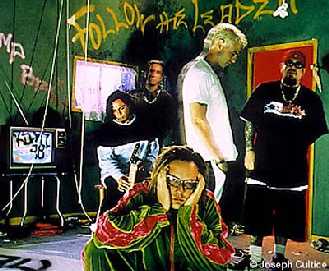
In making "Follow The Leader", KoRn took
their time to assure that this album
would benefit from the success of both
previous albums, by incorporating higher
quality recording equipment, giving
"Follow The Leader" a crisp, higher
quality new sound. This album also
incorporated various guest artists from
Fred Durst of Limp Bizkit fame, and Ice
Cube, to Trevant Hardson of Pharcyde
and Cheech Marin. Needless to say,
"Follow The Leader" was a smash hit.
The single "Got The Life" continuously
played on the radio, while the "Freak
on a Leash" music video went on to win
two awards at the 1999 MTV Music Video
Awards. The men from KoRn had
accomplished the journey from anonymity
to megastardom, and while some bands
might have felt the urge to give in and
"sell out", KoRn maintained their
integrity, both moral and musical,
and now, in 1999, are ready to unleash
their biggest album yet to an ocean of
thirsty fans.

Tentatively entitled "Issues", not much
is known of KoRn's forthcoming album.
Though the release date is fairly near,
November 16th, the members have maintained
a tight lid on their new project. However,
for those lucky enough to attend this
year's Woodstock, KoRn indulged their
fans by performing two songs from their new
album. The first one, apparently entitled
"Beg For Me", is a mixture of old-style
KoRn with newer, faster beats, and is very
enjoyable in all respects, but it is the
second song performed, called "Falling
Away From Me", that is sure to be a
wholesale hit. What is there to say about
this song? Everything is done right.
is a personification of KoRn's evolution,
and to the trained KoRn fan's ear, one
can hear in this song all of KoRn's
different musical stages. If all of the
songs on "Issues" are half as good as
"Falling Away From Me", this album will
be a raving success. Accessible to those
new to KoRn, but also, hopefully, deep
enough to satisfy those of us who have
been there from the start, "Issues"
should be one of those truly memorable
albums, which fans will be listening to
for years to come.

And so the voice rolls on, now a deep,
low laugh. For those who understand
its complex jargon, it seems to say,
with fearless ranting and steadfast
determination:

"WHO THEN NOW, BITCHES?"

           BY:Jeffrey Yates
|
HOME BANDS MEDIA LINKS LYRICS REVIEWS CONTACT