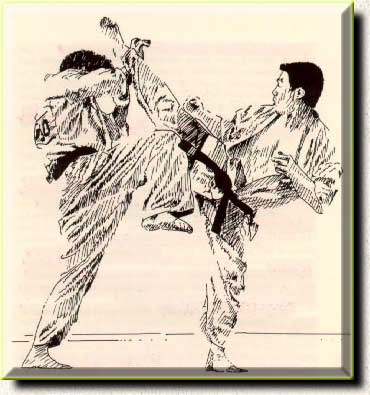
Beginners wear the white belt that comes with their gi. This is useful for keeping the top of their gi together, and for some place to put their hands (and thereby keeping them under control) when practicing kicks . Following a successful grading, they change their belt colour according to the kyu awarded by the examiner. The initial kyu awarded is known as the 10th kyu. This is usually a red belt.The remaining colours are blue, yellow, green, brown, and then black. More details can be found on the Details page under Belt Colours. The same colour is worn over two successive kyu, with the more senior being denoted by a strip of black tape or cloth about 1 cm wide, attached firmly about 15 cm from each end of the belt.
In some dojo the 10th and 9th kyu are denoted by a white belt with one and two black strips respectively. This was due to a new edict by Mas Oyama shortly before he died. In some MA styles, a red belt denotes a very high grade and that having a red belt for a relative beginner was misleading to the uninformed observer, and disrespectful to the styles in which red was a high rank.
A karateka under the age of 16 should, regardless of grade, have a white
stripe along the length of the belt. This is to indicate to older karatekas,
again regardless of grade, that this person may not be treated as roughly
as someone over the age of 16 could be. When they turn 16 the stripe is
removed, but they are re-evaluated on the basis of their physical ability,
performance, and mental maturity, to determine whether they retain that
grade, or whether they are moved down a couple of grades. All dan grades
wear a black belt with the appropriate number of gold stripes, and their
name in Japanese script, usually katakana , embroidered in one end of the
belt. These belts are specially produced in Japan for the successful candidates.

There are statutory time requirements between each grading, both in terms of hours trained, and calendar time between gradings. Passage of calendar time however is NOT sufficient. Training must have taken place continuously during that time. The current status of these is as follows:
Kyokushin - - - -Belt Colour - - - Total training - - - Time since - - - - Minimum
- grade - - - - - - - - - - - - - - - - - - - -time - - - - - - - - - - -last belt - - - - - - -time since
- - - - - - - - - - - - - - - - - - - - - - - - - (hours) - - - - - - - - -(hours) - - - - - - - last grading
----------------------------------------------------------------------------------------------------------------------10th kyu - - - - - -Red - - - - - - - - - - - 30 - - - - - - -- - - - - 30 - - - - - - - - - 3 months
9th kyu - - - - - - Red with one - - - -- 70 - - -- - - - - - - - - 40
- - - - - - - - - - - - -black band8th kyu - - - - - - Blue - - - - - - - - - - -116 - - - - - - - - - - -46
7th kyu - - - - - -Blue with a -- - - - - -170 - - - -- - - - - - - 54
- - - - - - - - - - - - black band6th kyu - - - - - -Yellow - - - - - - - - - -230 - - - - -- - - - - -60
5th kyu - - - - - -Yellow with a - - - - -296 - - - - -- - - - - -66
- - - - - - - - - - - - black band4th kyu - - - - - -Green - - - - -- - - - - 376 - - - -- - - - - - - 80
3rd kyu - - - - - -Green with a - - - -- 466 - - -- - - - - - - -90 - - - - - - - - - - -6 months
- - - - - - - - - - - - -black band2nd kyu - - - - - - Brown - - - - - - - - - 570 - - - - - - - - - 104
1st kyu - - - - - - Brown with a - - - --700 - - -- - - - - - -130
- - - - - - - - - - - - -black bandShodan - - - - - - Black with one - - -1000 - - - - - - -- -300 - - - - - - - - - - -1 year
- - - - - - - - - - - - gold band - - - - - - - - - - - - - - - - - - - - - - - - - - - - - - -and > 14 years oldNidan - - - - - - - Two gold bands - - - - - - - - - - - - - - - - - - - - - - - - - - - - - 2 years
- - - - - - - - - - - - - - - - - - - - - - - - - - - - - - - - - - - - - - - - - - - - - - - - - --and > 18 years oldSandan - - - - - - Three gold bands - - - - - - - - - - - - - - - - - - - - - - - - - - - 3 years
Yondan - - - - - - Four gold bands - - -(On recommendation only) - - - - 4 years

10th kyu - - - - - - - -9thkyu-
- - - - - - - 8th kyu
- - -
-
- - - - -7th kyu- - - - - -
-6th kyu
Taikyoku Sono - - - -Taikyoku Sono
-
- - --Taikyoku Sono - - - --Pinan Sono
- - - -Pinan Sono
Ichi - - - - - - - - - - - -Ni -
- - - - - - - - - - - - San - - - - - - -
- - - - - Ichi - - - - - - - - - Ni
5th kyu - - - - - - -4th
kyu-
- - - - - - - 3rd kyu- - - -
- - - - - - - 2nd kyu- - - -
1st
kyu
Pinan Sono San- - Sanchin No-
- - - -Pinan Sono Yon - - - - - Pinan
Sonoi - - -Yantsu
- - - - - - - - - - - - Kata -
- - - - - - - -Sanchin No - - - - - - - -
-Go Gekisai - - - Tsuki-no
- - - - - - - - - - - - (with ibuki)-
- - - - Kata (with kiai) - -
- - - Dai
- - - - - - - - - - - - - - - - - --------------------------------------------------------------------
Shodan-
- - - - - - - - - - -Nidan-
- - - -- - - - - - - - Sandan
Tensho, Saiha -
- - - - - - -Kanku-dai, Gekisai - -
- - -Sushi Ho, Garyu,
Taikyoku Sono - - - - - - - Sho
Seienchin - - - - - - - - Seipai Pinan
Sono
ichi,ni, and san - - - - - - -
Pinan
sono - - - - - - - - - -ni
in ura
all in ura - - - - - - - - - - --ichi
in ura - - -
- - - - - - - -Personally created kata
- - - - - - - - - - - - - - - - - - - - - - -
- - - - - - - - - - - with min. 28 movements

From 6th kyu onwards, each candidate must take part in a certain number of sparring matches (see the table below), each of which lasts between 1.5 and 2 minutes. These fights are semi-full contact or ju-kumite. Unlike full contact, you are not supposed to try to take your opponent down for the count (but you can knock them down with, say, a sweep). It must however be evident that your technique is such that with slightly different control, your opponent might have been knocked down. The semi-contact also shows the judges how well you defend, and how well you can take being hit. It is also a test of stamina, especially for shodan candidates. Candidates under the age of 16 only do half the number of fights shown below, and women also have that option. Anyone over 40 has the option of not doing ANY of the fights, but the belt then has a red stripe on it to indicate the fact that you got your shodan on "other merits". The over 40's are also given the option of just half the fights (but just for the shodan grading).
The sparring is against the other candidates. Shodan candidates, who have another 20 fights to go after all others have finished, must fight each other and also the (fresh) instructors and existing black belts i.e. the yudansha and any other senior kyu grades who have been invited along for the fun.
6th Kyu 4 fights
5th Kyu 6 fights
4th Kyu 8 fights
3rd Kyu 10 fights
2nd Kyu 15 fights
1st Kyu 20 fights
Shodan 40 fights

Tameshwari is probably the most stereotypical of all aspects of karate. It is a required part of some gradings and some tournaments. The boards are made of radiata pine (Pinus radiata)with dimensions of 205mm × 237mm × 18mm. The grain would normally be parallel to the 20.5 cm edge. The latter two dimensions are approximately those of standard, dressed-all-round (DAR) pine planks, the nominal dimensions of which are 20mm × 250mm.
The specific requirements vary between the different Kyokushin organisations, and for gradings may start from as low as 8th kyu. Such schools usually also perform tameshiwari before tournaments. In this practice, the opponenents start by breaking a number of boards before the quarter-finals (usually starting with three boards). Should they be successful, then another board is added, and again and again, until one of them fails to break the boards. If no clear decision can made for the subsequent fight(s), on the basis of a knock-out or points, the one who won the tameshiwari will be declared the winner of the fight.
These breaks were only for adult males over the age of 16. Women, and
children under the age of 16, were not required to break. The syllabus
has recently changed, and breaks are now only required for Dan gradings
with the quantities to be specified before the grading.

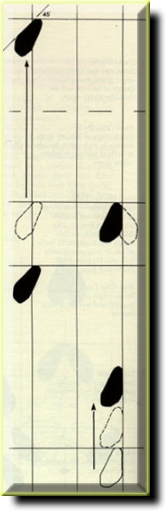
Click the picture if you want to see the larger version Tsuri-ashi-dachi (Stork stance) and Shiko (or sumo) dachi have been left out ; the first because it cannot be shown completely, and the second because we don't really use it.