
The stage figures an exhibition room. Judith and Jeremy are crossing slowly the stage from the right to the left, looking successively at their right and left, just like if they were viewing an exhibition. The Chronicler, a female bi-figurer, is sitting on the floor, in the middle of the place, with a laptop. The lighting is whiter.
[Observer 1 selects two persons among the assistance willing to participate.]
THE CHRONICLER
Jeremy Smart's installation is an adding up vision where each sensitive data is integrated into a well structured system. Everyday life dynamism lives aside the emptiness of set bodies and things, from which reality escapes any definition...
Observer 1 and the guest observers move beside Jeremy's installation.
OBSERVER 1, as he passes beside The Chronicler
Good evening...
THE CHRONICLER
The terrace is a privileged place to measure the daily continuum of the city. Place of acceleration and decelaration, changes and interruptions, but also, place of shared anonymity. The banality of the sculpted work drives our eyes to visit the environment as if a halation was projected on it. The passers by's austerity, with their military march, installs a rhythm in which our thoughts get quickly caught. Before you know, the artwork has disappeared, and facing this artistic anonymity, one can only takes a greater responsibility toward the direct felt effects. The dramatic pretext of the work, also banal, is not enough to calm our anguish and reinforces the impressions that a latent danger weights on us, as much as on the carved characters. It is perhaps their nonchalance, even more than their passivity and their indifference that makes s fear for the worst.
Judith and Jeremy move toward Jeremy's installation.
JEREMY, to The Chronicler
Hi - nice to see you -
THE CHRONICLER
Hey, mister sculptor, good evening. (She stands up to shake Judith's hand.) Madam' -
JUDITH, to The Chronicler, as she standing up
No, no - you don't need - (as The Chronicler stands in front
of her.) Well, Judith Vøøtin.
They shake hands.
THE CHRONICLER
Ho, I know who you are. Good evening.
JUDITH
Good evening.
THE CHRONICLER, to Jeremy
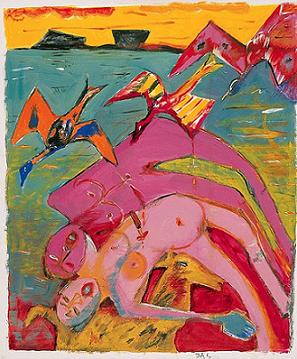
So, how is it going big boy?
JEREMY
Quite well, quite well.
THE CHRONICLER
Long time no see...
JEREMY
I've been really busy lately - and -
THE CHRONICLER
Oh, I know you've been quite productive - I wonder how you
manage to have time to work with all those papers you're
writing.
JEREMY
I like to keep busy.
THE CHRONICLER
What about this one?
JEREMY
Slfppp -
THE CHRONICLER
I know, I know: artists, stand up, create, and shut up.
JEREMY
I guess they are questioning their own self-awareness.
THE CHRONICLER
Nervous, hey?
JEREMY
Nervous, not really - but it is a thrill every time... We're never satisfied - completely -
THE CHRONICLER
I know what you mean - sometimes, I could use more space - you know, to talk about the works an artist did during his youth, or have him questioned about others works - things like that...
JEREMY
Yeah. I guess I'll - would you excuse us?
THE CHRONICLER
Hey! Be my guest -
Jeremy moves toward his installation and the three observers.
Judith follows him.
JEREMY
Fuck me.
JUDITH
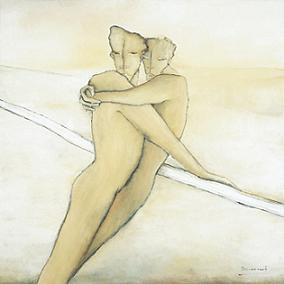
Oh, give it to me, big boy...
JEREMY
Yeah, -(to the three observers:) good evening, lady[ies] and
gentleman[men] -
OBSERVER 1
Good evening, Mr. Smart. My fellows and I were talking about
how the stardom of things became a topic of predilection, some
sort of marker for contemporary artists, - like manufactured
products some years ago - and how a work that reconciles
research, preciseness and the urban beat and its irrationality,
is welcomed in the landscape.
JEREMY
What has become urban life in a context where books are written to argue the very possibility that such things as mountains are unreal? (He pauses.) Is it still relevant to have achievements of productive activities displayed - or "stardomized" -? Those are questions I can't answer - but, knowledge economy relies on the speed of information transmission, and in some ways in the mechanical process of copying images of beings as subjects or objects, alternatively. One can be deluded that there is more chance to emancipate in the copy of the copy, in the mockery of the show, than in the original, since the original - as we see in that boxed urban scene - tends to look trivial, static, without weight... without sense.
OBSERVER 1
We can't help ourselves, but feeling guilty after some time: I am unable to find a point of view from which looking at this installation seems natural, or even comfortable -
JEREMY
There's a possibility to move on that frontier that keeps the being and the appearing, separated - there's such possibility as - to move - on that thin line, keeping the original apart from the copies, the creation, apart from the limitations. If one reduces life to the ability of moving... then...
OBSERVER 1
Those passers - the formality of the suggestion - it leads us to forecast some sort of future - but -
JEREMY
Yes, they are really good - I was introduced to them by Judith - Judith Vøøtin; and they have been trained for weeks by - eh, (to Judith:) what was his name again?
JUDITH
Eh, Morris - Major Morris -
JEREMY
Yeah, that's it - he used to train paratroopers units, in the army - all together they had something like ten sessions of work, with him... There are two groups of them. They are in good shape, aren't they? (to Judith:) you know what?, we should make them rest in the clear... somewhere around here, instead of backstage... so people could see them, and talk to them... touch them!
JUDITH
It wouldn't be that hard to set up -
JEREMY
Yes - it'd be fun to hear, them... what they have to say could
certainly surprises us. I think. It would be interesting to hear
them, and to check them... just like if they were, you know,
survivors - witness... or some sort of "waste"; from a
previous event... (Judith pauses.) Yeah, that's it -
they have witnessed some sort of event, and the event doesn't
need them... Or doesn't want them anymore... (To one of the
guest observer:) That would be funny, hey?
Judith slowly moves away from Jeremy's installation, and
heads for Artist F's installation. The Chronicler stops her work to
friendly nod at Judith, when she passes beside her. During this
time, Jeremy's installation is replaced by Artist F's installation.
THE CHRONICLER
...'athologists, the incapicty to discern relationship between
the signifier and the signified, is a recurrent symptoms among
serial killers. Delusional fantaisies mirror the...
We hear a loud and sudden burst of laugh, and then Jeremy's
voice (OFF): "... I just wanted you to be well advised..." Judith
pauses, turns her head quickly, and continues her way. Artist F is
eating a pizza slice, while painting her installation.
ARTIST F
Hey!
JUDITH
Hi, how you doing?
ARTIST F, she stops eating and moves toward Judith
I'm flying high, you?
JUDITH
I'm good.
ARTIST F
Do you want a slice?
JUDITH
Oh, no. Thank you.
ARTIST F
You two should do something together. I wonder how it would look like.
JUDITH, having a quick look behind her
Yeah... You know what? I wonder too...
Martin gets out of Artist F's installation, and comes toward Judith and Artist F.
ARTIST F
It's Martin, my boyfriend.
JUDITH
Nice to meet you, Martin.
As the lighting fades out, everybody exists the stage save The Chronicler.
THE CHRONICLER
Formalism often urges us to take action. This is the case of that closed universe, calling us of all its lungs to react. There is no symbol of fears or motivations shown, and that total absence of myths related to mankind can only make us wish to be one of those perceived as marginal, as one of those, reacting against stagnation, repetition, and infertile environment.
THE CHRONICLER - So, how is it going big boy?
JUDITH - Oh, give it to me, big boy...
JEREMY - Yeah, that's it - they have witnessed some sort of event, and the event
doesn't need them... Or doesn't want them anymore...