^
Deaths
which occurred on a 28 March:
2005
Yurisman Halawa, 20, and some 2000 persons in and after magnitude 8.7 earthquake
at 23:10 (16:10 UT) with epicenter in the Andaman Sea, 30 km deep at 2º04'N
97º01'E, 245km SW of Medan, Sumatra, Indonesia, and close to the small
Nias Island (SSW of the red star on the map below, and just above the date
1861), which has 700'000 inhabitants (mostly Christians), and whose main
town, Gunungsitoli (1º16'N 97º34'E), 111 km from the epicenter
(30'000 inhabitants), is the worst hit. Many of the deaths occur in the
following days among those trapped under rubble. Thousands more are injured.
Some 20% of the dead are on Simeuluë Island and other Banyak islands
(population 5000), north of Nias and even closer to the epicenter, The main
reason why there are not more casualties is that no significant tsunami
is caused. Also the region affected has been partially depopulated as a
result of the 26 December 2004 magnitude 9.0 earthquake (epicenter at at
3º19'N 95º51'E) and tsunami, which collapsed many buildings which
are therefore no longer a hazard. Today's is the 7th strongest earthquake
in the world since 1900.
2003 Some 60 persons, by a misguided US bomb which,
at 18:00, hits the al-Nasr market in the working-class al-Shoala neighborhood
of Baghdad, Iraq. Some 100 are injured.
2003 Eight persons
in Baath party headquarters in Baghdad, Iraq, bombed by the US.
2003
British Cpl. Matty Hull, in combat in Iraq, possibly shot
from his own side.
2003 Mohammed Ghanem, 24, Palestinian,
shot by Israeli troops in Tul Karm refugee camp, West Bank.
2002::
29 workers as a wall of water floods into a giant dry dock in Dubai.
Dubai DryDocks employs some 3500 workers, most of them Asians, mainly Indians,
Filipinos, Bangladeshis and Sri Lankans and is one of the largest facilities
in the world for ship repairs.
2002 Rachel Gavish and David
Gavish, 50, their son Avraham Gavish, 20, his maternal grandfather Yitzhak
Kanner, 83; and, after midnight, Ahmed Abdel Jawad, a Hamas member,
who had shot them in their home in the Jewish enclave settlement of Elon
Moreh, West Bank, south of Nablus, and is killed by Israeli soldiers.
2001 Palestinian boy, 9, by explosion of unexploded Israeli shell
with which he was playing with three others, who are injured, in Rafah,
Gaza Strip.
2001 Palestinian suicide bomber and 2 Jewish teen-agers
of a group waiting near the Sdeh Hemed kibbutz (close to Qalqiliya) for
an armored bus to their seminary in West Bank settlement of Kedumim, shortly
after 07:30. Two other seminarians are severely injured.
1997
Treinta y nueve componentes de la secta religiosa Higher Source
se suicidan colectivamente al creer que, tras la cola del cometa Hale-Bopp,
viajaba una nave extraterrestre que los recogería.
1996 Kanemaru
Shin, 81, of a stroke stemming from diabetes. Before he was indicted
in 1993 for tax evasion he was Japan's most powerful politician, though
the highest position he held in the Liberal Democratic Party was that of
vice president. His trial was to have begun earlier in March 1996, but it
was suspended because of his poor health.
1994 Eugène
Ionesco, dramaturgo francés de origen rumano.
1985
Marc Chagall, French painter and designer born on 07 July 1887
in Vitebsk, Russia (now Belarus). Distinguished for his surrealistic inventiveness,
he is recognized as one of the most significant painters and graphic artists
of the 20th century. — MORE
ON CHAGALL AT ART “4” MARCH
with links to images.
1985 All 40 passengers and 6 crew members
aboard a Fokker F-8 Fellowship 3000 of Satena airline which had stopped
at San Vicente del Caguán after leaving Bogotá and, in rain
and fog, crashes into a mountain as it attempts to land at Florencia, Colombia.
1969 Dwight David Eisenhower, 78, the 34th US president
(1953-1961), in Washington. He was born on 14 October 1890.
1957
Jack Butler Yeats II, Irish artist born on 29 August 1871. —
MORE
ON YEATS AT ART “4” MARCH with
links to images.
1950 Hellinger,
mathematician.
1944 Rabbi Chayyim Most, Maggid of
Kovono, killed by nazis
1943 Sergei Vasilievich Rachmaninoff
composer, in Beverly Hills, California. — compositor, pianista y director
de orquesta ruso.
1942 Miguel Hernández, poeta español.
1942: 768 Italian soldiers and sailors, in sinking
of liner Galilea, transporting troops from North Africa back to
Italy, by a British sub, near Antipaxo.
^
1941:: 2303 Italian sailors
in sinking of 3 battleships and 2 cruisers.
Andrew Browne Cunningham, Admiral of
the British Fleet, commands the British Royal Navy's destruction of
three major Italian battleships and two destroyers in the Battle of
Cape Matapan in the Mediterranean. The destruction, following on the
attack on the Italian Fleet at Taranto by the British in November
1940, effectively put an end to any threat the Italian navy posed
to the British. Admiral Cunningham was one of Britain's most distinguished
naval officers, having served as Gen. Dwight Eisenhower's naval deputy.
As Commander in Chief Mediterranean, he had a clear-cut goal: to disable
the Italian navy. When the war began, Britain's ships were generally
older than Italy's. By the fall of 1940, with the surrender of the
French to the Germans the previous June, Britain was alone and shaky
in the Mediterranean. Admiral Cunningham knew he had to confront the
Italian navy soon and considered an offensive while the Italian Fleet
was still in harbor the most prudent strategy. On 11 November 1940,
the British aircraft carrier Illustrious was 275 km southeast of the
Italian navy port at Taranto in southern Italy. Twenty-one Swordfish
aircraft took off from the Illustrious and launched a raid against
the Italian Fleet. The Italians lost three battleships, sending a
shockwave through the Italian navy.
The next major engagement between the Royal and Italian fleets was
at Cape Matapan, off Greece's southern tip. On 25 March 1941, British
air reconnaissance picked up increased Italian naval activity off
Greece and Crete, and further intelligence confirmed an Italian plan
to attack a British convoy in the area. Two days later, Admiral Cunningham
put his battle fleet to sea to meet up with Vice-Admiral Pridham-Wippell's
cruiser force. The element of surprise was crucial, given that the
Italian fleet was larger, faster, better armed, and more modern. The
Italian battleship Vittorio Veneto spotted Pridham-Wippell's cruisers
and opened fire. The Italians missed and the Brits got away; the RAF
followed up with an air attack, but this time it was the Vittorio
Veneto that got away. But, on 28 March the British battleship Warspite
proved a better shot, firing five 15-inch shells at the Italian battleship
Fiume, crippling it. Another Italian battleship, the Zara, was hit
broadside by the Brits' Valiant and Barham and suffered a similar
fate. The Pola was also struck by an 18-inch torpedo; it caught fire
and lay dead in the water. Once the crew was taken off, torpedoes
sank it. On top of these crushing losses, two escorting destroyers,
the Alfieri and the Carducci, were also sunk by the Royal Navy. In
total, the Italians lost 2303 men from the five ships. The long-term
effect on the Italian navy was to effectively render it impotent.
|
^
1941 Virginia Woolf
London, author (Jacob's Room, To the Lighthouse).
Virginia
Adeline Woolf was born on 25 January 1882. Her novel To the Lighthouse
(1927) is one of her most successful and accessible experiments in
the stream-of-consciousness style. The three sections of the book
take place between 1910 and 1920 and revolve around various members
of the Ramsay family during visits to their summer residence on the
Isle of Skye in Scotland. A central motif of the novel is the conflict
between the feminine and masculine principles at work in the universe.
With her emotional, poetical frame of mind, Mrs. Ramsay represents
the female principle, while Mr. Ramsay, a self-centered philosopher,
expresses the male principle in his rational point of view. Both are
flawed by their limited perspectives. A painter and friend of the
family, Lily Briscoe, is Woolf's vision of the androgynous artist
who personifies the ideal blending of male and female qualities. Her
successful completion of a painting that she has been working on since
the beginning of the novel is symbolic of this unification.
WOOLF ONLINE: Monday
or Tuesday — Monday
or Tuesday — Night
and Day — Night
and Day — The
Voyage Out — The
Voyage Out. In her writing, Virginia Woolf attempted to reveal
the truth of human experience, emotion, and thought: which are what
the couples in a play (also made into a movie) by Edward Alby try
to cover up when they sing “Who's
afraid of Virginia Woolf?”. |
1940 José María Salaverría, escritor español.
1933
Henri Émilien Rousseau, French artist born on 17 December
1875. — MORE
ON ROUSSEAU AT ART “4” MARCH
with links to images.
1931 Derwent Lees, British
artist born in 1885.
1918 Bernhard Wiegandt, German
artist born on 13 March 1851.
1917 Albert Pinkham Ryder,
US painter born on 19 Mar 1847. — MORE
ON RYDER AT ART “4” MARCH
with links to images.
1917 Joe Nowling, Black, lynched
in Mitchell County, Georgia.
^
1881 (16 March Julian)
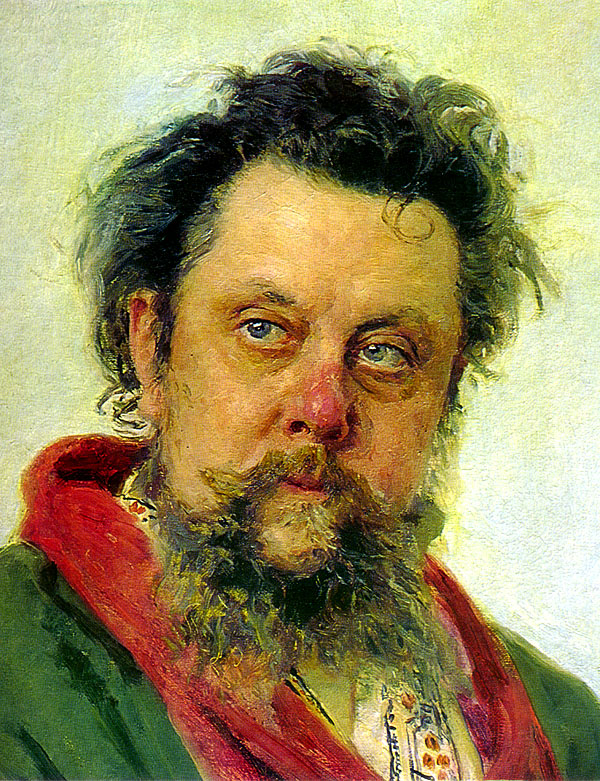
Modest Petrovich Mussorgsky, Russian composer born
on 21 March (09 March Julian) 1839. He is famous for his opera Boris
Godunov (final version first performed 1874), his songs, and
his piano piece Pictures from an Exhibition (1874). Mussorgsky,
along with Aleksandr Borodin [12 Nov 1833 – 27 Feb 1887], Mily
Balakirev [02 Jan 1837 – 29 May 1910], César Cui [18 Jan 1835
– 24 Mar 1918], and Nikolay Rimsky-Korsakov
[18 Mar 1844 – 21 Jun 1908],
was a member of The Five, a group of Russian composers bound together
in the common goal of creating a nationalist school of Russian music.
Mussorgsky was the son of a landowner
but had peasant blood, his father's grandmother having been a serf.
According to his autobiographical sketch, written in 1881, Mussorgsky
learned about Russian fairy tales from his nurse. “This early
familiarity with the spirit of the people, with the way they lived,
lent the first and greatest impetus to my musical improvisations.”
His mother, herself an excellent pianist, gave Modest his first piano
lessons, and at seven he could play some of Franz Liszt's simpler
pieces.
In August 1849 his father
took Modest and his other son, Filaret, to St. Petersburg, where Modest
attended the Peter-Paul School in preparation for a military career.
At the same time, mindful of Modest's musical bent, their father entrusted
the boys to Anton Gerke, future professor of music at the St. Petersburg
Conservatory.
In 1852 Mussorgsky
entered the School for Cadets of the Guard. There, in his first year
he composed his Podpraporshchik (Porte-Enseigne Polka), published
at his father's expense. Although not the most industrious of students,
he gave proof of tremendous curiosity and wide-ranging intellectual
interests.
In 1856, by now a lieutenant,
Mussorgsky joined the Preobrazhensky Guards, one of Russia's most
aristocratic regiments, where he made the acquaintance of several
music-loving officers who were habitués of the Italian theater.
During this same period he came to know Aleksandr Borodin, a fellow
officer who was to become another important Russian composer. Borodin
has provided a very vivid picture of the musician:
There
was something absolutely boyish about Mussorgsky; he looked like a
real second-lieutenant of the picture books … a touch of foppery,
unmistakable but kept well within bounds. His courtesy and good breeding
were exemplary. All the women fell in love with him. … That
same evening we were invited to dine with the head surgeon of the
hospital. … Mussorgsky sat down to the piano and played …
very gently and graciously, with occasional affected movements of
the hands, while his listeners murmured, “charming! delicious!”
During the winter of 1856
a regimental comrade introduced Mussorgsky into the home of the Russian
composer Aleksandr Dargomyzhsky [14 Feb 1813 – 17 Jan 1869].
At one of the musicales there, Mussorgsky discovered the music of
the seminal Russian composer Mikhail Glinka [01 Jun 1804 – 03
Feb 1857], and this quickened his own Russophile inclinations. Three
years later, in June 1859, he saw the Moscow Kremlin for the first
time, an important experience that represented his first “physical”
communion with Russian history. Through Dargomyzhsky, Mussorgsky met
another composer, Mily Balakirev, who became his teacher. Since the
death of their father (in 1853), the Mussorgsky brothers had seen
their poorly administered patrimony decrease substantially. With the
freeing of the serfs in 1861, it vanished. Having decided to devote
himself to music, Modest Mussorgsky had quit the army three years
earlier and since 1863 had been working as a civil servant in the
Ministry of Communications. His distressing financial troubles date
from that time, and he had to seek the help of moneylenders.
 Mussorgsky achieved artistic maturity in 1866 with a series of remarkable
songs about ordinary people such as “Darling Savishna,”
“Hopak,” and “The Seminarian,” and an even
larger series appeared the following year. Another work dating from
this time is the symphonic poem Ivanova noch na Lysoy gore
(1867; Night on Bald Mountain). In 1868 he reached the height of his
conceptual powers in composition with the first song of his incomparable
cycle Detskaya (The Nursery) and a setting of the first few
scenes of Nikolay Gogol's Zhenitba (The Marriage).
Mussorgsky achieved artistic maturity in 1866 with a series of remarkable
songs about ordinary people such as “Darling Savishna,”
“Hopak,” and “The Seminarian,” and an even
larger series appeared the following year. Another work dating from
this time is the symphonic poem Ivanova noch na Lysoy gore
(1867; Night on Bald Mountain). In 1868 he reached the height of his
conceptual powers in composition with the first song of his incomparable
cycle Detskaya (The Nursery) and a setting of the first few
scenes of Nikolay Gogol's Zhenitba (The Marriage).
In 1869 he began his great work Boris Godunov to his own
libretto based on the drama by Aleksandr Pushkin [06 Jun 1799 –
10 Feb 1837]. The first version, completed in December 1869, was rejected
by the advisory committee of the imperial theatres because it lacked
a prima donna role. In response, the composer subjected the opera
to a thorough revision and in 1872 put the finishing touches to the
second version, adding the roles of Marina and Rangoni as well as
several new episodes. The first production of Boris Godunov
took place on 08 February 1874, at St. Petersburg and was a success.
In 1865, after the death of his mother,
he lived with his brother, then shared a small flat with the Russian
composer Nikolay Rimsky-Korsakov until 1872, when his colleague married.
Left very much alone, Mussorgsky began to drink to excess, although
the composition of the opera Khovanshchina perhaps offered
some distraction (left unfinished at his death, this opera was completed
by Rimsky-Korsakov). Mussorgsky then found a companion in the person
of a distant relative, Arseny Golenishchev-Kutuzov. This impoverished
25-year-old poet inspired Mussorgsky's two cycles of melancholy melodies,
Bez solntsa (Sunless) and Pesni i plyaski smerti
(Songs and Dances of Death). At that time Mussorgsky was haunted by
the specter of death, he himself had only seven more years to live.
The death of another friend, the painter Victor Hartmann [1834-1873],
inspired Mussorgsky to write the piano suite Kartinki s vystavki
(Pictures from an Exhibition; orchestrated in 1922 by the French composer
Maurice Ravel [07 Mar 1875 –
28 Dec 1937]). One of the ten pictures is The
Great Gate of Kiev.
The
last few years of Mussorgsky's life were dominated by his alcoholism
and by a solitude made all the more painful by Golenishchev-Kutuzov's
marriage. Nonetheless, the composer began his opera Sorochinskaya yarmarka
(unfinished; Sorochintsy Fair), inspired by Gogol's tale. As the accompanist
of an aging singer, Darya Leonova, Mussorgsky departed on a lengthy
concert tour of southern Russia and the Crimea. On his return he tried
teaching at a small school of music in St. Petersburg.
Nonetheless, the composer began his opera Sorochinskaya yarmarka
(unfinished; Sorochintsy Fair), inspired by Gogol's tale. As the accompanist
of an aging singer, Darya Leonova, Mussorgsky departed on a lengthy
concert tour of southern Russia and the Crimea. On his return he tried
teaching at a small school of music in St. Petersburg.
On 24 February 1881, three successive attacks of alcoholic epilepsy
laid him low. His friends took him to a hospital where for a time
his health improved sufficiently for one of the leading Russian artists
of the day, Ilya
Repin [05 Aug 1844 – 29 Sep 1930], to paint a famous Portrait
of Mussorgsky (574x480, 49kb _ detail
781x600pix, 264kb). (Mussorgsky did NOT compose the music for Rudolph
the Red-Nosed Reindeer}. Mussorgsky's health was irreparably
damaged, however, and he died within a month, shortly after his 42nd
birthday.
Mussorgsky's importance
to and influence on later composers are quite out of proportion to
his relatively small output. Few composers were less derivative, or
evolved so original and bold a style. The 65 songs he composed, many
to his own texts, describe scenes of Russian life with great vividness
and insight and realistically reproduce the inflections of the spoken
Russian language.  Mussorgsky's
operas Boris Godunov and to a lesser extent Khovanshchina
display his dramatic technique of setting sharply characterized individuals
against the background of country and people. His power of musical
portrayal, his strong characterizations, and the importance he assigned
to the role of the chorus establish Boris Godunov as a masterpiece.
From a technical standpoint, Mussorgsky's unorthodox use of tonality
and harmony and his method of fusing arioso and recitative provide
Boris Godunov with great dramatic intensity. Mussorgsky's
operas Boris Godunov and to a lesser extent Khovanshchina
display his dramatic technique of setting sharply characterized individuals
against the background of country and people. His power of musical
portrayal, his strong characterizations, and the importance he assigned
to the role of the chorus establish Boris Godunov as a masterpiece.
From a technical standpoint, Mussorgsky's unorthodox use of tonality
and harmony and his method of fusing arioso and recitative provide
Boris Godunov with great dramatic intensity.
Shortly after Mussorgsky's death, Rimsky-Korsakov prepared Mussorgsky's
works for publication, in the process purging them of what he considered
to be their harmonic eccentricities and instrumental weaknesses. Rimsky-Korsakov's
widely performed edition of Boris Godunov is the best known
of these works. From roughly 1908, however, after the production of
Rimsky-Korsakov's version of Boris Godunov at the Paris Opera,
there was a growing demand for the original versions of Mussorgsky's
works, which were made available beginning in 1928 in a collected
edition edited by Paul Lamm. This edition displayed Mussorgsky's original
orchestration for Boris Godunov, which is as stark and economical
as his unorthodox harmony. |
1850 Holmboe,
mathematician.
1840 Lhuilier,
mathematician.
1839 Pieter Gerardus van Os, Dutch
artist born on 08 October 1776. — more
with links to images.
1712 Jan van der Heyden (or
Hyde) [not Jekyll at times?], Dutch painter born in 1637. —
MORE
ON VAN DER HEYDEN AT ART “4” MARCH
with links to images.
1678 Dechales,
mathematician.
1673 (burial) Adam Pynacker, Dutch painter
and merchant born on 15 February 1622. — more
1584 (18 March Julian) Ivan IV Vasilyevich
“Grozniy” (“The
Terrible”), born on 25 August 1530, Grand Prince of Moscow
from the death of his father Grand Prince Vasily III [1479 – 03 Dec
1533], and first tsar of Russia from 16 January 1547 until his death. His
politics led to territorial expansion of Russia, consolidation of the central
power, structural reorganization of the institutions of power; increasing
of political and trade relations with England, and Netherlands in Europe,
with Kabarda, and Kakhetya in the Caucasus, Bukhara in the East. At the
same time the strengthening and toughening of the serfdom led to future
economical failure of Russia. He was a quick-tempered, irascible person,
very hard to deal with. On 16 November 1581, Ivan IV walked into the apartment
of his son Ivan Ivanovich [1554–], the tsarevich, and started criticizing
Ivan's seven month pregnant wife about her dress. Ivan the Terrible was
so enraged by her unacceptabe dress, that he started to hit her and kick
her, resulting in the death of her unborn child. His son heard her screaming
and ran in. He tried to stop his father. Ivan the Terrible was so furious
that he took his staff and struck his son in the temple, killing him. Ivan
the Terrible was then horrified by what he had just done. — See the
painting Ivan
the Terrible and His Son Ivan on 16 November 1581 (1885) by Ilya
Repin.
0193 Roman Emperor Publius Helvius Pertinax,
assassinated by a small group of Praetorian Guards, after he tried to enforce
unpopular economies in military as well as in civilian expenditures. The
Guards auction off the imperial title to Marcus Didius Julianus. Born on
01 August 126, son of a freed slave, Pertinax taught school, then entered
the army, commanded units in Syria, in Britain, and on the Danube and the
Rhine. He earned distinction during the great invasion by German tribes
in 169. Given senatorial rank and command of a legion, he was soon promoted
to the consular commands of Moesia, Dacia, and Syria, but under the emperor
Commodus (reigned 180–192) he fell from favor, together with the future
emperor Lucius Septimius Severus [146 – Feb 211], during the ascendancy
of the praetorian prefect Perennis. In the last years of Commodus' life,
Pertinax became prefect of the city of Rome, while Severus commanded the
armies of the upper Danube. After Commodus [31 Aug 161 – 31 Dec 192]
was murdered, the Senate met before dawn on 01 January and proclaimed Pertinax
(then senior marshal of the empire) emperor. After Severus was proclaimed
emperor by his troops on 13 April 193, he declared himself the avenger of
Pertinax, marched on Rome, and entered it without resistance a few days
after Julianus was assassinated on 01 June 193. Later in the year, he decreed
divine honors for Pertinax and added his name to his own, becoming Lucius
Septimius Severus Pertinax.
|
 On
a 28 March:
On
a 28 March:


 Soviet novelist, playwright, and essayist, who was a founder of socialist
realism. Although known principally as a writer, he was also prominent
in the Russian revolutionary movement. Gorky was born in Nizhniy Novgorod
(renamed Gorky in his honor from 1932 to 1991), into a peasant family.
He was self-educated. Compelled to earn his own living from the age
of nine, Gorky worked for many years at menial jobs and tramped over
a great part of European Russia. During this time he shot himself
through a lung in an attempted suicide, later developing tuberculosis,
which left him in ill health for the rest of his life. Bitter experiences,
thence his pen name (gor'kiy = bitter).
Soviet novelist, playwright, and essayist, who was a founder of socialist
realism. Although known principally as a writer, he was also prominent
in the Russian revolutionary movement. Gorky was born in Nizhniy Novgorod
(renamed Gorky in his honor from 1932 to 1991), into a peasant family.
He was self-educated. Compelled to earn his own living from the age
of nine, Gorky worked for many years at menial jobs and tramped over
a great part of European Russia. During this time he shot himself
through a lung in an attempted suicide, later developing tuberculosis,
which left him in ill health for the rest of his life. Bitter experiences,
thence his pen name (gor'kiy = bitter). 
