search 8100 artists, their works, museums, movements, countries, time periods, media, specializations
<<< ART 23 Mar
ANY DAY ...IN ART ...IN HISTORY ||| HISTORY “4” MAR 24 ||| ALTERNATE SITES
ART 25 Mar >>>
ART “4” “2”-DAY  24 March v.5.20
NOW
DEBT
abspic
4~2day
DEATHS: 1888 FRÈRE — 1476 VIVARINI
BIRTHS: 1767 AGASSE — 1862 BENSON
^ Born on 24 March 1767: Jacques~Laurent Agasse, in London, Swiss English painter specialized in animals, who died on 27 December 1849. — {Agasse a dû se rendre compte qu'un animal qu'on agace ne fait pas un bon sujet pour un tableau}
— Born into a wealthy and politically influential Huguenot family, Agasse spent his early childhood at the country estate of Crévin, where he may have developed the interest in animals and natural history that was to guide his later career as an artist in England. Agasse was trained first at the École du Colibri in his native Geneva and subsequently in Paris under Jacques-Louis David (beginning in 1787) and possibly under Horace Vernet. His early artistic output consisted chiefly of unpretentious silhouette ‘cut-outs’ in the style of Jean-Daniel Huber. At this time he also undertook a serious study of dissection and veterinary science.

LINKS
The Nubian Giraffe (1827)
White Horse in Pasture (1807)
The Last Stage on the Portsmouth Road (1815)
Landing at Westminster Bridge (1818)
The Flower Seller (1822)
The Playground (1830)
Stallinneres (23x28cm)
Lord Rivers's Groom Leading a Chestnut Hunter towards a Coursing Party in Hampshire (1807, 66x62rm)
5 images at Bildindex
^ Died on 24 March 1888: Charles-Théodore Frère “ frère Bey”, French painter specialized in Orientalism, born on 21 June 1814. He was the brother of Pierre Édouard Frère [10 Jan 1819 – 20 May 1886]. — {Ce dernier aurait dû devenir moine: il aurait été le Frère Frère frère de Frère ...}
— Frère began his career painting the French countryside, but during a stay in Algeria in 1837 he was attracted to the Islamic world and from that time on he exhibited only oriental scenes and landscapes, and views of Eastern cities and interiors. In 1861 he made his final visit to the eastern Mediterranean, traveling in the party of the Empress Eugénie [05 May 1826 – 11 Jul 1920].

LINKS
A View of Beni Souef, Egypt (46x38cm)
Interior of a Moorish Café (21x39cm)
Jerusalem from the Environs (1881, 75x111cm) _ This may be a work that Frère exhibited at the Salon of 1881, View of Jerusalem from the Valley of the Jehoshaphat. It was undoubtedly painted from an earlier study or a photograph. The meticulous style, like that of Gérôme [11 May 1824 – 10 Jan 1904], was based on the technique and paint handling of Ingres [29 Aug 1780 – 14 Jan 1867] and his students.
Les Chameliers Buvant le Thé (1855, 65x55cm)
A Market Place, Cairo (62x40cm)
Along The Nile (97x130cm)
An Arab Encampment (74x92cm)
Halte à L'Oasis (44x72cm)
The Souk (46x31cm)
A Street In Damascus (35x26cm)
A Street In Cairo
Sunset On The Nile (46x65cm)
^ Born on 24 March 1862: Frank Weston Benson, Salem, Massachusetts, Impressionist painter, etcher, and teacher, who died on 15 November 1951.
— He attended the School of the Museum of Fine Arts, Boston, from 1880 to 1883 as a student of Otto Grundmann [1844–1890] and Frederick Crowninshield [1845–1918]. In 1883 he travelled with his fellow student and lifelong friend Edmund C. Tarbell to Paris, where they both studied at the Académie Julian for three years with Gustave Boulanger and Jules Lefebvre. Benson went with Tarbell to Italy in 1884 and to Italy, Belgium, Germany and Brittany the following year. When he returned home, Benson became an instructor at the Portland, Maine, School of Art, and after his marriage to Ellen Perry Peirson in 1888 he settled in Salem, MA. Benson taught with Tarbell at the Museum School in Boston from 1889 until their resignation over policy differences in 1913. Benson rejoined the staff the next year and taught intermittently as a visiting instructor until 1930.
— Benson was a painter of impressionist seascapes and landscapes, often with figures posed by his wife and children and also numerous hunting scenes. He spent most of his life in the seaport town of Salem and loved trekking through the countryside for his subject matter, especially wildlife. He is credited with making the US sporting print a distinct art form and for being one of the outstanding 20th-century wildlife printmakers. He was a teacher in Portland, Maine at The Society of Art, and in Boston at The Museum of Fine Arts, where he and his good friend Edmund Tarbell established it as a top-notch institution. He studied art in Boston at the Museum School of Fine Arts and in 1883 in Paris with Boulanger and Lefebvre at the Academie Julian during the French Impressionism movement. By the early 1900s, he had a very successful career and was a member of the Ten American Painters, a prestigious group of early impressionists. He was a life-long hunter, and it was said that he knew birds as only a sportsman can. He worked in both etching and drypoint and was lauded for his clear design, the naturalness of his birds and hunters, and the mastery of etching techniques. In 1900, Benson discovered the pleasures of North Haven Island off the coast of Maine, and from that time, he and his family spent every there, even purchasing a farm where he had a studio. There his style became increasingly impressionistic. Midway through his career as a recognized oil painter, he began to paint with watercolors, perhaps inspired by Winslow Homer's use of that medium to show hunting scenes in the Adirondacks. In 1921, Benson became a serious watercolorist while on a fishing expedition to the Gaspé Peninsula of Quebec, and from that time until his death in 1951, he created nearly six hundred watercolors.

LINKS
Eleanor Holding a Shell (76x63cm; _ ZOOM by clicking on “VIEW high-resolution image in browser”)
Indian Guide (1927, 81x102cm)
The Punter (1926, 37x47cm)
Two Duck Hunters (1926, 66x51cm)
The Sisters (1899, 83kb)
Mrs. Benjamin Thaw and her Son (1900, 60kb)
Lady Trying On a Hat (1904, 78kb)
Sunlight (1909, 72kb)
Girl Playing Solitaire (1909)
20 prints at FAMSF
^ Died on 24 March 1476 (at the earliest): Antonio Vivarini da Murano, Italian painter born in 1415. His date of death is uncertain and may have been any between 24 March 1476 and 24 April 1484. Antonio Vivarini became prominent in Venetian painting about 1440, producing many joint works with his brother-in-law Giovanni d’Alemagna [–1450]. Antonio also often collaborated with his younger brother Bartolomeo Vivarini [–>1500], and the family dynasty remained important until the death of Antonio’s son, Alvise Luigi Vivarini [1450-1505].
— Vivarini, family of Venetian painters of the mid- and late 15th century, descended from a family of glassworkers active in Murano. Their work represents a transition from the traditional stylized Gothic- and Byzantine-inspired school to the more realistic Renaissance-influenced manner of the 1500s. The brothers Antonio Vivarini and Bartolomeo Vivarini (birth date 1432 is fake) collaborated on religious polyptychs with linear, often stiff figures and vertical architectural backgrounds, all enclosed in ornate gilded frames. Alvise Vivarini was the son of Antonio. Because of the collective nature of much Vivarini workshop activity, connoisseurs have remained unusually confused about Antonio’s work, and attributions, particularly as regards his late work, are often misleading. After Giovanni d’Alemagna’s death, Antonio probably continued to produce independent works but also collaborated with Bartolomeo; from about 1460 he ran the workshop alone.
— Antonio Vivarini's students included Carlo Crivelli.

LINKS
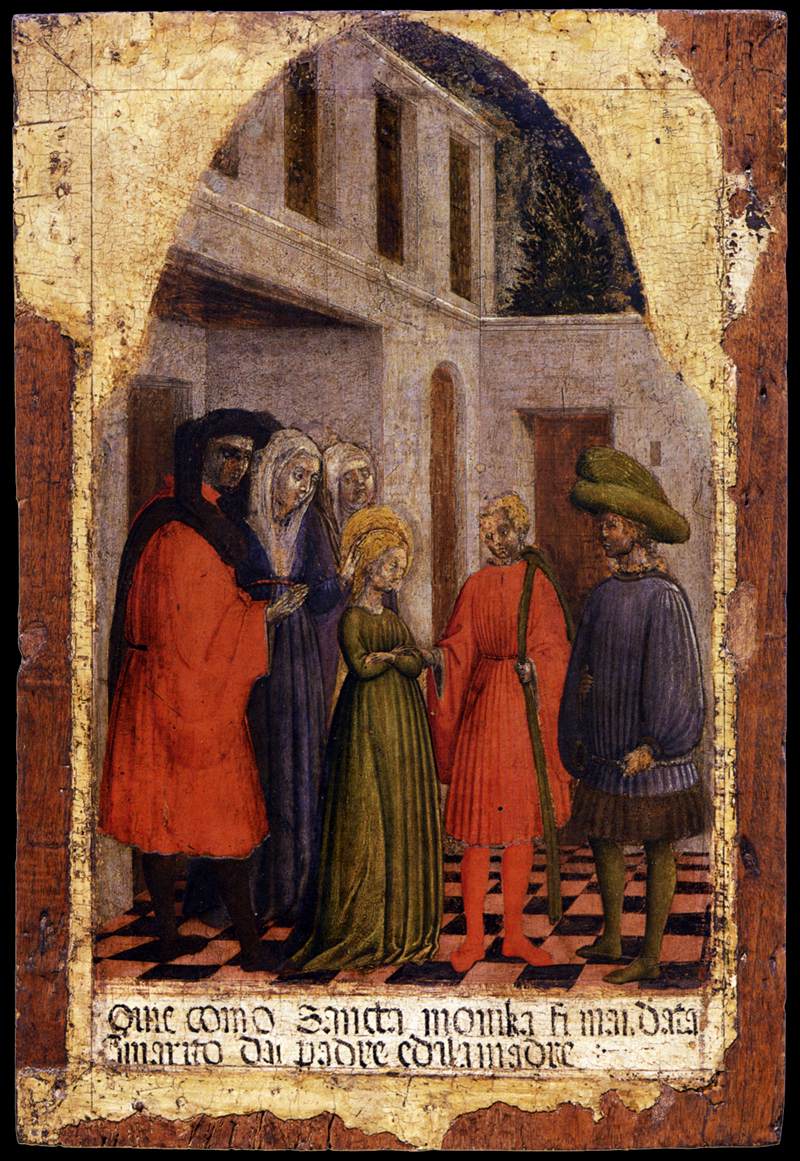
Marriage of St. Monica (1441, 46x31cm) _ This small panel, together with others which have recently been identified, made up an altar-piece dedicated to St. Monica in the Church of S. Stefano in Venice. The domestic scene is set in the courtyard of a bourgeois household and embodies Antonio Vivarini's timid attempts at rendering spacial perspective. It demonstrates too the extent to which his world, suspended between the new and the old, acknowledged the importance of Renaissance rules. In contrast with the uncertain definition of the architecture in terms of perspective, the details of costume and the physical and spiritual gestures of the characters are carefully recorded.
Triptych (1446, 339x200cm central, 339x138cm each side) _ In this grandiose triptych Antonio Vivarini, helped by his brother-in-law Giovanni d'Alemagna (active 1441-1450), achieved a highpoint of balance between the International Gothic tradition now in decline, and the rising Renaissance. A natural light lends tenderness to the holy figures. The Virgin, however, sits rigid like a Byzantine empress on a Gothic throne, surrounded by Masolinoesque angels who are holding the poles of the high canopy almost as if it were a game. The saints Gregory and Jerome on the left and Ambrose and Augustine on the right, stand immobile in their heavy ecclesiastical garments shining with gold and color. The holy scene appears constrained by the marble walls with their Gothic fretwork, set in a perspective as improbable as it is ostentatious. The sumptuous static scene is a final dazzling reminder of a fairy-tale world. _ detail _ The picture representing Saints Gregory and Jerome is the left canvas of the triptych _ detail 2 _ The picture representing the Enthroned Virgin and Child is the central canvas of the triptych. _ detail 3 _ The picture representing Saints Ambrose and Augustine is the right canvas the triptych.
Virgin and Child (1441, 56x41cm) _ While at Padua and even in Venice itself some of the main figures of the new art of Tuscany were working to the laws of perspective and in the conviction of the conscious dignity of man as an individual, Venetian painting reacted to the promptings of the new culture almost with reluctance, filtering them through a vision which in substance was still Gothic. This is the context of the work of Antonio Vivarini and Jacopo Bellini [1400-1470], both founders of dynasties of artists, and both crucial figures in the period of transition in Venice from the first to the second half of the fifteenth century. This Madonna and Child belongs to Antonio Vivarini's earliest period and is characterized by a certain plasticity of shape and form arising out of the gentle throbbing of the chiaroscuro and the luminous timbre of the color.

Died on a 24 March:

^ 1921 Marcus C. Stone, London English painter born on 04 July 1840. He was trained by his father Frank Stone [22 Aug 1800 – 18 Nov 1859] and inherited from him the patronage and friendship of Charles Dickens [07 Feb 1812 – 09 Jun 1870], who invited him to illustrate Our Mutual Friend (1865). Stone’s naturalistic style transferred awkwardly to engraving, and he did not have the impact of his distinguished predecessors. He also illustrated for Cornhill Magazine, but found working on a small scale restrictive, so, disillusioned by the tepid response of Anthony Trollope [24 Apr 1815 – 06 Dec 1882] to his designs for He Knew He Was Right (1869), he gradually abandoned illustration for a successful career as a painter. His early paintings include such subjects from military history as On the Road from Waterloo (1863). He later specialized in themes of romantic tribulation; such pictures as In Love (1888) and Il y en a toujours un autre were widely known through engravings. He was among the first of several Victorian artists to commission a house from Richard Norman Shaw [07 May 1831 – 17 Nov 1912] in Melbury Road (no. 8; 1875–1876), London.— LINKSTwo's Company, Three's None _ Two's Company, Three's None

^ 1859 James Stark, English painter born on 19 November 1794. His father, Michael Stark, was a Scottish dyer who had settled in Norwich. James Stark first exhibited in Norwich in 1809 and in London in 1811. In 1811 he became articled to John Crome before moving to London in 1814; there he met William Collins, who became a friend and influenced his work. His first success came when the Dean of Windsor, the Hon. Edward Legge, bought his picture The Bathing Place, Morning (1815). Later patrons included the Marquess of Stafford, George Granville Leveson-Gower [1758–1833] and Sir George Beaumont and the Academicians Thomas Phillips and Sir Francis Chantrey. Stark enrolled as a student at the Royal Academy Schools in 1817 but returned to Norwich due to ill-health in 1819. In 1821 he married Elizabeth Younge Dinmore of King’s Lynn, and they moved to London in 1830. His wife died three years after the birth of their son, Arthur James Stark [1831–1902], who also became a painter, assisting his father during the 1850s. — Woody Landscape (52x81cm) — A Hillside Covered with Gorse-Scrub (41x50cm)

^ 1825 Jean Frédéric Schall (or Challe), French artist born on 14 March 1752. — {Shall Schall ever have his work shown on the internet? I can find no examples of it now.] — He studied at the École Publique de Dessin in Strasbourg c. 1768 and in 1772 was admitted to the Académie Royale in Paris, where he was a pupil of Nicolas-Bernard Lépicié between 1776 and 1779. He did not become a member of the Académie and so could not exhibit at the Salon until the French Revolution. He worked for private patrons, producing erotic and pastoral subjects in a style influenced by François Boucher, Jean-Honoré Fragonard and Pierre-Antoine Baudouin; many of these pictures achieved popularity in the form of engravings. His most distinctive paintings are single figures of dancers and young ladies in soft, picturesque landscape settings (e.g. A Dancer). In 1794 he painted the Heroism of William Tell but this politically engaged subject was exceptional in his output. Although he continued to paint erotic scenes such as the Peeping Toms, his later paintings have a delicate, evocative character that suggests the influence of Pierre-Paul Prud’hon. The moralizing theme and detailed finish of the False Appearance, which was awarded a prize in the Salon of 1798, demonstrate Schall’s ability to adapt both style and content to changing tastes. He also illustrated narrative scenes from historical and literary sources, from which series of prints were made, notably by Charles-Melchior Descourtis. Despite the variety of styles in which he worked, Schall is chiefly of interest as a belated exponent of the Rococo whose work became a major source for the Rococo Revival at the time of his death.


Born on a 24 March:


1622 Osias Beert II (or Beet II), Antwerp Flemish painter who became a master in 1645 and died in 1678. He was the son of Osias Beert the Elder [1575-1624]

<<< ART 23 Mar
ANY DAY ...IN ART ...IN HISTORY ||| HISTORY “4” MAR 24 ||| ALTERNATE SITES
ART 25 Mar >>>
TO THE TOP
PLEASE CLICK HERE TO WRITE TO ART “4” MARCH
http://www.safran-arts.com/42day/art/art4mar/art0324.html
http://www.intergate.com/~canu/art/art4mar/art0324.html
http://www.geocities.com/quermaz/art/art4mar/art0324.html
updated Wednesday 16-Mar-2005 22:45 UT
Previous update Saturday 20-Mar-2004 18:48 UT
safe site site safe for children safe site
Hosted by www.Geocities.ws

1