search 8100 artists, their works, museums, movements, countries, time periods, media, specializations
<<< ART 06 Mar
ANY DAY ...IN ART ...IN HISTORY ||| HISTORY “4” MAR 07 ||| ALTERNATE SITES
ART 08 Mar >>>
ART “4” “2”-DAY  07 March v.4.61
DAY
GONE
abspic
4~2day
DEATHS: 1931 KÜPPER — 1826 VAN STRY — 1957 LEWIS
BIRTHS: 1744 or 1752 DEMARNE — 1802 LANDSEER — 1872 MONDRIAN
2002: MAASTRICHT ART FAIR
^ Died on 07 March 1931: Christiaan Emil Maria Küpper “Theo Van Doesburg” or “J.K. Bonset”, Dutch Neoplasticist painter, decorator, poet, and art theorist, a leader of the de Stijl movement, born on 30 August 1883.
— Originally he intended to follow a career in the theater, but he turned to painting about 1900 and worked in Post-Impressionist and Fauvist styles until 1916, when he began to paint geometric abstractions of subjects from nature. In 1917 he was instrumental in founding the de Stijl group and founded the avant-garde art review De Stijl (a publication that was continued until 1931). His advocacy of de Stijl's geometric style influenced the modernist architects Le Corbusier, Walter Gropius, and Ludwig Mies van der Rohe. From 1921 to 1923, when he taught at the Weimar Bauhaus, Doesburg's painting style was much influenced by the aesthetic of neoplasticism of Piet Mondrian [07 Mar 1872 – 01 Feb 1944]. Using the alias J.K. Bonset, he exhibited as a Dadaist in Holland in 1923 and published another art review, Mechano. In 1926 he wrote his manifesto “De Stijl,” explaining his theory of elementarism, an aesthetic concept based on the use of inclined planes in geometric abstract paintings to increase the dynamic effect of the composition.
— In 1883 werd op 3 augustus Christian Emil Maria Küpper in Utrecht geboren. Kort na zijn geboorte verliet vader Wilhelm Küpper het gezin en vertrok naar zijn geboortestad Keulen, waar hij in 1893 overleed. Christiaan groeide op bij zijn moeder en pleegvader. Theodorus Doesburg was al jaren een vriend van de familie en vermoedelijk ook de natuurlijke vader van Cristian Emil Maria. Waarschijnlijk om deze reden wijzigde Christian op latere leeftijd zijn naam met als toevoeging het woordje "Van" als mogelijke verwijzing naar zijn afkomst. Luisterend naar de naam Theo van Doesburg bezocht hij na het lager en voortgezet onderwijs voor een korte tijd de toneelschool. Toen hij daarna de ambitie koesterde om schilder en schrijver te worden, waren zijn ouders niet erg enthousiast. Dit was voor Theo de aanleiding om op 18-jarige leeftijd het ouderlijk huis te verlaten.
      Naast de naam Theo van Doesburg gebruikte hij nog twee pseudoniemen. I.K. Bonset was waarschijnlijk een anagram van de stelling "Ik ben sot", welk pseudoniem hij gebruikte als ondertekening van zijn Dadaïstische gedichten en activiteiten. En het pseudoniem Aldo Camini gebruikte Van Doesburg ter ondertekening van zijn anti-filosofische activiteiten als criticus. Na de mobilisatie verbleef Van Doesburg van februari tot december 1916 bij zijn moeder in Haarlem waarna hij zich in Leiden vestigde.
— A Dutch artist and architect. Theo van Doesburg founded De Stijl magazine in 1917. The magazine gave its name to a group of artists and architects which included Mondrian, Huszar and Vantongerloo, Oud and Rietveld. The style was abstract. Forms were generalized from natural shapes and forms. Primary colors were used. Theo van Doesburg influenced the Bauhaus.

LINKS
Composition XI (1918) — Composition XXII (1922)
Countercomposition (1924) — Simultaneous Countercomposition (1929)
Composition in Gray (Rag-time) (1919, 96x59cm)
— (Contra-Compositie XIII) (1926, 50x50cm) _ About 1924 Theo van Doesburg rebelled against Piet Mondrian’s programmatic insistence on the restriction of line to vertical and horizontal orientations, and produced his first Counter-Composition. The direction consequently taken by Neo-Plasticism was designated “Elementarism” by van Doesburg, who described its method of construction as “based on the neutralization of positive and negative directions by the diagonal and, as far as color is concerned, by the dissonant. Equilibrated relations are not an ultimate result.”1 Mondrian considered this redefinition of Neo-Plasticism heretical; he was soon to resign from the De Stijl [more] group. This canvas upholds the Neo-Plastic dictum of “peripheric” composition. The focus is decentralized and there are no empty, inactive areas. The geometric planes are emphasized equally, related by contrasts of color, scale, and direction. One’s eyes follow the trajectories of isosceles triangles and stray beyond the canvas to complete mentally the larger triangles sliced off by its edges. The placement of the vertical axis to the left of center and the barely off-square proportions of the support create a sense of shifting balance.
^ Born on 07 March 1752: Jean-Louis Demarne (or de Marne), French painter who died on 24 January (24 March?) 1829. He is born on in Brussels where he will be baptized on 22 January 1754.
— He went to Paris at the age of 12 after the death of his father, who had been in Brussels as an officer in the service of the Emperor of Austria. Having spent eight years studying history painting under Gabriel Briard [1729–1777], he entered the Prix de Rome competition in 1772 and 1774 but failed to win. Thereafter he concentrated on landscape and genre painting, in which he was greatly influenced by such 17th-century Dutch masters as Aelbert Cuyp, the van Ostade brothers, Adriaen van de Velde, and Karel Dujardin, all artists enjoying a tremendous vogue and high prices in Paris at that time. Demarne was made an associate (agréé) of the Académie Royale in 1783 but did not become a full member. He seems to have cared little for official honors and later, in 1815, was unwilling to seek membership of the Institut de France. He was, however, awarded the Légion d’honneur at the Salon of 1828.
— In 1764 he came to Paris where he studied at the Académie 1769-1777 under the history painter G. Briard. He first visited Switzerland and the Dauphiné in 1776 with N.-A. Taunay, and the sight of Karel Dujardin's works in the Randon de Boisset collection (sold in 1777) confirmed his inclination to paint picturesque scenes rather than history pieces. In 1779 he exhibited a landscape 'dans le goût de Karle Du Jardin' at the exposition de la jeunesse. He was agréé in 1783 (Paysage avec animaux) and showed regularly at the Salon 1789-1827. His work, which also included village fairs and guard-room scenes, was profoundly influenced by seventeenth-century Dutch masters, such as Wouwerman, Potter, Palamedesz, and Lingelbach. He never signed or dated his pictures and the titles of his exhibited works are repetitive. In 1806 he was commissioned to paint Napoléon et Pie VII à Fontainebleau (landscape by A. Dunouy). He worked for the Sèvres porcelain factory 1809-1813 and made a number of landscape and figure etchings. He died at Batignolles, near Paris, on 24 January 1829.
— Jean-Michel Diébolt [1779–], Jules Dupré, and Auguste Forbin were students of Demarne.

Landscape with Gothic Monument (443x600pix, 84kb)
Foire à l'Entrée d'un Village (36x50cm) — Une Route (1814, 50x61cm)
Entrevue de Napoléon et du Pape Pie VII dans la forêt de Fontainebleau, le 25 novembre 1804 (1808, 180x219cm)
Women and Soldiers Revelling (1787, 49x57cm) — The Elixir (49x60cm)
^ Died on 07 March 1826: Abraham van Stry I, Dutch painter of oils and watercolors, born on 31 December 1753.
— Abraham van Stry was born in Dordrecht. A versaitile painter, van Stry first made still life scenes of flowers and fruit. Later, obliged to assist his father, Leendert van Stry, he began to make history paintings and landscapes. Van Stry painted interiors and genre scenes in the style of Gabriel Metsu and Pieter de Hooch, and his landscapes reveal a close study of Cuyp. Van Stry also painted illusionistic grisaille imitations of marble reliefs, a popular decor in the Netherlands since the Renaissance. These were known as "witjes" ("wit" or white) after Jacob de Wit [1695-1754], who gained international renown in this style. In 1774 Abraham van Stry founded the society "Pictura" of Dordrecht. Beginning in 1818 he was a member of the Antwerp Academy. His works earned several prizes in Paris and London.

Young Sweethearts (36x46cm) _ This is a genre scene of the type popular in eighteenth-century Holland. Middle-class patrons delighted in their status and possessions, and enjoyed painted representations of this kind.
^ Born on 07 March 1802: Sir Edwin Henry Landseer, English painter specialized in animals [why not landscapes? He wasn't named Beastseer after all.]. He died on 01 October 1873.
—  Edwin Henry Landseer was the son of engraver John Landseer [1769-1852]. Trained by his father to sketch animals from life, he began exhibiting at the Royal Academy when only 13; the same year (1815) he received a silver medal from the Society of Arts for his drawing of a hunter. Success came easily and early. By the age of 16 he was a constant and active exhibitor at the RA, already patronized by leading collectors and talked about as a rising star. His election as an Associate of the RA in 1826, when he was only 24, surprised no one but himself.
       In 1824, Landseer went to Scotland for the first time to visit Sir Walter Scott. He fell in love with the Highlands, and since then every year he used to return there for inspiration, drawing, hunting, and rest. Landseer's romantic vision of border history is reflected in his work, inspired by Scott, The Hunting of Chevy Chase (1826). Landseer was elected a full Academician in 1931; the decade that followed was the most successful and the most creative of his entire career.
       Major works, such as Hawking (1832), Scene in the Olden Time at Bolton Abbey (1834) won him critical acclaim, but it was often his smaller pictures of dogs such as The Old Shepherd's Chief Mourner (1837) and Dignity and Impudence (1839) that captured the popular imagination. Most of Landseer's pictures were well known from excellent engravings of them by his elder brother Thomas (1796-1800). The publication of numerous prints won him a vast and devoted popular audience.
       The strain of keeping up his career, of satisfying his patrons, and of maintaining his social position cost Landseer more effort than he cared to admit. In May 1840, at the height of his powers and reputation, he suffered a severe nervous breakdown. In the face of all his personal and professional problems, Landseer continued to paint pictures of high quality, which enhanced his popularity. His The Monarch of the Glen (1851) was exhibited in 1851; the bronze lions at the foot of Nelson's Monument in Trafalgar Square were modeled by him (1859-66). He was a favorite with the aristocracy, but it was his position at court, which gave him an unrivaled prestige in the eyes of the public. As well as painting a succession of royal pets Eos, A Favorite Greyhound, the Property of H.R.H. Prince Albert (1841), Macaw, Love Birds, Terrier, and Spaniel Puppies, Belonging to Her Majesty (1839), Landseer undertook major portrait commissions, including the great unfinished picture of Queen Victoria , the conversation piece Windsor Castle in Modern Times (1841-1845), and the Portrait of Queen Victoria and Prince Albert (1842-1846).
       Landseer was the most famous English artist of his generation, and he was mourned throughout the nation. He was accorded the honor of public funeral, and he was buried in St. Paul's Cathedral alongside Sir Joshua Reynolds, Sir Thomas Lawrence (1769~1830), and J.M.W. Turner.

LINKS
Lady Louisa Russell, Marchioness (and later Duchess) of Abercorn Holding her Daughter, Lady Harriet Hamilton (Later Countess of Lichfield) (1834)
The Old Shepherd's Chief Mourner (1837) — Dignity and Impudence (1839)
Windsor Castle in Modern Times (Queen Victoria, Prince Albert, and Princess Victoria) (1843)
Scene in Braemar- Highland Deer (1857)
^ Died on 07 March 1957: Percy Wyndham Lewis, Canadian British writer and painter, born on a yatch near Amherst, Nova Scotia, on 18 November 1882.
—     Lewis founded the abstract Vorticist movement, which, in painting and literature before WW I, sought to relate art to the industrial process. (Tarr, Apes of God). Lewis went to England and was educated at Rugby School and the Slade School of Art (1898-1901). After leaving art college Lewis spent the next seven years in Europe. When he returned to England in 1909 he began publishing stories, essays, novels and plays. In 1912 Lewis became the founder of Vorticism, a literary and artistic movement. Members of the group included Charles Nevinson, Henri Gaudier-Brzeska, William Roberts and Alvin Langdon Coburn. In his journal, Blast (1914-15), Lewis attacked the sentimentality of 19th century art and emphasized the value of violence, energy and the machine. In the visual arts Vorticism was expressed in abstract compositions of bold lines, sharp angles and planes. From 1916 to 1918 Lewis served on the Western Front as a battery officer. He was also commissioned by Lord Beaverbrook and the Canadian War Memorials Fund to paint A Canadian Gun Pit. However, his most famous war painting is A Battery Shelled. Lewis later wrote an account of his experiences in the war entitled, Blasting and Bombardiering (1937).
      After the First World War Lewis developed right-wing views and was sympathetic to the political changes taking place in Germany and Italy. On the outbreak of the Second World War returned to Canada. In 1951 Lewis went blind and was forced to give up painting. In his later years he concentrated on writing, this included the autobiographical Self-Condemned (1954) and The Human Age (1955). Percy Wyndham Lewis died in London.

ART LINKS
A Canadian Gun-Pit (1918, 305x362cm) _ A Battery Shelled (1918, 183x318cm) — Despite the difference in format and the - less obvious - difference in style, these two works may be considered as being two moments from the same story. Through his training, Wyndham Lewis (1882-1957) belonged to the Vorticists, the London branch of the Cubo-Futurists. Along with the poet Ezra Pound, he edited the magazine Blast and stood out as a leader of that movement, if only because of his provocative stances and his taste for controversy. In March 1916, he signed up in the artillery. In May 1917, he met Orpen and, paradoxically modeling his style on this painter whose art he considered outmoded, he in turn became "official army painter" with the Canadian and later British troops. This took him to the Vimy sector, before he transcribed his observations onto monumental formats. A Canadian Gun-Pit and A Battery shelled are examples of this original enterprise - at the risk of disconcerting, Lewis combined the geometrical stylization of Vorticism and more immediately figurative elements, close to the portrait for instance. The former offers a wealth of detail, with the sheet metal of the dugouts, the mechanisms of the gun, the uniforms and camouflage nets. The latter is more elliptical; a group on the left observes impassively the devastation caused by the bombing as a dead gunner is buried by his comrades. More deliberately modernist in tone, it is based on a plastic language of angles, lines, changes of scale and schematization of silhouettes. These paintings are thus the product of one of the rare attempts at inventing a modern style of war painting._ Wyndham Lewis endeavors to show the war in terms of energy - Battery Shelled - in which the symbolism dominates, in which men lose their human form in action; chimneys wave and bend, and the very shells zigzag in lumps and masses across the sky.
Born on 07 March 1872: Pieter Cornelis Mondriaan “Piet Mondrian”, Dutch Neo~Plasticist painter who died on 01 February 1944.
— Pieter Cornelis Mondrian was trained as an art teacher. To earn money to support himself as a young artist, he gave lessons and produced illustrations and copies of old masterpieces. Mondrian's early work followed on from the tradition of the Hague School and the Amsterdam Impressionists. Inspired by modern movements such as Expressionism and Cubism, he changed his style of working. Mondrian tried to reproduce the essence of reality in his paintings. To make the relationships evident that he felt formed the foundation of reality, he made his forms and colors ever more radically abstract. This led in the 1920s to the completely abstract compositions of horizontal and vertical lines and primary colors that made him world famous.
      Mondrian worked mostly in foreign countries. Before Word War II, he lived for years in Paris. The looming threat of war induced him to flee to London in 1938. In 1940 he left London for New York where, inspired by his new environment, he worked until his death in 1944. It was in the US that he dropped the second 'a' of his original Dutch name 'Mondriaan'. Mondrian left his mark on modern art not only as a painter but also as a theoretician. Over the years he expressed his ideas in various articles. Together with Theo van Doesburg he founded the magazine De Stijl  in 1917.
—     Mondrian carried abstraction to its furthest limits. Through radical simplification of composition and color, he sought to expose the basic principles that underlie all appearances. [click on image for full self-portrait >]
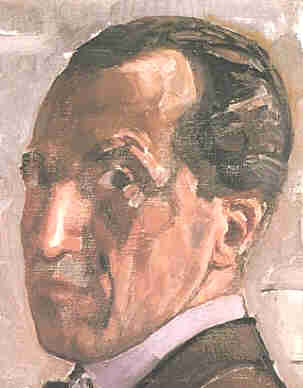
Mondrian self-portrait      Born in Amersfoort, the Netherlands, Mondrian embarked on an artistic career over his family's objections, studying at the Amsterdam Academy of Fine Arts. His early works, through 1907, were calm landscapes painted in delicate grays, mauves, and dark greens. In 1908, under the influence of the Dutch painter Jan Toorop, he began to experiment with brighter colors; this represented the beginning of his attempts to transcend nature. Moving to Paris in 1911, Mondrian adopted a cubist-influenced style, producing analytical series such as Trees (1912-1913) and Scaffoldings (1912-1914). He moved progressively from seminaturalism through increased abstraction, arriving finally at a style in which he limited himself to small vertical and horizontal brushstrokes.
      In 1917 Mondrian and the Dutch painter Theo van Doesburg founded De Stijl magazine, in which Mondrian developed his theories of a new art form he called neoplasticism. He maintained that art should not concern itself with reproducing images of real objects, but should express only the universal absolutes that underlie reality. He rejected all sensuous qualities of texture, surface, and color, reducing his palette to flat primary colors. His belief that a canvas—a plane surface—should contain only planar elements led to his abolition of all curved lines in favor of straight lines and right angles. His masterly application of these theories led to such works ZOOM IN on Mondrian's Compositionas Composition with Red, Yellow, and Blue (1942, 39x35cm), in which the painting, composed solely of a few black lines and well-balanced blocks of color, creates a monumental effect out of all proportion to its carefully limited means. [< image]
      When Mondrian moved to New York City in 1940, his style became freer and more rhythmic, and he abandoned severe black lines in favor of lively chain-link patterns of bright colors, particularly notable in his last complete masterwork, Broadway Boogie-Woogie (1943, 127x127cm). Mondrian was one of the most influential 20th-century artists. His theories of abstraction and simplification not only altered the course of painting but also exerted a profound influence on architecture, industrial design, and the graphic arts. Mondrian died in New York.
— [Nederlands biografie]

LINKS
Self Portrait (1918)
River View with Boat (1908, 66x102cm) _ A river scene in the early twilight: the sky is a lilac pink under the setting sun. The silhouettes of the sailing boat and the trees stand out sharply. Under the trees one can see the faint contours of a farm. There is no wind: the mast of the sailing boat rises vertically and is reflected in the unruffled surface of the water. The atmosphere of this landscape at dusk is peaceful. There is no hint here of any human presence. This early work was painted by Mondriaan long before he became famous for his abstract paintings.
    Yet one can already detect some aspects which which will prevail in Mondriaan's abstractions. He reduced this actual landscape to a simple arrangement of lines and surfaces. The horizontal line, the 'axis' of this almost symmetrical painting, dominates the composition. Most of the brushstrokes are also horizontal. The vertical mast and the group of trees on the left provide a balanced composition. Details are of secondary importance, while the role of color is vital, determining the whole atmosphere of this landscape.
     Color not only determines the atmosphere here; it also contributes to a sense of perspective: the changing color of the river, for instance, adds to the suggestion of a surface stretching to the horizon. At the same time the horizontal and vertical lines and the silhouette of the trees emphasise the 'flatness' of the composition. Soon Mondriaan would cease to include in his work any hint of a space that is 'almost real'. See for example his Composition No. II in Line and Color (1913; 628x829pix, 100kb). He ended up working with purely two-dimensional rhythms of lines and color.
     Between 1905 and 1908 Mondriaan painted a large number of evening landscapes. He drew his inspiration from the countryside outside Amsterdam where he lived. He depicted the flat, open countryside on the banks of the River Amstel and the Gein in increasingly sober compositions. Nature was a source of inspiration for Mondriaan but other painters also influenced him. One example is Paul Joseph Constantin Gabriel [05 Jul 1828 – 23 Aug 1903], whose imposing-looking painting, Windmill on a Polder Waterway (1889, 102x66cm; 1600x1044pix, 282kb) known as In the Month of July, was the first painting which Mondriaan copied, early in his career when he tried to earn a living by making copies of paintings by established masters. The theme of the sun-drenched mill was to remain a significant motif in Mondriaan's work for many years.
     Mondrian is known for his 'modern art'. But his early paintings are in the nineteenth-century style of painters such as Toorop, Karsen, or Van Gogh. They show that Mondrian, the 'abstract' painter, had his roots in the nineteenth century.
Little Girl (1901) — Still Life with Gingerpot II
Composition with Large Blue Plane, Red, Black, Yellow, and Gray (1921)
Composition blanc, rouge et jaune (1936) — River View with Boat (1908)
Molen (Mill); Mill in Sunlight Avond (Evening); Red Tree (1908 )
Amaryllis (1910) — Gray Tree (1911)
Composition No. II; Composition in Line and Color (1913)
Ocean 5 (1915) — Composition with Color Planes and Gray Lines 1 (1918)
Composition with Gray and Light Brown (1918)
Composition A: Composition with Black, Red, Gray, Yellow, and Blue (1920)
Lozenge Composition with Yellow, Black, Blue, Red, and Gray (1921)
Composition with Red, Yellow and Blue (1921)
Composition with Blue, Yellow, Black, and Red (1922)
Lozenge Composition with Red, Black, Blue, and Yellow (1925)
Fox Trot; Lozenge Composition with Three Black Lines (1929)
Composition with Yellow Patch (1930) — Composition with Yellow (1930)
Composition No. III Blanc-Jaune (1942) — Rhythm of Black Lines (1942)
Vertical Composition with Blue and White (1936) — Composition No. 8 (1942)
Composition No. 10 (1942) — New York City (1942) — Broadway Boogie Woogie (1943)
Solitary House (1898) — Composition with Oval in Color Planes II (1914)
Composition with Grid VII (Lozenge, 1919) — Composition with Grid IX (1919)
Composition A (1920) — Composition with Black, Red, Gray, Yellow, and Blue (1921)
Lozenge Composition with Red, Gray, Blue, Yellow, and Black (1925)
Place de la Concorde (1943) — New York City I (1942) — Victory Boogie Woogie (1943)
Died on a 07 March:

^ 1914 Arthur B. Parton, US painter born on 26 March 1842 in Hudson NY. He studied in Philadelphia under William Trost Richards. Parton traveled in northern Europe in 1869. — {On the Internet? Part on, part off? Well, I find only a very small Parton part on the Internet.}— Cattle Watering Along the Mountainside (1890, 56x81cm; 401x600pix, 44kb) — River Landscape (31x36cm; 436x600pix , 32kb) — The Green Arch (36x51cm; 312x450pix, 41kb)

1750 Cornelis Troost, “the Netherlands' Hogarth, or Watteau”, Dutch painter, draftsman, and printmaker, born on 08 October 1697. One of his teachers was Arnold Boonen. Troost was the most important Dutch artist of the 18th century; he received many commissions (the catalogue by Niemeijer contains 925 numbers). Although he generally looked back to the genre scenes of the Dutch 17th-century masters, his satirical paintings earned him the nickname “the Dutch Hogarth” after his English contemporary. His work shows no stylistic development, despite his versatility in choice of subject-matter and technique. He was also called “the Netherlands' Watteau”. — Jacobus Buys, and Pieter Tanjé were students of Troost.


Born on a 07 March:


^ 1903 Bernarda Bryson Shahn, who died on 12 December 2004, US writer, printmaker, illustrator, and best known, late in life, as a painter with a style both realistic and mysterious. She was the widow of the social realist painter Ben Shahn [12 Sep 1898 – 14 Mar 1969]; the mother of Jonathan Shahn, a sculptor, and of Abby Shahn, a painter; and the stepmother of Judith Shahn Dugan, a painter.Bernarda Bryson was born in Athens, Ohio. From her family, she inherited both an interest in writing (her father owned The Athens Morning Journal) and the progressive social conscience that informed much of her work (her maternal grandfather's home had been a stop on the underground railroad). She studied printmaking at several schools, including Ohio University, Ohio State and the Cleveland School of Art. After an early marriage that ended in divorce, she went to work as a newspaper journalist. In 1933, she went to New York to interview the muralist Diego Rivera. There, she met Rivera's assistant, Ben Shahn, who became her mate (they married shortly before Shahn's death). In the mid-1930's, the couple drove across the country, documenting rural life for the Resettlement Administration. Bernarda Shahn's series of lithographs from that trip was published in 1995 as The Vanishing American Frontier. She collaborated with her husband on two of his New Deal-era murals, one in what is now the Roosevelt Public School in Roosevelt, N.J., and the other in the Bronx General Post Office. Both still exist. In midcareer, Bernarda Shahn turned primarily to illustration. She wrote and illustrated several children's books, including The Zoo of Zeus (1964) and Gilgamesh (1967). She also wrote a 1972 monograph on Ben Shahn's work. — Portrait of Bernarda Bryson Shahn, at 99, in her studio (2001; 621x761pix, 767kb) by Mel Leipzig. // — Reflection (1977; 380x380pix, 68kb) — The Twenty Miracles of Saint Nicholas (450x336pix, 74kb) _ cover of book by Bryson.

1900 Albert Carel Willink, Amsterdam Dutch painter who died on 19 October 1983. After studying architecture at the Technische Hogeschool in Delft (1918–20), he decided to become a painter. In 1920 he went to Berlin where he had lessons from Hans Baluschek [1870–1935]. He followed the activities of the artists associated with Der Sturm and in 1922 joined the Novembergruppe, with whom he exhibited some abstract work at Die grosse Berliner Kunstausstellung in the Glaspalast. He was also in touch with avant-garde groups and publications, such as Zenith in Belgrade and Het Overzicht (‘The survey’), later called De Driehoek (‘The triangle’) in Antwerp. — Girl in renaissance Costume (1945)

1841 Carl Kronberger, Austrian artist who died on 27 October 1921.

1820 Ferdinand Mallitsch (or Malitsch), Austrian artist who died on 10 November 1900.

^ 1786 Michel-Martin Drölling, Parisian painter who died on 09 January 1851; son and student of Martin Drölling [bap. 19 Sep 1752 – 16 Apr 1817]. They both were portrait painters. But whereas the father expanded his range by concentrating on bourgeois domestic interiors, the son produced a number of history paintings on mythological and religious subjects. Another of Martin Drölling’s three children by his second wife, Louise-Elisabeth (née Belot), was painter Louise-Adéone Drölling [29 May 1797 – <1831], otherwise known as Mme Joubert. Michel-Martin Drölling also studied in David’s studio, in 1806. He obtained the Prix de Rome in 1810 with La Colère d'Achille. After his stay in Rome he exhibited La Mort d'Abel in the Salon of 1817. He decorated two ceilings in the Musée Charles X in the Louvre and obtained two commissions from the Musée d’Histoire at Versailles: Les États-Généraux de Tours (1836) and La Convention d'Alexandrie (1837). His genre scenes show that while his style was generally colder, he inherited his father’s love of Dutch art and use of thinly applied, porcelain-like paint, contrasting effects of light and meticulous detail. His figures were either half-length with a landscape background in the English manner (Portrait de Manuel, 1819) or full-length and set in countryside, with the charming naivety of Pierre Duval Le Camus. — The students of Michel-Martin Drölling included Theodor Aman, Jacques-Aimé-Paul Baudry, Bertall, Jules Breton, Paul-Alfred de Curzon, Pierre Victor Galland, Jean-Jacques Henner, Charles Nègre, John Charles Robinson, William Strutt [03 Jul 1825 – 03 Jan 1915].

1651 Pieter Janszoon van Ruijven (or Reuver), Dutch artist who died on 17 May 1716.


Happened on a 07 March:

07 March 2002: OPENING OF THE MAASTRICHT ART FAIR
     Every year, despite continued grumbling about the dwindling supply of great paintings, furniture and decorative objects available today, thousands of collectors, curators, scholars and auction house experts flock to this Dutch city and the European Fine Art Fair, where some 200 dealers from 13 countries offer their best.
      Although there are fewer blockbuster paintings and objects than before, this remains the largest art fair in the world, with everything from a $40 million Rembrandt to first-rate examples of classical antiquities, modern art, diamonds, Oriental ceramics and 18th-century furniture.
      From the minute the doors to the fair opened here this afternoon, museum directors could be seen shepherding trustees, while scholars hovered around art in deep debate and collectors inspected the offerings.
      During the customary two days before the fair opens, when a committee of experts authenticates the works on display and the Art Loss Register checks for stolen pieces, a complement of Italian police officers arrived, taking digital photographs of artworks that they suspected might have been illegally exported from Italy.
      In February 200, Frederick Schultz, a New York antiquities dealer, who was convicted in a federal courtroom in Manhattan of conspiring to sell ancient artifacts that had been illegally taken out of Egypt.
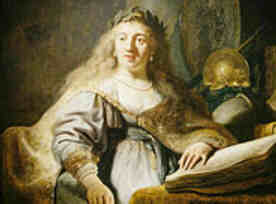
Minerva at her Study      More than 50 people at a time were gathering behind a black rope to see the star of the show: Rembrandt's Minerva in Her Study (1635) [image >], which depicts a regally dressed Minerva, goddess of wisdom, with long blond hair, seated at a table, apparently distracted from a book she is reading. [a different 1635 Rembrandt Minerva]
      "This is the last history painting by Rembrandt that will ever change hands," said Otto Naumann, the Manhattan dealer who wants to sell it for $40 million. It was last exhibited in 1956 at the National Museum in Stockholm for the 350th anniversary of Rembrandt's birth. Mr. Naumann bought the painting last year from an unidentified Japanese company and is asking $40 million for it. "At least four museums are trying to raise the money to buy it," he said, emphasizing that many American museums have no Rembrandts. "Most of the big ones only have his portraits," he said.
      By the time the fair ends on 10 March 2002, nearly 80'000 visitors have come through the Maastricht Convention Center for an event vastly larger than any New York art fair.
      The show boasts many exceptional artworks. One painting, A Young Turk Cutting Up Tobacco With a Gentleman Smoking in the Background, is by the Italian artist Mattia Preti (1613 – 13 Jan 1699), and shows a slave with a shaved head cutting tobacco. Jean- Luc Baroni, a London dealer, bought it at Sotheby's in London in December. "They had dated it to the 1630's and people were uncertain about its attribution," he said. His own research concluded that the work was painted during the artist's time in Malta, around 1660.
      He has another painting, circa 1640, Lorenzo Lippi's Creation of Music, a portrait of Music, personified by a pretty girl, with her score resting on a spinet while she dips her quill pen into an ink pot. Her hand rests on an anvil and hammer, a reference to Pythagoras' ideas about the origin of music.
      Among the old master dealers is Charles Beddington, whose three-month-old gallery, Beddington & Blackman, brought a pair of panel paintings by Johannes Hispanus, who worked in Italy from 1495 to 1528, which tell the story of the early life of Achilles.
      This year modern art can be found in many guises. One of the most interesting works is Birds in Flight, a 1928 stone fresco by Brancusi (1876-1957) that is hanging at Dickinson Roundell of New York and London. James Roundell discovered it unrecognized in a London collection. The theme of birds in flight was a fundamental one in Brancusi's work. While few frescoes by Brancusi are known, several works relate to this work, including Birds in Flight, a watercolor. [Brancusi's sculptures Bird in Space (1923), Golden Bird (1920)]
      One of the most talked about booths at the fair belongs to Kunstkammer Georg Laue, a Munich dealer, which is showing more than 100 memento mori, or reminders of man's mortality. They depict the fascination with the transitory nature of life and human frailty from the 16th to the 20th centuries. The works include a 17th-century watch in the form of a skull, a pair of early 17th- century Italian boxwood skeletons, a Japanese ivory skull with a snake tightly woven around it and a series of 1920's photographs of a young woman seduced by a skeleton. One of the show's most popular pieces is a wooden sculpture, circa 1520, of a monk standing with a skeleton.

— Other examples of Memento Mori or Vanitas (unrelated to the fair):
Giovanni Martinelli, Memento Mori (Death Comes to the Banquet Table)
Master M.Z., Vanitas (Memento Mori) (1503)
Pieter Boel:: Large Vanitas Still-Life (1663)
Abraham Mignon:: The Nature as a symbol of Vanitas (1675) [pas un sujet très mignon!]
David Bailly:: Self-Portrait with Vanitas Symbols (1651)
Gregor Erhart:: Vanitas (1500)
Harmen Steenwijck:: Vanitas (1640)
Nicolaes van Verandael:: Vanitas
Willem van Aelst::Vanitas Flower Still Life (1656)
Barthel Bruyn the Elder:: Vanitas Still-Life
Jacques de Gheyn II:: Vanitas Still Life (1603)
Jan van Kessel:: Vanitas Still Life (1665
Jan Lievens:: Vanitas Still Life (1630)
Jan Davidszoon de Heem:: Vanitas
Cornelis de Heem:: Vanitas Still-Life with Musical Instruments (1661
Pieter Claesz:: Vanitas Still-Life (1630) — Vanitas Still Life with the Spinario
Frans Hals:: Young Man with a Skull (Vanitas) (1628)

<<< ART 06 Mar
ANY DAY ...IN ART ...IN HISTORY ||| HISTORY “4” MAR 07 ||| ALTERNATE SITES
ART 08 Mar >>>
TO THE TOP
PLEASE CLICK HERE TO WRITE TO ART “4” MARCH
http://www.safran-arts.com/42day/art/art4mar/art0307.html
http://www.intergate.com/~canu/art/art4mar/art0307.html
http://www.geocities.com/quermaz/art/art4mar/art0307.html
updated Monday 07-Mar-2005 0:33 UT
Previous update Friday 19-Mar-2004 22:55 UT
safe site site safe for children safe site
Hosted by www.Geocities.ws

1