ART “4”
“2”-DAY 03 March
v.5.20 |
| ^
Born on 03 Mars 1700: Charles~Joseph Natoire,
French Rococo painter, draftsman and teacher, active also in Italy, who
died on 29 (23?) August 1777. — He was a student of François Lemoyne and of Nicolas Vleughels. Natoire was a winner of the Rome Prize, academician, director of the French Academy in Rome. He made numerous decorative cycles and tapestry models for the Gobelins and Beauvais factories. An exact contemporary of François Boucher, he was a painter of cabinet pictures, decorations and tapestry cartoons and one of the most adept practitioners of Rococo art in 18th-century France. The greater part of his career was spent in Paris, where he received important commissions from Louis XV as well as from private patrons. In 1751 he accepted the post of Director of the Académie de France in Rome. From then on he devoted himself to his teaching duties at the expense of his painting. — The students of Natoire included Aignan-Thomas Desfriches, François-Hubert Drouais, Jean-Baptiste Greuze, Nicolas Guibal, Johann Christian von Mannlich, Jean-Baptiste Pierre, Allan Ramsay, Joseph-Marie Vien. — LINKS — The Rest by a Fountain (1737; 787x1059pix, 116kb — ZOOM to 1968x2648pix, 1411kb — or, for more fun than watching your toenails grow, but not a better picture, try this 1968x2648pix, 10'798kb) — Vénus demande à Vulcain une arme pour Énée (1734; 836x600pix, 54kb — ZOOM to 2517x1809pix, 564kb — or, for more fun than watching paint dry, but not a better picture, try this 2518x1809pix, 8828kb) — Bacchanal (1749; 893x1189pix, 154kb — ZOOM to 1912x2419pix, 1170kb — or, for more fun than watching the flow of a glacier, but not a better picture, try this 1912x2419pix, 9273kb) — La Toilette de Psychée (1737; 787x1059pix, 116kb — ZOOM to 2375x2015pix, 1411kb — or, for more fun than watching a snail sleep, but not a better picture, try this 2375x2015pix, 10'798kb) — Le Siège de Bordeaux (Histoire de Clovis) _ An episode from the conquest of Aquitaine, at that time a Visigoth kingdom, by Clovis I, King of the Franks. This representation bore witness to a revival of interest in national history and was inspired by a passage from a heroic poem in twenty-six cantos and 11'052 alexandrin verses, Clovis ou La France chrestienne, written by academician Jean Desmarets de Saint-Sorlin [1595 – 28 October 1676] and published in 1657. “Clovis pourvoid à tout, actif et diligent:/ et par les escadrons brille en armes d'argent./ Car depuis son baptesme, il ne craint plus les charmes. Il peut braver l'enfer, sans les celestes armes./ La gloire et le bon-heur semblent luire en ses yeux./ Il va parmy les rangs, d'un air victorieux,/ sur un tartare blanc, à la bouche écumante./ Braves guerriers, dit-il d' une grace charmante,/ nos coeurs sont enflammez par le divin esprit:/ et nous allons vanger l'honneur de Jesus-Christ./ Il arreste ses pas. Maxent fait la priere./ Aurele à son costé tient la sainte banniere./ Tout soldat brule d'estre ou vainqueur ou martyr.” — Télémaque dans l'Ile de Calypso (1745, 121x153cm) — Truth (24x19cm) drawing) |
| ^
Died on 03 March 1804: Giovanni-Domenico
Tiepolo, Italian Rococo
Era painter born on 30 August 1727. Son of Giovanni-Battista Tiepolo
[05 Mar 1696 – 27 Mar 1770]. — Giandomenico a été apprécié par ses contemporains surtout pour ses talents d'imitateur zélé de son père, Giambattista Tiepolo. Il vivra longtemps dans son ombre. C'est par ses innombrables dessins qu'il a trouvé son moyen d'expression privilégié, le mieux accordé à sa manière intimiste. Parmi ses thèmes favoris, on retrouve, comme dans l'oeuvre de son père, de nombreux croquis de Pulcinelli et de scènes de la vie vénitienne. — Painter and etcher, son of Venetian artist Giovanni Battista Tiepolo. Worked in Venice, Würzburg, Udina, and Madrid. Master and President of the Venetian Academy in his life time. A talented genre painter, especially of scenes from contemporary life and popular theatre. Notable among early works are the paintings of the Stations of the Cross for S. Polo, Venice (1747-49), and the chinoiserie decorations of the guest wing of the Villa Valmarana (1757) in Vicenza. Worked in Madrid from 1762 until his father died in 1770. Returned to Venice, executed several frescoes and easel paintings, and especially scenes from the commedia dell'arte. Produced innumerable drawings for collectors, and nearly 200 etchings after his and his father's designs. Brother, Lorenzo Tiepolo (1736-76), specialized in genre scenes in pastel. — Giovanni Domenico (= Giandomenico) Tiepolo was the son of Giovanni Battista Tiepolo, the greatest Italian painter of the 18th century. His mother was Cecilia Guardi, the sister of the painter Guardi brothers, Niccolo Guardi [09 Dec 1715 – 26 May 1785], Francesco Guardi [1712-1793], and Gian Antonio Guardi [1698 – 23 Jan 1760]. The gifted and clever son of a great artist, Giandomenico Tiepolo spent many years learning by working alongside his father. Giambattista was so convinced of his son's talent that he involved him in the major commissions he undertook at the height of his own powers, and Giandomenico went with him to Würzburg, Vicenza, Stra, and Madrid. It becomes progressively easier to pick out Giandomenico's contributions to the works completed in these years, as during this time he was gradually acquiring his own personal style. This was substantially different (at least in the choice of subject matter) from his father's. Giandomenico's temperament emerged most effectively in the frescos he painted for the guest lodge at Villa Valmarana near Vicenza (1757). They are imbued with a strong sense of realism, if still elegant and playful. Giandomenico had a marked preference for scenes from contemporary life. He viewed life always from a somewhat ironic perspective (although this was usually quite gentle, he could on occasion become savage). This was true of him both as a painter and as an engraver. At the same time he never broke away fully from his father's style. In particular, Giandomenico worked very closely with his aged father during their stay in Spain (1762-1770). The paintings he and his father produced in Madrid were to be a fundamental influence on Goya at the start of his own career. After his return to Italy, Giandomenico pursued important decorative programs in Venice, Brescia, and Genoa. His painting gradually became tinged with the feeling that it was the end of an epoch. This translated as a lightness of touch and a latent melancholy in the frescos he painted in his family's own villa. These were painted during the last decade of the eighteenth century. Giandomenico is noteworthy also for his etchings, especially the twenty-two variations on the theme of the Flight into Egypt (1753). — LINKS — Self-Portrait (1775, etching 12x9cm) — Portrait of the Artist's Father, Giovanni Battista Tiepolo (1775, etching 12x10cm) — Minuet 1756 _ This is an extremely interesting early piece which borrows its compositional layout from scenes painted by his father. The difference is that Giandomenico chose not to paint mythological or allegorical scenes. The minuet is being danced by people wearing traditional masks and having a good time. Its proper classification is therefore a genre painting. It was works like this that made such a deep impression on the young Goya. — The Swing of Pulcinella (1793, 200x170cm) _ This fresco comes from the Tiepolo villa at Zianigo, between Padua and Venice. — The Procession of the Trojan Horse in Troy (1773, 39x67cm) _ The Building of the Trojan Horse (1773, 39x67cm) _ These companion-pieces are part of a series illustrating a famous passage from Virgil's Aeneid (Book 2): The Greeks build a wooden horse, fill it with armed men and leave it outside the enemy city of Troy. The two pictures are close in style to the work of the artist's father Giambattista. — Peasants at Rest (1757) _ The prevailing style of the first half of the 18th century was set by the enormous success of often flamboyant Venetian painters: Sebastiano Ricci, Piazzetta, and above all, Giambattista Tiepolo. But there were other currents as well. The Lombard painters Ceruti and Ghislandi, the Genoese artist Magnasco, Crespi from Bologna and Traversi from Naples (in addition of course Giandomenico Tiepolo in Venice) all adopted different but equally lively approaches. These artists paid close attention to themes and people taken from everyday life, which later led to the strand of "social" painting of the second half of the nineteenth century. Giandomenico Tiepolo's frescoes in the guest house of Villa Valmarana represent examples of this approach. — Summer Stroll (1757) _ While Giambattista was busy in the main house painting famous episodes taken from heroic poems, his son Giandomenico decorated the rooms in the guest house with enjoyable if somewhat enigmatic scenes like this. The subject of the seasons, which Giambattista would probably have portrayed in wonderful allegories, provided Giandomenico with the occasion to depict scenes set in the countryside with romantically distant vistas but utterly real people. — The Flight into Egypt (episode of the falling idols) (1753, etching 17x22cm) — 55 etchings at FAMSF |
| ^
Born on 03 March 1814: Abram Louis
Buvelot, Swiss Australian painter, lithographer, and photographer,
active in Brazil and Australia, who died on 30 May 1888. — Louis Buvelot arrived in Australia in 1865 at the height of the Melbourne boom. Since 1850, when the Separation Bill was passed and Victoria was governed independently from the colony of New South Wales, there had been measurable progress. The population had increased in Victoria from 80'000 to 600'000 and revenue from £750'000 to £3'000'000. In 1851, 24'000 hectares had been cultivated and by 1864 this had increased to 200'000 hectares. Five hundred kilometers of railway linked Victoria. 1200 churches had been built from an original 39. The discovery of gold in Victoria added further to an era of prosperity and economic expansion. By the time Buvelot arrived in Melbourne at the age of fifty-one he was already an experienced and mature artist. He had trained as an artist in Switzerland and for a short time in Paris. Buvelot was not only a versatile painter but also a practised lithographer and photographer. During the 1870s his reputation as an artist rose and his vision of the landscape inspired the young artists Tom Roberts and Frederick McCubbin, who considered him the 'father of Australian landscape painting'. Buvelot's attitude to landscape painting in some part was influenced by the art of his fellow-countryman Barthélémy Menn. Menn had lived in Paris and had been aquainted with and influenced by the French Barbizon artists Camille Corot, Théodore Rousseau [1812-1867], and Charles Daubigny. It is possible that Buvelot also had some first-hand knowledge of a landscape by Rousseau shown in Lausanne in 1855. The Barbizon artists and Menn painted naturalistic landscapes of familiar countryside as opposed to the previous romantic views of nature. Buvelot's landscape paintings were a result of sketching trips undertaken in and around Melbourne, although he occasionally traveled further afield, and was commissioned to do a few homestead paintings in the Western District of Victoria. On his trips, he made pencil, watercolor, or oil sketches, from which he executed more elaborate charcoal drawings, watercolor and oil paintings in his Melbourne studio. His painting style was considered broad and even unfinished when his paintings were first shown in Melbourne. Buvelot's paysages intimes were an appropriate expression of the colonists' growing acceptance of their environment as no longer alien and antagonistic but their proper home, familiarly Australian rather than discomfortingly non-European. Buvelot's Australian landscape painting acted as a catalyst in reconciling Victoria's settlers to their environment. — LINKS — The Pool (1878, 18x25cm) — At Lilydale (1870, 76x102cm) — Man with horse and cart (1872, 28x45cm) — Summer afternoon, Templestowe (77x119cm) _ Summer afternoon 1866 was made after a study and completed in the studio. A glance at the preliminary sketch (38x54cm) reveals that Summer afternoon 1866 is not topographical and Buvelot took liberties as an interpreter. Unlike photography, for the painter nature is converted according to the laws of art. Actual visual experience has been modified. This depicts a rural scene on the outskirts of Melbourne. The low viewpoint makes us part of the scene as we look along the dusty road to the oncoming sheep. The horizon line is also low, and contributes to the openness of the countryside. The landscape is dotted with human activity, from the drover with his two sheep-dogs to the various people in conversation. The houses already appear to be old, and add to the feeling that the countryside is well settled, familiar and commonplace. This is not the setting for heroic deeds by pioneers, but rather the every-day routine activities by local farmers. The tall, centrally-located gum-tree, with barren branches exposed, establishes the scene as Australian. As the sun sets, the light glows rather than shines on the brown rough vegetation, although a few patches of green grass defy the sullen heat. The whole atmosphere is heavy with the lingering heat, but the long weary afternoon is drawing to a close and the build up of clouds suggests that some relief is in sight. — Compare this Paysage by Théodore Rousseau. |
| ^
Died on 03 March 1928 Theodoor
Jan Toorop, Dutch Symbolist painter born on 20 December
1858. — {En plus d'un O de trop dans Theodoor, Toorop c'est trop, c'est
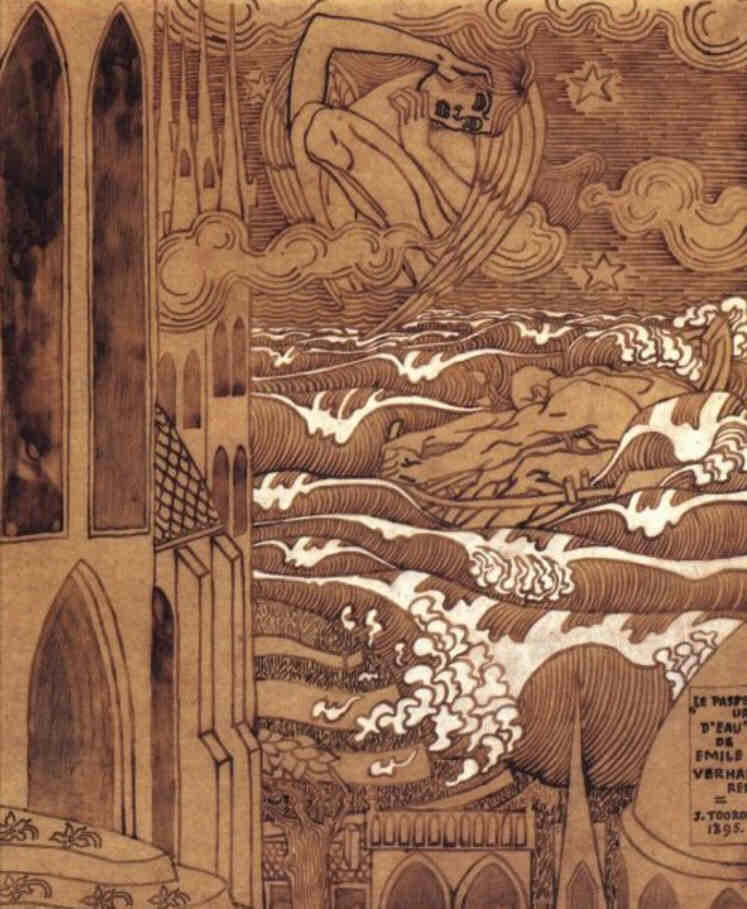
Trop avec a deux O de trop. Non?} — Dutch painter, born in Java. Studied art in Delft and Amsterdam. A grant allowed him to study in Brussels, where he came into contact with the XX group, and became a member in 1885. He befriended Khnopff, Ensor and de Groux. In 1886, he met Whistler in London. He discovered the Pre-Raphaelites and William Morris' views on art and socialism. In 1890 he developed his own version of Symbolism using elements of a Javanese aesthetic. Met Péladan in 1892. In 1905 converted to Catholicism. His themes thereafter became religious and even mystic. His style simplified and he adopted a technique close to Pointillisme, which he put at the service of a fragmentation of the surface of the painting at poles from the measured unity to which Seurat aspired. These fragmentary surfaces relate Toorop to Expressionism. — Jan (actually Jean Theodoor) Toorop was born in Purworejo on Java. From 1872 onwards, he lived in the Netherlands and in 1880 became a student at the State Academy in Amsterdam. From 1882 until 1886 he lived in Brussels, where he joined 'Les Vingts', a group of progressive Belgian artists centered around James Ensor. Toorop worked in various different styles during these years, such as Realism, Impressionism and Post-Impressionism. After his marriage to the English Annie Hall in 1886, Toorop alternated his time between The Hague, England and Brussels and after 1890 also the Dutch seaside town of Katwijk aan Zee. During this period he developed his own unique Symbolist style, with dynamic, unpredictable lines. After his period of highly stylised Symbolist drawings and paintings, Toorop turned to Art Nouveau. In the drawings and posters which he produced, such as the Salad Oil poster, the same play of lines can be seen as in his Symbolist paintings, but then solely for decorative purposes, without any symbolic meaning. — O grave, where is thy Victory (1892 drawing, 60x75cm) _ Two angels are removing thorns from a corpse coveted by the forces of Evil, on the right. The curved lines express good, the broken lines evil. An enigmatic depiction with whimsical trees and two mysterious women with slim, elegant bodies and flowing hair. The women, modern angels as it were, pull away the thorny boughs growing over a dying (or dead) man. The man lies beside an open grave, his legs hanging limply over the side. The three threatening personages make fists and stretch their claw-like hands towards him. Toorop explained that these strange characters are the earthly passions of the dying figure: Resentment, Envy, Jealousy, Hate, Love and Conflict. They are trying to hold on to the dying person. The two women, on the other hand, are trying to free him from earthly life and earthly suffering, symbolised here by the branches of thorns. at their feet (right) The title is taken from the Bible: O Death, where is thy sting? O Grave, where is thy Victory? The text is found in 1 Corinthians 15:55. Presumably, Toorop read the text in the Bible owned by his English wife Annie Hall, whom he married in 1886. It is a good example of his symbolist work. It shows no objective depiction of reality but rather an image filled with dreams, visions and emotions. — Poster for Delftsche Slaolie (1894, 95x54cm; 975x688pix, 714kb _ ZOOM to 1600x1044pix, 480kb) _ The best-known example of Dutch Art Nouveau is this poster designed by Jan Toorop Delft Salad Oil. This litho was printed in various color combinations: red-brown or purple with yellow-green and black with yellow, as here. The heading makes it clear that the subject is salad oil, as do the bottles on either side of the text. Underneath are the crowned arms of the manufacturer, with a decorative pattern using peanuts on the left. The larger part of the poster is taken up by two female figures with long hair and long gowns. One sits and dresses salad in a large dish; the other lifts her gaze and hands upwards. In this way Toorop elevates preparing salad to the level of an almost mystic rite. Not a centimeter is left uncovered in the decorative design. The most striking aspect of this poster is the graceful pattern formed by the lines of the clothes and hair. Their wavy movement is characteristic of Art Nouveau or Jugendstil, a style which was popular in Europe about from 1890 to 1910. In the Netherlands Art Nouveau was also known as the 'salad oil style' after Toorop's poster. Toorop worked in various styles, such as realism and Impressionism, but he was particularly fascinated by Symbolism. Symbolist artists did not aspire to represent reality objectively. Symbolism is subjective: mysticism and religion play a role and so do personal feelings, dreams and visions. Toorop's drawing O Grave, where is thy Victory, for example, is about life and death, envy, hate and love. The sinuous, restless lines and marked stylization and distortion are typical. The same linear patterns characterize Toorop's Art Nouveau work. The symbolic significance is lost by then: the line has become a purely decorative surface covering. Woman was one of Toorop's favorite themes, especially in his Symbolist years. In his graphic work the figure of the young, innocent girl recurs frequently, now with her eyes cast down, now looking up. Through this girl he alludes to a higher spiritual life. These women in the salad oil poster together form a curious combination of the mystical and the everyday. The model for the woman was probably the artist's sister-in-law Janet Hall. She is also seen in other lithos, such as Dolce (1896). The Industrial Revolution led to an increase in the number of manufacturers in the nineteenth century. There was greater competition and companies began to use advertising to establish a distinct identity. Lithography was invented in 1796 and color lithos, in which a separate stone was used for each colour, began to appear as early as the first half of the nineteenth century. Lithos were often used for advertising posters and this stimulated the development of the new technique. Artists such as Toulouse-Lautrec (e.g. Moulin Rouge - La Goulue) and Toorop made celebrated contributions to this new form of applied art. — The Sea (1887, 86x96cm) _ Here, Jan Toorop has painted the sea at Katwijk on the Dutch coast in an original way. We can only see the water with the waves rolling in, the foaming surf and a small piece of sky. No boat or bird distracts our attention from the main subject: the sea itself, rendered in wonderful nuances of color, from mauve and light green to yellow and blue-gray. Toorop has painted an almost abstract image which leads the spectator's eye across the restless waves to the peaceful horizon. The waves form a regular horizontal pattern. Toorop has used a palette knife to apply the paint thickly. He adopted this technique from the Belgian painter James Ensor, whom Toorop often met during the years he lived in Brussels (1882-1886). In 1886, Toorop returned to the Netherlands and went to live in The Hague. He also stayed in Katwijk for a few years and regularly spent the summers in Domburg, both on the Dutch coast. After moving to The Hague, the sea became a recurring theme in his work. This picture is one of his first sea paintings and the most pure, depicting only sea. Other works show the sea or the beach in combination with ships or people, as for instance in The Shellfish Gatherer {NOT The Selfish Gatherer}. The Sea has been painted in an Impressionist manner: a quick impression using loose paint marks. Toorop worked for a time in this style, though also experimented with other styles such as Pointillism Pointillism and Realism (for example Mauvais salaire). He was open to the new innovative ideas of his contemporaries and used these in his own work. In the 1890s he mainly made work with mystical, symbolic subjects, such as O Grave, Where is Thy Victory. This picture, with its many curls and wavy lines, also relates to Art Nouveau. Toorop used this style for advertising posters such as his famous one for Delftsche slaolie (Delft salad oil). — The Artist's House — A New Generation (1892; 160kb) — Oceanide (1893) — Le Passeur d'eau (1895) _ A book illustration for the poem of Émile Verhaeren (21 May 1855 – 27 Nov 1916). |
 site safe for children