search 8100 artists, their works, museums, movements, countries, time periods, media, specializations
<<< ART 28 Feb   <<< ART 29 Feb
ANY DAY ...IN ART ...IN HISTORY ||| HISTORY “4” MAR 01 ||| ALTERNATE SITES
ART 02 Mar >>>
ART “4” “2”-DAY  01 March v.5.12
LEBON
SICK FIT
abspic
4~2day
DEATHS: 1704 PARROCEL — 1944 SCHOFIELD — 1935 DEGOUVE 
BIRTHS: 1886 KOKOSCHKA — 1944 “BACCHIACA”
^ Died on 01 March 1704: Joseph Parrocel “des Batailles” ou “le Vieux”, French painter born on 03 October 1646.
— He belonged to one of the most numerous French artistic dynasties, which from the 16th century produced 14 painters over 6 generations. Starting with him, they were most prominent in the late 17th century and the 18th. He and his son Charles Parrocel [06 May 1688 – 24 May 1752] were notable painters of battles and hunts. His nephew Pierre Parrocel [16 Mar 1670 – 26 Aug 1739] was a prolific painter of religious works, as was Pierre's nephew and student Etienne Parrocel “le Romain” [08 Jan 1696 – 13 Jan 1775]. |
—     Joseph Parrocel was taught by his father Barthélemy Parrocel [1595–1660} and then by his brother Louis Parrocel [1634–1694]. He went to Paris for four years to perfect his work and then, about 1667, to Rome, where he became the student of the battle painter Jacques Courtois and was influenced by Salvator Rosa. Parrocel remained in Italy for eight years and stayed for a time in Venice, before returning to settle in Paris in 1675. He was approved (agréé) by the Académie Royale de Peinture et de Sculpture in February 1676 and received (reçu) as a full member in November 1676, presenting Le Siège de Maastricht.
     His painted oeuvre consists principally of military scenes, particularly battles, and he received numerous royal commissions. In the period 1685–1688 he made 11 paintings for the Salle du Grand Couvert at the château of Versailles; in 1699 he painted The Crossing of the Rhine for the château of Marly, Yvelines, and in 1700 he painted The Fair at Bezons, anticipating the fêtes galantes of Antoine Watteau. Parrocel was also the author of a number of hunting scenes. His most important religious paintings were The May of Notre-Dame de Paris (1694), Saint John the Baptist Preaching and Saint Augustin Secourant les Malades (1703). He also contributed battle scenes to the backgrounds of portraits by Hyacinthe Rigaud and by Gabriel Blanchard. His technique was highly original in the context of his time; he employed a very free style of painting and used thick impasto and intense colors. He was also a prolific engraver, producing around 100 plates, among them 25 Mysteries from the Life of Jesus Christ and 40 Miracles from the Life of Our Lord Jesus Christ. Others were for the Missale parisiense of 1685, and some depicted military subjects.
— Joseph Parrocel’s students included his son Charles, his nephew Pierre, another nephew, Ignace-Jacques Parrocel [1667–1722], and the landscape painter François Sylvestre.

LINKS

Passage du Rhin par l'armée de Louis XIV, à Tolhuis
(1699, 234x164cm; 1440x1260pix — or adjust the size to your liking — 186kb either way) _ Peint pour le château de Marly, ce tableau relate l'épisode militaire du 12 juin 1672. Plus pittoresque et plus tumultueuse que Passage du Rhin par l'Armée Française à Lobith de Van der Meulen [1632-1690] sur le même sujet, l'oeuvre est représentative des scènes de bataille de Parrocel influencées par Jacques Courtois et Salvator Rosa.
Bataille pour la salle des gardes du roi
(1685; 748x936pix, 89kb)
Un Jeu de Dés
(962x728pix, 62kb)
The Return from the Hunt (1700, 109x104cm; 254kb)
Cavalry Battle (124kb)
Scène de bataille avec Louis XIV à cheval (79x114cm; 510x750pix, 70kb) _ auctioned off at Sotheby's, Paris, on 27 June 2002 for € 14'400
27 prints at FAMSF
^ Born on 01 March 1886: Oskar Kokoschka, Austrian Expressionist painter who died on 22 February 1980.
— Kokoschka was born at Pöchlarn an der Donau, Lower Austria. His mother came from a family of foresters in Lower Austria. His father came from a celebrated line of goldsmiths in Prague, but when Oskar was born his father worked as a commercial traveler for a jewelry firm. Oskar was the second of four children. A few months after he was born the family moved to Vienna, where he spend the early part of his life. In 1904 Kokoschka was awarded a state scholarship to attend the Kunstgewerbeschule (School of the Arts and Crafts). His intention was to become a art teacher. In 1908 he had his first exhibition or, more truly, he got the chance to show some of his work to the public, because The Klimt group came on a visit to Vienna. In 1909, he had his first exhibition at the "Internationale Kunstschau" and the same year he left the school.
      In 1910 Kokoschka went to Berlin for the first time to work with Walden. In 1912 his name became know in the art world around Europe, and he was normally on every important exhibition on the continent. In 1913 he married Alma Mahler [so der Maler married die Mahler] who built a house for him where he could work and where they lived for a year. After Alma had an abortion in 1914 their life together ended.
      On 01 August 1914, the First World War broke out. Oskar enlisted in one of the most prestigious regiments in the Austro-Hungarian army, the 15th Imperial-Royal Dragoons. He was send to the Eastern Front, where he got wounded. He was discharged from the army as unfit for active service.
      In 1918 Gustav Klimt died. Oskar wrote to his mother: "I cried for poor Klimt, the only Viennese artist who had any talent and character. Now I am his successor, as I once asked of him at the "Kunstschau", and I do not yet feel ready to take charge of that flock of lost sheep."
      Three years later he moved to Dresden as a professor at the academy. At this time in Germany there were fights between different political parties. In March 1920, a Rubens painting was damaged in crossfire. Oskar addressed an open letter to the population of Dresden: "I request all those who intend to use firearms in order to promote their political beliefs, …, to be kind enough to hold their military exercises elsewhere than in front of the art gallery in the Zwinger; for instance, on the shooting-ranges on the heath, where human civilization is in no danger… It is certain that in the future the German people will find more happiness and meaning in looking at the paintings that have been saved than in the totality of contemporary German political ideas."
      Later the same year he wrote to his family: "Since leaving Vienna I have been in love about nineteen times, all serious, single-minded ladies with plenty of heart…. Then I get love letters regularly, and they are like sunshine when the sun goes in; and so I can paint wonderful colors that glow".
      In 1922 he wrote to his father: "I believe, in all seriousness, that I am now the best painter on earth." [which only goes to show that he was not the best art critic]
      In 1923 he started the life of a traveling restless soul. He painted as we today use a camera. He traveled around and painted and traveled and painted. Later he moved to Paris and after he broke with his art-dealer he moved to Prague.
      During the Second World War, he was banned by the Nazi regime, but after the war he again was represented at every large exhibition. It was also then that he had his first exhibition in the US. Often his works where exhibited were jointly with those of artists such as Klimt or Schiele. Kokoschka was the founder of The Free German League of Culture, set up in London in 1939 just before the second world war started. Oskar died in a hospital in Montreux.

LINKS
Self-Portrait (1921 rough sketch, 36x24cm; 1/4 size, 19kb _ ZOOM to half~size, 70kb _ ZOOM to full size, 299kb)
Bride of the Wind (1914)
Walliser Landschaft (1947; 600x811pix _ ZOOM to 1400x1893, 439kb)
Die Jagd (1818; 600x904pix)
Ezra Pound (1964 rough sketch, 46x38cm; 1/6 size, 16kb _ ZOOM to 1/3 size, 60kb _ ZOOM to 2/3 size, 233kb)
56 images at Bildindex

^ Died on 01 March 1944: Walter Elmer Schofield, US Impressionist painter born on 09 September 1867.
— Schofield was born in Philadelphia where he attended Swarthmore College and the Pennsylvania Academy of Fine Art, before leaving for Paris to study at the Academie Julian. From Paris Schofield headed to England, where he settled in the St. Ives art colony at Cornwall. Schofield is remembered for his Impressionist winter scenes, painted in England and Pennsylvania. His works were richly developed, and often infused with brilliant cobalt blues.
— Schofield was born in Philadelphia to Benjamin Schofield and Mary Wollstonecraft Schofield in 1867; Schofield's father had emigrated from England to the United States about 1840.(1) He attended Swarthmore College around 1885 and then studied art at the Pennsylvania Academy of Fine Arts between 1889 and 1892. There, he studied under Thomas Anshuz, who encouraged him to pursue an art education in Europe.(2) This he did, especially at the Academie Julien, Paris, under Bouguereau, Doucet, Ferrier, and Aman-Jean in 1892.(3) He encountered both traditional and innovative studies in these schools. After 1892, Schofield spent most of his time traveling to Europe, especially to Paris; he settled for the first time in Southport, England, with his family in 1901 and later moved to Saint Ives in 1903.(4) As he settled back in England, however, he maintained his US citizenship and, in fact, spent a substantial portion of almost every year in the United States around the Pennsylvanian area in order to produce winter landscape scenes. He then spent the rest of the year with his family, creating his Cornish village paintings.
— Schofield painted landscapes filled with sun and bright colors, but became best known for his snowscapes and rushing streams, with the movement of the water often shown in diagonal lines, using broad fluid strokes.
     He was born in Philadelphia to a very creative family. His mother was the grand niece of Mary Wollstonecraft Shelley, author of Frankenstein. He attended Swarthmore College and the Pennsylvania Academy of the Fine Arts, studying with Thomas Anshutz from 1889 to 1892. Thinking he needed to supplement his art training, he went to Paris to study for three years, 1892 to 1895, and attended the Academie Julian. However, he soon tired of the strict regimen and chose to paint directly from nature in the Forest of Fontainbleau.
     Later he went to England, where he eventually settled in the St. Ives art colony in Cornwall in 1903, along with his English wife, Murielle Redmayne, and children. While living in various cities in England -- Yorkshire, Southport, Bedfors, and while attending the Academy, Schofield met US expatriate artists including Robert Henri, Edward Redfield, John Sloan, William Glackens, and Everett Shinn, members of "The Eight".
     Rebelling against the rigidity of the National Academy, "The Eight" were a group of painters whose historic exhibition was held at the Macbeth Galleries in New York in February 1908. Not all of "The Eight" painted in a similar mode, but they were generally interested in urban realism as well as Impressionism.
     Although he became an expatriate, Schofield was recognized as part of the Pennsylvania Impressionist tradition. After about 1903, his Impressionist style often incorporated cobalt blues, and prevailed throughout the rest of his career. He continued to exhibit in the United States and to belong to US art organizations. In the 1930s, he traveled in the US West, painting in California, Arizona, and New Mexico.
     From an early age, Schofield was familiar with Bucks County, north of Philadelphia, especially when visiting friends such as Edward Redfield. As a student at the Pennsylvania Academy of Fine Arts, he painted several geographic areas. In 1904, his Center Bridge, Across the River, earned him a Carnegie Institute medal. His friendship with Redfield ended in rivalry, however, as Redfield claimed the composition was initially his own concept, that Schofield stole it, and warned him to vacate the area. Schofield agreed, but Redfields influence to his painting style would continue.
     Perhaps influenced by his affinity for the rugged outdoors and winters bitter elements, Schofield favored snow scenes, as seen in Bucks County and other venues of the Delaware River Valley. Marine vistas, often painted in Cornwall, England, were done in bold colors with thick, heavy brushstrokes.
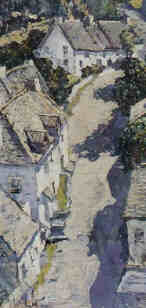
click for STREET IN NORMANDY
Cornish Inn (1936, 76x91cm; 650x782pix, 91kb)
Cornwall (1930; 505x594pix, 50kb)
Street in Normandy (980x1100pix, 137kb)
Godolphin House (890x1100pix, 148kb)
Outer Harbor Polperro (1913; 876x1100pix, 110kb)
Mclegrenow Farm (1925; 886x1100pix, 103kb)
Boat House on a Canal (795x1000pix, 82kb)
Summer Morning (1016x1200pix, 211kb)
January Morning (1941; 768x900pix, 98kb)
Pennsylvania Barn in the Snow (830x1000pix, 86kb)
Seascape (836x1000pix, 83kb)
Boat House on a Canal (795x1000pix, 82kb)
A Cornish Village (797x1000pix, 75kb)
The Winter Woods (762x900pix, 71kb)
Hill Country (750x900pix, 63kb)
Frosty Morning (900x756pix, 51kb)
^ Born on 01 March 1494: Francesco Ubertini Verdi “Bacchiaca”, Florentine painter and draftsman who died on 05 October 1557.
— He belonged to the generation of Pontormo and Rosso Fiorentino, but, with a conservative disposition and limited talents, he never regarded style as a vehicle for creative expression as much as they did. His contribution to the evolution of Mannerism is, nevertheless, the central issue for critics of his work. Although he studied with Perugino and was heavily influenced by him, he did not demonstrate an exclusive allegiance to any one style even in his earliest works. In Adam and Eve with their Children (1517), for example, the figures of the parents are borrowed from Perugino’s Apollo and Marsyas, but the landscape comes from the engraving Adam and Eve (1504) of Albrecht Dürer, and the children are taken from God Appearing to Noah, engraved by Marcantonio Raimondi. The curious transformation of Perugino’s Apollo into Eve is telling evidence of Bacchiacca’s unfamiliarity with the nude, a shortcoming he never overcame. Throughout his career, he effected a compromise between conservative and progressive elements. His reference to a northern print in Adam and Eve suggests an acquaintance with advanced practices then current in Florence. Perhaps the most lasting legacy of his training by Perugino [1450-1523] was the habit of relating form and content only superficially. While other artists of his generation employed a variety of sources to achieve a creative synthesis, Bacchiacca’s eclecticism remained merely a pragmatic solution to the problem of providing a wide variety of characters for his scenes.

LINKS
Deposition of Christ from the Cross (1518, 93x71cm; 1017x770pix, 131kb) _ This work, however youthful, shows the interest which Bacchiaca had for the painting of landscape. The whole composition - besides being balanced and almost symmetrically divided by the ladders, the crosses and the group of figures - is in fact set in a rural landscape which serves not only as a background to the scene, but is the natural continuation and development of the grassy terrain in the foreground.
Mary with Child Jesus, Saint Elisabeth, and the Child Saint John the Baptist (1536, 60x50cm, 867x722pix, 150kb) _ The painting is based on an engraving by the Bolognese Marcantonio Raimondi, which is based on the Madonna del divino amore painted in Raphael's workshop probably by Giovanni Francesco Penni.
The Preaching of Saint John the Baptist (1520, 68x92cm; 686x940pix, 137kb) _ detail (900x718pix, 138kb) _ This painting (restored in 1960) of the eclectic artist shows the strong influence of Perugino.
The Flagellation of Christ (1515; 933x800pix, 103kb)
The Baptism of Christ (1523; 600x1244pix)
The Beheading of John the Baptist (1539; 600x528pix)
A Lady (1530)

Died on a 01 March:


^ 1932 Ramón Casas i Carbó, Barcelona Catalan painter, especially of portraits and posters. Born on 05 January 1866 into a wealthy family, he was a student of Joan Vicens [1830–1886] and published his first drawing in the magazine L’Avenç of Barcelona in 1881, the same year in which he went to Paris. There he studied under Carolus-Duran and exhibited his chiaroscuro Self-portrait as Andalusian at the Salon des Champs-Elysées (1883). At the Académie Gervex he knew another Catalan painter Laureà Barrau [1863–1957], and they went together to Granada in 1884. In this year his painting Bullfight, already sketchy and luminous, was considered too avant-garde by the critics when it was exhibited at the Sala Parés of Barcelona. Casas’s main period of work began in 1890, when he returned to Paris with his close friend the painter and writer Santiago Rusiñol. They lived with Miquel Utrillo [1862–1934] at the Moulin de la Galette in Montmartre. His painting now focused on views of suburban Paris and interiors with figures; it used grey tones, seeking poetry in vulgar or everyday themes. Works such as Plein air (1890) and Interior of the Moulin de la Galette (1890) show Degas’s influence in their compositions, and Whistler’s in their sense of color. At that time he began to exhibit his works at the Salon du Champ de Mars, also showing twice at the Salon des Indépendants. When he exhibited the Parisian paintings in Barcelona (Sala Parés, 1890 and 1891; Exposició General de Belles Arts, 1891), the critics began to talk about his ‘modernism’; the term soon became associated with the new generation of Catalan artists that used to meet at Els Quatre Gats café in Barcelona (1897–1903), established by Casas.

1884 Ludwig Vollmar, German artist born on 07 January 1842.

^ 1811 Jean-Simon Berthélémy, French painter and draftsman born on 05 March 1743. In 1764 he entered the studio of Noël Hallé, whose work strongly influenced his early paintings. Alexander Cutting the Gordian Knot, with which he won the Prix de Rome in 1767, is a brilliant exercise in the grand academic style as conceived by the followers of François Boucher. After a period at the Ecole Royale des Elèves Protégés he completed his training at the Académie de France in Rome from 1771 to 1774. Although he impressed the then director of the Académie, Charles-Joseph Natoire, and formed friendships with the painters François-Guillaume Ménageot, François-André Vincent, and Joseph-Benoît Suvée, and the architects Pierre-Adrien Pâris and Jean-Jacques-Marie Huvé [1742–1808], his artistic activity during his years in Rome is obscure. A number of spectacular drawings in red chalk, such as those of the Villa d’Este, Tivoli and the Villa Colonna and Villa Negroni, are the only evidence of Berthélemy’s talent for landscape, while an oil study of a Dying Warrior is the only known surviving example of the works he was obliged, like the other pensionnaires, to send to Paris for scrutiny. — Alexandre Coupe le Noeud Gordien (113x145cm; 520x671pix, 27kb) — Thomyris fait tremper la tête de Cyrus dans un vase de sang (1766 rough oil sketch, 32x46cm; 800x609pix, 70kb) — Denis Diderot (oval 350x234pix - 10kb)

^ 1810 Jean-Jacques de Boissieu, Lyon French printmaker, draftsman, and painter, born on 30 November 1736. Apart from studying briefly at the École Gratuite de Dessin in Lyon, he was self-taught. His first concentrated phase as a printmaker was 1758–1764, during which he published three suites of etchings. Boissieu spent 1765–1766 in Italy in the company of Louis-Alexandre, Duc de la Rochefoucauld [1743–1793], returning to Lyon via the Auvergne with a cache of his own landscape drawings. He remained in Lyon, where he published further prints at intervals, making occasional trips to Paris and Geneva. Boissieu’s prints earned him the reputation of being the last representative of the older etching tradition (he particularly admired Rembrandt van Rijn) at a time when engraving was being harnessed for commercial prints, and lithography was coming into use. For his landscape etchings Boissieu drew upon the scenery of the Roman Campagna, the watermills, windmills and rustic figures of the Dutch school (notably Salomon van Ruysdael) and the countryside around Lyon. He also engraved têtes d’expression and genre scenes. His work as a printmaker was intermittent, covering the periods 1758–1764, 1770–1782 and after 1789, although his skill was such that he was much sought after as a reproductive engraver; one example of his work is the Landscape with Huntsmen and Dogs after a painting by Jan Wijnants. — Auguste Forbin was a student of de Boissieu. — LINKSSelf-Portrait (1796 etching, 37x29cm; 2/5 size, 56kb _ ZOOM to 4/5 size, 226kb) _ Boissieu holds a picture of two cows in a landscape. — Self-Portrait (1796 etching, 29x23cm; half~size, 50kb _ ZOOM to full size, 195kb) _ Identical to the preceding, except for size and for the picture Boissieu is holding, which is of only one, not cow, but person, his wife, without a landscape. — Ancienne porte de Vaize à Lyon (1803 etching 27x39cm; half~size; 75kb _ ZOOM to full size, 271kb) — Maitre et Élèves (etching; 1/4 size, 84kb _ ZOOM to half~size; 317kb _ ZOOM+ to full size; 1181kb)

^ 1803 Jean François Gilles Colson, French painter, architect, and writer, born on 02 March 1733. He was apprenticed to his father, Jean-Baptiste Gilles, called Colson [1686–1762], who copied the work of the portrait painters Charles Parrocel and Jean-Baptiste van Loo and also painted miniatures, mainly for a provincial clientele. Jean-François got to know many studios, and worked for the portrait painters Daniel Sarrabat and Donat Nonnotte, among others. One of his liveliest early works is the informal, intimate and meditative portrait of The Artist’s Father in his Studio. Through the acting career of his brother Jean-Claude, Jean-François also came into contact with the theatrical world, as in his portrait of the actress Mme Véron de Forbonnais (1760). The manner of this painting, with its subject looking up as if disturbed from reading a letter, is attuned to contemporary developments in portraiture. Later theatrical work includes Mlle Lange in the Role of Silvie (1792.), showing the actress in costume in a scene from Claude Collet’s play L’Ile déserte. — Lady with a Serinette (La Charmeuse) (1750, 67x57cm; 1/4 size, 53kb _ ZOOM to half~size; 221kb _ ZOOM+ to full size; 900kb, recommended to those who are interested in the texture of the canvas and the fine cracks in the paint) — A Lady Asleep (1759; 400x311pix, 27kb) — Samuel Foote [1720-1777] actor and dramatist (1769, 56x46cm; 225x182pix, 8kb)


Born on a 01 March:


^ 1882 Edgar Alwin Payne, US painter, specialized in landscapes of the US West, who died in 1947. Born in Missouri, Edgar Payne left home at an early age because his father disapproved of his painting. Self-taught, he worked as a sign and house painter and painted scenery for theatrical productions. He lived in Chicago for several years, joining the Palette and Chisel Club, where he made contact with other artists and first exhibited his landscape paintings. The Santa Fe Railway sponsored his first trip to New Mexico and Arizona in 1916. He married artist Elsie Palmer; together they made regular visits to California and the Southwest. They painted murals for theaters and courthouses until they could support themselves through the sale of oil paintings, They lived briefly in Laguna Beach, California, where Payne established the Laguna Beach Art Association and Art Gallery. Payne became known for his paintings of the Sierra Nevada Mountains, done from sketches made on many camping trips. His book, The Composition of OutdoorPainting, was published in 1941. — LINKSSpring in Lincoln Park (Chicago) (1910, 14x19cm; 427x592pix, 62kb) _ Payne studied briefly at the Art Institute of Chicago. It was in this early phase of his career that he painted this landscape. The loose brushwork and soft colors found in this work are the hallmarks of his contribution to US impressionism. — Sunlit Hillside (30x40cm; 340x450pix, 47kb) — Grand Canyon (1918, 25x20 cm; 461x350pix, 27kb)

^ 1853 Henri-Jules-Jean Geoffroy “Geo”, French painter who died in 1924. — LINKSAu Jardin Des Plantes (1911, 51x68cm) — “Give me a Bite” (1883, 37x26cm; 1000x706pix, 241kb) _ girl does not want to share her pastry with either of two boys. — La Sortie de l'École (1879, 53x77cm) — Sharing a Meal (55x46cm) between child and cat. — Le Compliment un jour de fête à l'école (1893; 95kb) — Study Of The Head Of An Old Woman

^ 1842 Nicolaos (or Nicolas) Gysis (or Gyzes), Greek painter, active in Germany, who died on 04 January 1901. He studied at the School of Arts in Athens (1853–1864) and at the Akademie der Bildenden Künste in Munich (1865–1871), where he later became a professor (1882). Despite his great love for Greece and his desire to return there, he lived and worked in Munich, perhaps fearing that he might not find the same suitable conditions in Greece as in the Bavarian capital. He attracted many of the young Greek artists who went to study in Munich. Gysis worked on almost all types of subjects, and many of his paintings were inspired by Greek life. His primary failing was that he never really managed to free himself from the academicism of Munich, despite the revolutionary changes then taking place in art. Typical examples of this type of work are: the Secret School (1876), The Betrothal (1877) and The Ex-voto (1886). Also of interest are his portraits, especially the Artist’s Wife, the Artist’s Son and the Artist’s Daughter. Influenced by the prevailing fin de siècle mood, for about the last 20 years of his life Gysis turned to both mythological and religious allegorical subjects with an intense mystical and Symbolist flavor. Representative works of this period are: Art and its Geniuses (1876), Eros and Psyche, Spring Symphony (1886) and ‘Behold the Bridegroom Cometh ...’ (1895) — The students of Gysis included Heinrich Lefler, Rudolf Levy, Ludek Marold. — The Barber (1880; 872x633pix, 89kb)

1829 Adolf Seel, German artist who died on 14 February 1907. — {Not a Seel of approval by the internet, it seems: I find no online examples of his work.}

^ 1823 Hugues Merle, French painter who died on 16 March 1881. He studied painting under Léon Cogniet. — Merle's students included Elizabeth Gardner Bouguereau. — LINKSLa Mendiante (1861, 110x81cm; 600x432pix, 85kb) — Tristan et IseultGrandmother’s Story (38x46cm) — Ruth dans les Champs (1876, 152x99cm) — Affection Maternelle (1867, 56x46cm) — Afternoon Dreaming (1859, 79x97cm) — A Woman (45x38cm)

1818 Adriaan de Braekeleer, Belgian artist who died in 1904. — Relative? of Henri de Braekeleer (1840 – 21 Jul 1888)?

^ 1730 Anton Wilhelm Tischbein, German portrait painter who died on 01 November 1804. He was a court painter in Hanau. — A relative of Johann Heinrich Wilhelm Tischbein [15 Feb 1751 – 26 Jun 1829] and Johann-Friedrich-August Tischbein [09 March 1750 – 21 Jun 1812]? — A Lady (77x58cm; 400x269pix) in a rocky landscape with waterfall. Holding a letter in her hands.

1630 Ferdinand van Apshoven II, Flemish artist who died in 1694.

1629 Abraham Teniers, Flemish artist who died on 26 September 1670; son of David Teniers Sr. [1582 – 29 Jul 1649] and brother of David Teniers the Younger [15 Dec 1610 – 25 Apr 1690].

TO THE TOP
PLEASE CLICK HERE TO WRITE TO ART “4” MARCH
http://www.safran-arts.com/42day/art/art4mar/art0301.html
http://www.intergate.com/~canu/art/art4mar/art0301.html
http://www.geocities.com/quermaz/art/art4mar/art0301.html
updated Tuesday 01-Mar-2005 6:22 UT
Previous update Thursday 06-May-2004 5:40 UT
safe site site safe for children safe site
Hosted by www.Geocities.ws

1