| ART “4” “2”-DAY
22 February v.5.12 |
| ^ Died on 22 February
1875: Jean-Baptiste-Camille Corot, French Realist painter born on 16 July 1796. — Corot's students
included Alfred Sisley, Camille Pissarro, Berthe Morisot, Stanislas Lepine, Adolphe Appian and Dagnan-Bouveret — Landscape painter. Father was a draper. Mother was a very successful milliner of Swiss origin. After apprenticing with a draper, he was allowed by his parents to pursue his ambitions in art, and from 1822 to 1824 he studied landscape painting with Achille-Etna Michallon and Jean-Victor Bertin. In the classical tradition, he went to Italy to study in 1825 where he remained for three years, painting together with Theodore Caruelle d'Aligny and working mostly out-of-doors on oil sketches. Here he developed the serene, fresh landscape style that became his hallmark, although he continued throughout his life to produce paintings for the Salons in a more traditional and classical vein. Corot returned to Italy in 1834 and 1843 and also traveled to Switzerland, Holland, and England. Although he exhibited regularly at the Salon from 1827, he achieved critical success and official patronage only in the later 1840s and 1850s. He was awarded the Legion of Honor in 1846. In the early 1850s, Corot's work underwent a transformation from sharply observed studies of nature and light to a more diffused, Iyrical, loosely brushed mode. He spent his later years mostly at the family's country estate in Ville-d'Avray. — Jean-Baptiste-Camille Corot was a renowned painter — especially of landscapes — who worked in romantic and realistic styles and was a forerunner of impressionistic style. Corot was born in Paris, the son of a draper, who reluctantly allowed him to study painting. From the academic landscape painter Victor Bertin he learned classical principles of composition, which shaped the calm, well-structured landscapes he painted from 1825 to 1828 in Italy. Examples are The Forum Seen from the Farnese Gardens (1826) and the Bridge at Nantes (1827). From 1828 until his death, Corot lived in Paris. During the warm months he traveled throughout Europe, painting small oil sketches that, like those of his friends in the Barbizon School of artists, are among the first French landscapes to be painted outdoors. The sketches are marked by careful structure and the sense of natural light. He worked during winter months in his studio, producing large salon pieces with biblical or historical subjects. By 1845, after receiving critical acclaim, Corot began to sell his work. His landscapes thereafter became imaginary creations bathed in a filmy romantic atmosphere achieved by silvery tones and soft brushstrokes. Examples of this protoimpressionistic style, for which he became famous, are versions of Ville d'Avray - The Pond and the Cabassud House (1840) Ville d'Avray (1870) [detail], and Souvenir de Mortefontaine (1864). Although he tended to repeat his success in this vein to meet popular demand, he also painted such outstanding works as The Belfry at Douaix (1871) in his earlier classical style; he also painted a number of portraits and figure studies. He was generous to his friends and students with both time and money, earning the title père (“father”) Corot. He died in Paris. — At the age of 26 Corot abandoned a commercial career for art, and from the first showed a strong vocation for landscape painting. He lived in Paris, but travelled about France making sketches from nature and from these he composed in his studio. In addition to his journeys in France, he visited England, the Low Countries, Switzerland, and Italy three times (1825-28, 1834, and 1843). Throughout his life Corot found congenial the advice given to him by his teacher Achille-Etna Michallon `to reproduce as scrupulously as possible what I saw in front of me'. On the other hand he never felt entirely at home with the ideals of the Barbizon School, the members of which saw Romantic idealization of the countrysite as a form of escapism from urban banality, and he remained more faithful to the French Classical tradition than to the English or Dutch schools. Yet although he continued to make studied compositions after his sketches done direct from nature, he brought a new and personal poetry in the Classical tradition of composed landscape and an unaffected naturalness which had hitherto been foreign to it. Through he represented nature realistically, he did not idealize the peasant or the labors of agriculture in the manner of Millet and Courbet, and was uninvolved in ideological controversy. From 1827 Corot exhibited regularly at the Salon, but his greatest success there came with a rather different type of picture -- more traditionally Romantic in its evocation of an Arcadian past, and painted in a misty soft-edged style that contrasts sharply with the luminous clarity of his more topographical work. Late in his career Corot also turned to figure painting and it is only fairly recently that this aspect of his work has emerged from neglect -- his female nudes are often of high quality. It was, however, his directness of vision that was generally admired by the major landscape painters of the latter half of the century and influenced nearly all of them at some stage in their careers. His popularity was (and is) such that he is said to be the most forged of all painters (this in addition to an already prolific output). In his lifetime he was held in great esteem as a man as well as an artist, for he had a noble and generous nature; he supported Millet's widow, for example, and gave a cottage to the blind and impoverished Daumier. — LINKS — View of Rome: The Bridge and Castel Sant'Angelo with the Cupola of St. Peters (1827, 27x43cm) — Banks of the Somme at Picguigny (1869, 38x60cm) — Landscape with girl in boat (33x46cm) — Children at the Edge of a Stream in the Countryside near Lormes (1843) — Venise - Vue du Campo della Carita en Regardant le Dome de la Salute (1834) — View of Genoa (1834) — Ville d'Avray- The Pond and the Cabassud House (1840) — Ville d'Avray (1870) _ detail — Rebecca (1839) — Hagar in the Wilderness, detail (1835) — The Letter (1865) — Interrupted Reading (1870) — Gypsy with a Mandolin (1874) — Laura Sennegon, Carot's Neice, Later Madame Baudot (1831) — Jeune Fille Avec une Grande Coiffe (1835) — Orpheus Leading Eurydice from the Underworld (1861, 112x137cm) — Woman with a Pearl (349 x 266 cm) — 346 images at the Athenaeum — 282 images on 21 pages at Web Shots — 34 prints at FAMSF |
| ^ Born on 22 or 23 February 1883: Guy
Carleton Wiggins, US Impressionist painter who died in 1962. — Born in Brooklyn, New York, Guy Carleton Wiggins was the son of Carleton Wiggins, a painter of landscapes and animal subjects. Wiggins first studied with his father and later enrolled in the National Academy of Design after briefly studying architecture at the Polytechnic Institute in Brooklyn. Wiggins studied from other noted artists of the Old Lyme Colony in Connecticut, who were developing their own style of impressionism, combining the French traditions and emerging US technique. His annual routine included winters in his native New York and summers in Old Lyme. In 1937, Wiggins established his own art school in the nearby town of Essex. He is most noted for his snowy New York scenes and landscapes in the area of Old Lyme. — LINKS — Wall Street Winter (162kb) — Washington Square in Winter (50x60cm; 419x505pix, 112kb) — Columbus Circle, Winter (1911, 85x102cm; 348x419pix, 50kb) _ Born in Brooklyn, Wiggins looked to New York City as the subject for much of his art. He loved to paint the snow-covered urban landscape, often borrowing friends' offices or apartments as temporary studios. Columbus Circle, located near an entrance to Central Park, was at the heart of Broadway's growing theater and artistic district at the beginning of the twentieth century. |
| ^ Died on 22 February
1827: Charles Willson Peale, US painter born on 15 April
1741. — Charles Willson Peale had 17 children, 11 of which lived to adulthood and named sons after famous painters and succeeded in having them become competent painters in the cases of the still-life artist Raphaelle Peale (17 Feb 1774 – 25 Mar 1825), the portraitist Rembrandt Peale (22 February 1778 – 03 Oct 1860), and Titian Peale, but no so much with Rubens Peale (1784-1864) who had poor eyesight and was taught to paint by his daughter the painter Mary Jane Peale. He may also have influenced his brother James Peale (1749 – 24 May 1831) and his nephew Charles Peale Polk (1767-1822) to become painters. — [Is the appeal of a Peale only skin deep?] — Charles Willson Peale, painter, naturalist and museum visionary. (Thrice widowed, Peale fathered 17 children, eleven of whom survived to adulthood.) With his surviving sons and daughters, among them Raphaelle, Angelica Kauffman, Rembrandt, Titian Ramsay, Rubens (father of Mary Jane Peale), Sophonisba Angusciola, Charles Linnaeus, Benjamin Franklin, Sybilla Miriam, ". . . [he] reflected and promoted a contemporary outlook which emphasized the importance of educating citizens and exploring the topography of the new nation." — Charles Willson Peale was the most prominent portraitist of the Federal period. He studied in London with the US-born historical painter Benjamin West in 1767 and settled permanently in Philadelphia in 1776. Peale painted notable portraits of many military leaders, including 14 of George Washington. He was also an enthusiastic naturalist and established (1786) a museum of specimens in Independence Hall, Philadelphia. In 1805 he helped found Philadelphia's Pennsylvania Academy of the Fine Arts. One of Peale's best-known works is his life-size trompe l'oeil portrait of two of his sons, The Staircase Group (1795) an affectionate work showing them mounting a spiral staircase. — LINKS — Self-Portrait (1822, 74x61cm) — The Peale Family (1809) — Raphaelle Peale (1822) — The Staircase Group (Raphaelle Peale and Titian Ramsey Peale) (1795) — Mordecai Gist (1774) — Disinterment of the Mastodon (1808) |
^ Born on 22 February
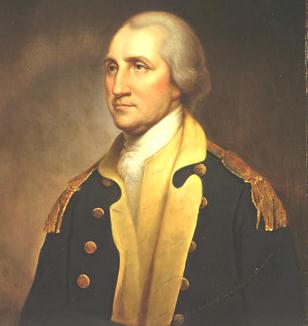
1778: Rembrandt Peale, US painter and writer.Rembrandt Peale, member of the famous Peale family of artists, painted hundreds of portraits. [portrait of George Washington >] Rembrandt Peale, born in Bucks County, Pennsylvania, was the son of Philadelphia artist and museum proprietor Charles Willson Peale, and his first wife Rachel Brewer, and the nephew of James Peale. He and his siblings, Rubens, Raphaelle (A Dessert), Titian Ramsay (Buffalo Hunt on the Platte), Sophonisba Angusciola, and Angelica Kauffmann (named after Swiss Neoclassical Painter Angelica Kauffmann [1741-1807] ), were born during the most productive years of their father's painting career and were named after European artists. Rembrandt Peale was a precocious artist, painting his first work, a self-portrait, at the age of thirteen. He continued to work as a portrait and history painter for almost seventy years, producing more than a thousand works. His most original works date from the first three decades of the nineteenth century. Although Philadelphia was his home town, Rembrandt worked at various times in most of the other major eastern United States cities, including Boston, New York, Baltimore, Washington and Charleston. As a young artist he benefited from his father's friendships and patronage in Federal America. He studied the work of contemporary painters, including Gilbert Stuart and Robert Edge Pine, as well as paintings by European artists that could be found in private collections. His father made it possible for him to paint life portraits of George Washington (1795) and Thomas Jefferson (1800, 1805). Charles Willson's ambitions also made him a museum director at times. In 1795-1798, for example, he went to Charleston, Baltimore, and New York City to paint portraits and exhibit sixty copies of his father's museum portraits, painted by himself and Raphaelle. In Baltimore in 1796-98 he managed the first Peale family museum outside of Philadelphia. In 1798-99 he worked as an itinerant artist in Maryland. In 1801 he assisted his father in unearthing the bones of prehistoric mammals in Newburgh, New York, and the following year he and Rubens took the skeleton assembled from these remains to England for exhibition. From 1813 to 1822 he established and managed the Peale Museum in Baltimore. More than was true for his father, Rembrandt benefitted as an artist from extended periods spent in European capitals. He studied briefly at the Royal Academy while in London in 1802-1803. He traveled to France in 1808, and again in 1809-1810, painting portraits of French scientists, artists and writers in Paris for his father's collection of portraits. His third European stay was in Italy, in 1828-1830, where he copied old master paintings for American collectors. On his last European trip, in 1832-1833, he returned to England. As a result, especially of the early trips, Rembrandt's style of painting changed, when he was still a young artist, from the tight, closely observed eighteenth century manner of his father, to a style strongly influenced by French neoclassicism and the work of Jacques-Louis David. His first attempt at a grand manner history painting was The Roman Daughter (1811). Even more ambitious was his enormous, multifigured painting of Court of Death (1820), whose theme of individual choice in creating a happy and rational life expressed the tenets of the new, controversial religion of Unitarianism. Next he turned his attention to creating a heroic portrait of Washington. His result was the painting known from its inscription as the "Patriae Pater" portrait — Washington as Father of his Country (1824). Later, in the 1840s, Peale returned to painting replicas of his portrait of Washington, capitalizing on the fact that he was the only living artist who had painted the first President's portrait at life sittings. While Rembrandt's ambitions and opportunities were very much derived from his father's energy and drive, the results and the context of his work was of his own generation. After his trips to England and Paris, Charles Willson Peale turned to him to learn new techniques for painting. His creation of an idealized portrait of Washington was a response to the nationalistic demands of the 1820s, marking the end of the Revolutionary era. His subject pictures of the 1830s and 1840s reflected the sentiments of the Victorian era. Rembrandt Peale was the husband of Harriet Cany Peale. Peale also promoted his theories of art and its role in a democracy by publishing brochures, articles and books. Some, like Description of the Court of Death; an Original Painting by Rembrandt Peale (1820), were written to accompany exhibitions of his work, held in several American cities. Others, including Graphics; A Manual of Drawing and Writing for the Use of Schools and Families (1835) and Introduction to Notes of the Painting Room (1852), were intended as drawing and painting manuals for mechanics and art students. He also wrote reminiscences of his life and family, poems, and accounts of his travels. From 1855 to 1857 he offered a personal history of US art in his Reminiscences and Notes and Queries published in The Crayon, a popular art periodical. He died in Philadelphia on 03 October 1860, the day before the 191th anniversary of the death of Rembrandt van Rijn, after whom he was named. — LINKS — Rubens Peale with a Geranium _ Rubens Peale with Geranium, (1801) — Portrait of Rosalba Peale (1820) — Michael Angelo and Emma Clara Peale (1826) — Falls of Niagara Viewed from the American Side (1831) — George Washington (1814) — Porthole Portrait of George Washington (1795, 90x74cm) _ In 1823 (1853?) Rembrandt Peale announced that he, one of the few living artists who had painted Washington from life, would create a portrait of the subject that would surpass all others in its authenticity and expression. The result was what has become known as the "porthole" Washington, from the trompe-l'oeil stone frame that surrounds the bust. Peale launched a publicity campaign that evidently worked, for it is estimated that between seventy-five and eighty replicas were produced. _ Although known as a member of one of the US's most famous artistic families, only recently has Rembrandt Peale emerged from the group as an individual who virtually embodied the industrious, experimental, yet above all fickle age of capitalism in which he lived. Ever seeking imaginative means by which to weave the production and appreciation of art into the fabric of the US's democratic enterprise-working in many of America's growing cities and founding a museum to foster national taste-Rembrandt Peale forged a career for himself characterized as much by failure as success. But, whereas such fits and starts were once considered reason to overlook him, the persistence with which he met them can be considered as the quality that makes him a quintessentially US painter. Raised in the long shadows of his accomplished artist-father, Charles Willson Peale, and the heroes and statesmen whose portraits lined the walls of his father's gallery, Rembrandt was, in a sense, surrounded by the achievements of past masters. The challenge to distinguish himself as an artist was compounded by a lack of public interest in the arts, his poor business skills, and his desire to depart from the well-trodden path of portrait painting. However, it was as a portraitist that Peale was able to support his large family and combine his high-minded, nationalist ideals with an art that appealed to a large audience. Having first painted George Washington in 1795, and having won acclaim for his Patriae Pater (1824), Rembrandt stated in the 1850s that his true calling was "to multiply the Countenance of Washington.113 By his death in 1860 he had done so no less than seventy-nine times, systematically producing simplified versions of the Patriae Pater that became known as the porthole portraits, of which the Butler Institute's is one. Possibly seeking to surpass his father in painting the US's great figures, Rembrandt sought to capture the visage of the founding father both for the edification of the public and as the crowning achievement of his career. He perceived himself singularly qualified to paint what he called the "standard likeness" of Washington, writing that, 'Among the few persons now living, who can speak of their own impressions . . . concerning the personal appearance of Washington, I may be supposed to have some claim on the confidence of the rising generation-educated to venerate the memory of him, who will always be 'first in the hearts of his countrymen!" Emphasizing the fact that he had painted Washington from life, Rembrandt supported his claim by soliciting testimonials from other men who knew Washington personally and could confirm the accuracy of his portrait. He sought to distinguish himself from other artists who had painted the first president from life, and at last to match the accomplishments of his father, whom he acknowledged as having painted "the first portrait of Washington in 1772. Rembrandt's insistence on the importance of his direct contact with Washington is ironic. With his subject long dead, his Patriae Pater and the subsequent porthole portraits were actually composites of his 1795 portrait and others he had admired, such as the famous bust by the French sculptor Jean-Antoine Houdon. Nevertheless, his enterprise was a success, coming at a time of renewed interest in Washington as a national hero. The importance of Rembrandt Peale's icon-making to the evolution of American culture has been confirmed most recently in the potency of 1960s Pop Art images, and by that movement's revelation of our society's ongoing interest in icon creation. — Gilbert Stuart (1805, 60x50cm) _ Charles Willson Peale accompanied his son and protégé, Rembrandt Peale, to Washington, DC, in 1805 to assist him in obtaining important portrait commissions that would establish him as a painter. It was at this time, for example, that the younger Peale painted the Society's portrait of Thomas Jefferson. This portrait of fellow-artist Gilbert Stuart was also painted in Washington at this time. — Thomas Jefferson (1805, 71x60cm) _ Rembrandt Peale first painted Jefferson in 1800 (oil at Peabody Insitute, Baltimore). In 1805 he and his father, Charles Willson Peale, went ot Washington where Rembrandt painted portraits of national celebrities to hang in their Philadelphia museum. When the Peale Museum was dispersed in 1854 this portrait was purchased by the subject's namesake, Thomas Jefferson Bryan, and subsequently given by him to The New-York Historical Society. |
| ^ Died on 22 February 1792:
Nicolas-Guy Brenet, French painter born on 30 June
1728. — He was the son of the medal-engraver Guy Brenet (fl 1716–1742). In 1754, after an apprenticeship with François Boucher, he entered the École Royale des Élèves Protégés, then directed by Carle Vanloo. In 1756 he went to the Académie de France in Rome, becoming the first student there to copy a work by Caravaggio (The Entombment). Returning to France in 1759 he stopped at Lyon, where he received important commissions from churches, including Laban Seeking his Images and The Miracle of the Building of the Church. These early works are characteristic of Brenet in their monumental compositions, balanced masses, solid forms and light, pearly coloring. He also painted a complete cycle of the Life of Christ (1762–1769), and throughout his career he maintained a connection with the Lyon area, painting the Healing of the Lame Man and The Martyrdom of Saint Peter in 1788 — Brenet's students included Jean-Germain Drouais, François Gérard, Pierre Guérin, Taraval, Nicolas-Antoine Taunay. LINKS — Respect for Virtue: Honors are Bestowed on connétable du Guesclin by the Town of Randon (1777, 383x264cm; 600x422pix, 120kb _ ZOOM to a bit blurry 1096x750pix, 90kb _ ZOOM+ to 1400x985pix, 386kb _ ZOOM++ to 2019x1420pix, 3276kb) _ Bertrand du Guesclin [1320 – 13 Jul 1380] is a national French hero, an outstanding military leader during the early part of the Hundred Years' War (1337–1453). After attaining the highest military position as connétable de France in 1370, he brilliantly used the strategy of avoiding set battles with the English until the French had sufficient advantage to defeat them soundly. Du Guesclin died while besieging Châteauneuf-de-Randon, not by enemy action, but after suffering from fever, allegedly from having drunk too much icy water after having fought under a hot sun. He dies on the very day that the enemy had fixed for surrender if no relief forces arrived. The painting shows the scene outside the city in the tent of du Guesclin, a few hours after his death, when the enemy, having surrendered as agreed, brings to his corpse the keys of the city. — Roland délivre de Torque la belle Olympe trahie par son amant Byre (59x88cm; 471x692pix, 83kb) _ Episode tiré vraisemblablement de Orlando furioso de Ludovico Ariosto [08 Sep 1474 – 06 Jul 1533] ou de Gerusalemme liberata de Torquato Tasso [11 Mar 1544 – 25 Apr 1595]. Ce tableau est un curieux spécimen du style troubadour dont Guy Brenet est réputé l'initiateur. Moins caractéristique à cet égard et moins important que La Courtoisie du chevalier Bayard (Salon de 1783) il lui semble, d'autre part, assez sensiblement antérieur. On ne crée pas du premier coup un type complet comme le tableau de Grenoble; entre eux se place sans doute l'éclatant et long succès de la pièce de Collé Une partie de chasse de Henri IV (1774). — Caius Furius Cressinus Accusé de Sortilège (1777, 324x326cm; 473x463pix, 91kb gif) _ sujet tiré de Pline l'Ancien Naturalis Historia (XVIII, 6) — Henri II Donne le Collier de l'Ordre de Saint-Michel au Maréchal de Tavannes, Après le Combat de Renty. 13 Août 1554 (1789, 381x236cm; 512x312pix, 43kb) _ Henri II [18 Apr 1503 – 29 May 1555] became king of Navarre upon the death of his mother, Catherine de Foix [1470 – 12 February 1517], and for the rest of his life attempted, mostly in vain, by force and negotiation to regain territories of his kingdom that had been lost in 1514 by her and his father, Jean III d'Albret [1469 – 24 Jun 1516]. At Renty, an army of the emperor Charles V was routed by an army led by Henri II's master of the hunt and great chamberlain, François de Lorraine 2ème duc de Guise [24 Feb 1519 – 24 Feb 1563]. The man receiving the decoration is count Gaspard de Saulx de Tavannes [Mar 1509 – 19 Jun 1573]. — Piété et générosité des dames romaines (1785, 324x257cm; 512x409pix, 65kb) |
| ^ Died on 22 February
1980: Oskar Kokoschka, Austrian Expressionist painter born on 01 March 1886. — Kokoschka was born at Pöchlarn an der Donau, Lower Austria. His mother came from a family of foresters in Lower Austria. His father came from a celebrated line of goldsmiths in Prague, but when Oskar was born his father worked as a commercial traveler for a jewelry firm. Oskar was the second of four children. A few months after he was born the family moved to Vienna, where he spend the early part of his life. In 1904 Kokoschka was awarded a state scholarship to attend the Kunstgewerbeschule (School of the Arts and Crafts). His intention was to become a art teacher. In 1908 he had his first exhibition or, more truly, he got the chance to show some of his work to the public, because The Klimt group came on a visit to Vienna. In 1909, he had his first exhibition at the "Internationale Kunstschau" and the same year he left the school. In 1910 Kokoschka went to Berlin for the first time to work with Walden. In 1912 his name became know in the art world around Europe, and he was normally on every important exhibition on the continent. In 1913 he married Alma Mahler [so der Maler married die Mahler] who built a house for him where he could work and where they lived for a year. After Alma had an abortion in 1914 their life together ended. On 01 August 1914, the First World War broke out. Oskar enlisted in one of the most prestigious regiments in the Austro-Hungarian army, the 15th Imperial-Royal Dragoons. He was send to the Eastern Front, where he got wounded. He was discharged from the army as unfit for active service. In 1918 Gustav Klimt died. Oskar wrote to his mother: "I cried for poor Klimt, the only Viennese artist who had any talent and character. Now I am his successor, as I once asked of him at the "Kunstschau", and I do not yet feel ready to take charge of that flock of lost sheep." Three years later he moved to Dresden as a professor at the academy. At this time in Germany there were fights between different political parties. In March 1920, a Rubens painting was damaged in crossfire. Oskar addressed an open letter to the population of Dresden: "I request all those who intend to use firearms in order to promote their political beliefs, …, to be kind enough to hold their military exercises elsewhere than in front of the art gallery in the Zwinger; for instance, on the shooting-ranges on the heath, where human civilization is in no danger… It is certain that in the future the German people will find more happiness and meaning in looking at the paintings that have been saved than in the totality of contemporary German political ideas." Later the same year he wrote to his family: "Since leaving Vienna I have been in love about nineteen times, all serious, single-minded ladies with plenty of heart…. Then I get love letters regularly, and they are like sunshine when the sun goes in; and so I can paint wonderful colors that glow". In 1922 he wrote to his father: "I believe, in all seriousness, that I am now the best painter on earth." [which only goes to show that he was not the best art critic] In 1923 he started the life of a traveling restless soul. He painted as we today use a camera. He traveled around and painted and traveled and painted. Later he moved to Paris and after he broke with his art-dealer he moved to Prague. During the Second World War, he was banned by the Nazi regime, but after the war he again was represented at every large exhibition. It was also then that he had his first exhibition in the US. Often his works where exhibited were jointly with those of artists such as Klimt or Schiele. Kokoschka was the founder of The Free German League of Culture, set up in London in 1939 just before the second world war started. Oskar died in a hospital in Montreux. — LINKS — Self-Portrait (1921 rough sketch, 36x24cm; 1/4 size, 19kb _ ZOOM to half~size, 70kb _ ZOOM to full size, 299kb) — Bride of the Wind (1914) — Walliser Landschaft (1947; 600x811pix _ ZOOM to 1400x1893, 439kb) — Die Jagd (1818; 600x904pix) — Ezra Pound (1964 rough sketch, 46x38cm; 1/6 size, 16kb _ ZOOM to 1/3 size, 60kb _ ZOOM to 2/3 size, 233kb) — 56 images at Bildindex |
| ^ Born on 22 February 1850: Fyodor
Aleksandrovich Vasil'yev, in Gatchina, near St. Petersburg,
Russia, landscape painter who died on 06 October 1873 in Yalta. — The son of a post-office employee, he did not receive any regular training in art, but in 1863 attended the school of drawing of the Society for the Encouragement of Artists in St Petersburg. He worked with the landscape painter Ivan Shishkin [1832-1898] on the island of Valaam in Lake Ladoga in 1867, and his friendship with Ivan Kramskoy greatly influenced the formation of his creative identity, as did his private study of the techniques of masters of Russian and foreign art, notably from the Düsseldorf and the Barbizon schools. Vasil’yev’s first original works date from 1866. By 1870 he was already widely known in the artistic circles of St Petersburg and Moscow as a highly poetic, unusually gifted landscape painter, and he gradually became noted for his naturalism. His paintings The Return of the Herd (1868) and the more mature The Thaw (1871), among others, received the highest awards in competitions held by the Society for the Encouragement of Artists. — The works of the wonderfully gifted landscape painter Feodor Alexandrovich Vasilyev, who died very young, are of great importance for Russian culture. Born into a poor family in 1850 he had to earn his living from the age of 12 years – he worked as a mailman, scriber, assistant to a restorer of pictures. After his father’s untimely death, he became the sole supporter of the family. In 1865, he managed to enter the evening classes of the School of Painting, sponsored by the Society for Promotion of Artists. Vasilyev’s exceptional talent required perfection, but the artist’s hard life barred its progress denying him the opportunity of a necessary technical training. While at School, Vasilyev got acquainted with many painters, who took care of him. He was especially friendly and close with Kramskoy and Shishkin, who took Vasilyev to work with them en plein-air and in travels throughout Russia. In Vasilyev’s early works, such as After a Thunderstorm (1868), Near a Watering Place (1868) and others, one can feel the influence of the Barbizon School; it affected his art but never resulted in a non-creative borrowing of the motifs. Though, at first, Vasilyev was somewhat inferior technically to the Barbizon painters, he eventually found his own way of handling the subject and After a Rain (1869) and After a Rain. Country Road. exceed in many respects, the Barbizon stormy scenes in their expressiveness and deeply national sound. In 1870, Vasilyev traveled on the Volga, the picture Volga View: Barges (1870) made him popular. In 1871, Vasilyev painted Thaw (1871), which made him famous immediately, even the tzar's family ordered a copy, the Society for Promotion of Artists awarded him first prize, he was admitted, as an intern, to the Academy of Arts. Vasilyev had not time to enjoy his popularity — he got seriously ill and had to leave St. Petersburg forever. He moved to Crimea. The Society for Promotion of Artists sponsored his stay there, but he was obliged to pay with his paintings. First Vasilyev could not get used to new scenery. He goes on to paint Russian plains; his works, such as his masterpiece Wet Meadow (1872), were done from memory, old sketches and imagination. After some time Vasilyev started to draw Crimean scenes, gradually beginning to feel an attraction to its mountain views. In the Mountains of Crimea (1873) is an outstanding work, the last one of Vasiyev. At the posthumous exhibition in St. Petersburg all his works had been sold even before the exhibition opened. What he did is enough to put Vasilyev among the best masters of Russian landscape painting. — LINKS |
| ^ Died on 22 February 1890: Carl Heinrich
Bloch, of cancer of the stomach, Danish painter born on
23 May 1834. — Bloch was born in Copenhagen. He studied under Wilhelm Marstrand at the Kunstakademi in Copenhagen. He created his work during the final years of the Golden Age of Danish painting (mid-19th century to the late 1870's). His early work includes genre scenes representing the everyday life of the people. Bloch depicted farm life, as in Boy Waking a Girl with a Feather (1856), and the life of the fishermen, as in Fisher Families Awaiting the Return of the Men in an Impending Storm (1858). From 1859 to 1866 Bloch lived in Italy, and this stay provided him with a rich source on his return, as in such humorous scenes of daily life as Monk with Toothache (1871). Bloch's stay in Italy was particularly important for his history painting. He was influenced by contemporary examples of the genre, and he produced large-scale historical works there. He achieved his greatest success when Prometheus Unbound (1864) was exhibited in Copenhagen in 1865. The painting shows Hercules freeing Prometheus; and in the political context of Denmark's recent defeat by Prussia, the Danish public did not fail to see the stirring implications of Danish resistance to tyranny and the hope for national reconstruction. After the death of Wilhelm Marstrand, Bloch finished the decoration of the ceremonial hall at the University of Copenhagen. His largest public commission was for 23 paintings for the Frederiksborg Palace Chapel (1865-1879). His figures are realistic, full of motion, color (look for the reds) and expression. His classic depictions of the Savior's life are familiar throughout the Christian world. — Christ at Gethsemane (600x485pix, 50kb) — The Sermon on the Mount (403x800pix, 49kb) _ detail (600x749pix, 102kb) — Christ Healing the Sick (400x600pix, 120kb) — The Crucifixion (1870; 593x468pix, 29kb) — The Resurrection (487x386pix, 23kb) — The Burial of Christ (376x293pix, 13kb) — 23 images at Hope Gallery |
| ^ Born on 22 February 1806: Antoine Joseph
Wiertz, Belgian painter who died on 18 June 1865. He specialized
in Historical Subjects. Wiertz was born in Dinant. A precocious draftsman, he was an admirer of Géricault. Wiertz was the son of a Dinan tailor who forced him to learn music, drawing and grammar from early youth. In 1820, studied at the Antwerp Academy. He spent 1829-1832 in France, won the Prix de Rome in 1832, stayed in Italy from 1834 to 1836 at the Académie de France in Rome, where, under the direction of Horace Vernet, he copied the great Italian masters. In 1838, exhibited his Patrocles in Paris. The unfavorable critical reaction determined him not to seek French citizenship. In 1850, the Belgian government financed the construction of a studio modeled on one of the Greek temples of Paestum. The style of Wiertz shows the inspiration of Rubens along with reminiscences of medieval painters, but expresses humanitarian and even revolutionary overtones. This is combined with wild invention and a frequently erotic Symbolism. His masterpiece is La Belle Rosine, in which a beautiful woman is placed before a skeleton. The work is halfway between traditional vanitas and Baudelairian meditation. — Wiertz was from very humble origins, but his talent for drawing was detected at an early age. He was sent to the Antwerp Academie, where he attended classes given by Wilhelm Jacob Herreyns [1743–1827] and Mathieu Ignace Van Brée. During a stay in Paris from 1829 to 1832 he came into contact with the Romantic painters, in particular Théodore Géricault, who fostered his admiration for Rubens. In 1832 Wiertz won the Belgian Prix de Rome and in 1834 left for Italy where the works of Raphael and, above all, Michelangelo made an overwhelming impression on him. In Rome he abandoned the landscapes and scenes from Roman life, for which he showed a certain talent, and embarked on a much more ambitious work, The Greeks and the Trojans Contesting the Body of Patroclus (1835). The painting proved the turning-point in Wiertz’s career. Its frenzied composition and violently contorted figures excited considerable interest in Rome. Children fled from it with cries of horror, a fact that delighted the painter. Bertel Thorvaldsen commented, ‘This young man is a giant’—a somewhat hasty judgement, constantly repeated by later biographers, which nevertheless determined his subsequent development. In Antwerp and Liège Wiertz was at once acclaimed. He then sent the picture to Paris, expecting final consecration of his genius. However, it was badly hung in the Salon, went unnoticed by the public and was criticized by the press. Wiertz’s bitter disappointment was expressed in an undying hatred of Paris, which he never ceased to attack for its dissipation, stupidity and artistic incompetence. In 1839 he settled in Liège with his mother, painting grandiose mythological and historical subjects, which he believed would immortalize him, and portraits to earn a living. The latter, such as The Artist’s Mother (1838), were passable, while the former were merely superficial pastiches of Rubens and Michelangelo. However, the new Belgian State was keen to discover ‘geniuses of the national art’ and admired his weakly Raphaelesque Education of the Virgin (1843) and in particular The Revolt of the Rebel Angels (1842), a huge picture that Wiertz painted in a few weeks, in an effort to match the panache of Rubens’s brushwork. — Wiertz is a little known, but fascinating example of a Romantic artist. He won the Prix de Rome, a paid fellowship which allowed him to paint in Rome, in 1832. On his return he was warmly welcomed in Belgium, but met with little success in the Paris Salon, to which he submitted several works. In 1850 the Belgian government offered to build a studio for him in exchange for a number of works or art. The studio is now a museum, and is located in the Parc Leopold, not far from the Cinquantenaire Park. Despite this official success, he never received the full measure of recognition that he felt his genius deserved. His paintings are often huge, matching his ambition and ego; in size, at least, he tried to rival Rubens. One patriotic canvas celebrating The Apotheosis of the Queen (1856) was projected to be 50 meters high, though it was never completed. Another aspect of his Romanticism was his strikingly imaginative subjects. He was drawn to morbid themes, such as the image of mortality embodied in The Two Beauties: La Belle Rosine (1847). Other astonishing works include The Suicide [detail: the suicide note] (1854), and The Last Thoughts and Visions of a Decapitated Head (1853) -- a triptych, no less. Despite the morbid nature of this triptych, Wiertz meant it to be a statement against capital punishment. The painting is in a poor state of preservation today, because Wiertz experimented with a variety of painting materials which did not hold up well. He disliked the slickness of oil paint and tried to create new techniques for achieving a matte surface. Although we do not know what crime the malefactor in Wiertz's painting had committed, the horror of his execution is starkly emphasized. The guillotine had been most well known as a tool of the French Revolution and especially the Reign of Terror, but had become also an instrument of the conservative Restoration. Many Romantic artists opposed the death penalty for political and humanitarian reasons. Although the guillotine was invented to be a more humane means of execution, doubt lingered as to whether death was really instantaneous. Wiertz seems to have been inspired by some of the writings of the period which speculated gruesomely on the last moments of consciousness of the severed head. An early novel by Victor Hugo, Le Dernier jour d'un condamné [PDF] (1828) seems particularly relevant. The horrific contrast of life and death is seen in a number of Wiertz's paintings. La Belle Rosine clearly derives from the same tradition of vanitas imagery as the painting of The Woman and Death of the early sixteenth century by Hans Baldung-Grien. The painting of the fabric and, to some extent, the flesh tones, show affinities with the style of Rubens. The picture is also known as The Two Beauties. The skeleton of the woman has a label pasted to her skull which identifies her as "La Belle Rosine." Death and Romantic horror obsessed Wiertz. He was particularly attracted to these themes in Romantic literature, and a number of his works are based on novels and stories. The Premature Burial of 1854 is clearly inspired by Edgar Allan Poe. Wiertz also painted images of Quasimodo and Esmerelda from Notre Dame de Paris by Victor Hugo. LINKS — Le Philosophe (109x90cm; 913x745pix, 36kb — ZOOM to 1826x1491pix, 145kb _ ZOOM++ to 2239x1828pix, 1646kb) _ detail: head (1021x1201pix, 78kb — ZOOM to head 1515x1189pix, 93kb + hand 510x1197pix, 30kb) — Self-Portrait undated — Self-Portrait (1860) — L'outrage à une Belge (1854; 480x369pix, 59kb) _ détail — Last Thoughts and Visions of a Decapitated Head (1853) _ detail 1 _ detail 2 _ detail 3 _ detail 4 _ detail 5 — Guillotined Head (1855) — Things of the Present Before the Men of the Future (1855) —Triptych Christ in the Tomb (1839, each section 134x67cm) |
^
Diedon 22 February 1987: Andrew
Warhola Andy Warhol US filmmaker, Pop
artist, born on 06 August 1928. He said: In the future everyone will
be famous for fifteen minutes. But he was not everyone.
He an initiator and leading exponent of the Pop art movement of the 1960s
whose mass-produced art apotheosized the supposed banality of the commercial
culture of the United States. An adroit self-publicist, he projected a concept
of the artist as an impersonal, even vacuous, figure who is nevertheless
a successful celebrity, businessman, and social climber. Author of The Philosophy of Andy Warhol (1975), Portraits of the Seventies (1979), Andy Warhol's Exposures (1979). Out of the tumultuous atmosphere of the 1960s came an artist who became the icon of the free spirit. Andy Warhol introduced the world, and particularly the artistically fertile US, to the idea of life as an art. Gone were the days of portraiture and classical sculpture this was the era of the movie star, the celebrity, and consumerism. Warhol looked at the life surrounding him and portrayed it on his canvases and in his films, stating that "if you want to know all about Andy Warhol, just look at the surface of my paintings and films and me, and there I am. There's nothing behind it." Yet, to critics, the most intriguing aspect of Warhol was his private life, an indefinable mixture of artistic creativity, mystery, and sexual scandal. It is this very inexpressibility that comes through in the artist's work, giving Warhol an aura of cool acceptability and ambiguity. Born Andrew Warhola on August 6, 1928, Warhol was one of three boys in a Czechoslovakian immigrant working-class family. Growing up during the Great Depression in Forest City, Pennsylvania, Warhol faced an unstable household, further complicated by the death of his father in 1942. Three years later, Warhol dropped out of high school and enrolled at the Carnegie Institute of Technology in Pittsburgh, where he received his BA in pictorial design in 1949. After graduation, Warhol moved to New York, living in a coed basement apartment. He was a strange one to the others, being very quiet, young, and having an unusually white pallor. Angry with Warhol for not speaking to her, one of the female occupants of the apartment once threw an egg at him, which hit him in the head. The quiet young artist spent most of his time drawing and taking his work around to agencies in a brown paper bag, as he did not have enough funds for a portfolio. Intrigued by the odd character who walked into her office holding a brown paper bag, Glamor art director Tina Fredericks commissioned Warhol to design shoes, inadvertently launching him into the world of commercial arts. Gaining the attention of exclusive shoe store I. Miller, Warhol was soon offered an appointment in their art department. In 1949, Warhol changed the spelling of his name because of a credit that mistakenly read "Drawings by Warhol" for the article "Success is a Job in New York". Around this time, his eyes began to bother him, and Tina Fredericks urged him to go to an oculist. Having been told he had "lazy eyes," Warhol wore opaque glasses that had a tiny pinhole for him to see through these became his signature accessory, even though they were hideous. Warhol dyed his hair a distinct silver, showing a flair for the dramatic that set him apart from other artists. With the name change and his position in the commercial field, the intrepid artist soon created a niche for himself, becoming known for his exploration of the shoe as a reflection of the person. Warhol captured the essence of various people in his shoes, creating the likeness of celebrities and friends on paper. It did not matter if the shoe features were in the right places I. Miller loved his drawings. He received the Art Directors' Club Medal for his shoe designs in 1957. Earlier, in 1952, the artist had his first solo exhibition, showing pictures drawn for Truman Capote's short stories; unfortunately, the exhibit did not make much of an impact in the art world. By this time however, Warhol had an agent, Fritzie Miller, who got him contracts with big magazines such as Vogue and Harper's Bazaar. He worked with Eugene Moore to create window displays for Bonwit's, a department store. The introspective artist, who wore only old clothes, radiated a charm and mystery in both his manner and work that began to be noticed by people in the business. During this period of development in his life, Warhol came into contact with other cultures, both local and abroad, that were to have an influence on his later artwork. In the mid-1950s, he was part of a theater crowd that focused primarily on the plays of Franz Kafka and Bertolt Brecht; Warhol especially admired Brecht's idea of realism and would later apply the philosophy to his work. Influences from abroad came through his six-week tour of Europe and Asia, where he began his own collection of modern art, buying works from artists such as Joan Miró and Larry Rivers. In the 1960s, Andy Warhol combined all of these early influences and experiences into a style that was distinctly his own and yet allowed others to be involved in the creative process. This came to be known in art history as American Pop art, a movement against the "original" as the bastion of the elite. Warhol's outlook on artwork focused not on the end result, the "original work of art," but on the creative processes that produced the work of art. Reflecting this philosophy was the artist's use of the silk-screen, a process that allowed multiple identical images to be produced by anyone: Warhol liked to have his friends create prints using his silk-screens. Most of Warhol's creative work at this time took place in his studio, which he called "the Factory". This work, done between 1962 and 1964, ranged from portraits of friends and celebrities to car crashes to electric chairs to consumer products. Perhaps the most famous of his Factory work consumer product images of Campbell's Soup, Brillo boxes, green stamps, and Coca-Cola distinctly point to Warhol's fascination with the US's growing identification with brand-name labels. In 1962 Warhol had his first show in the Stable Gallery. It was a huge success, widely reported in the press and fully sold out. His paintings, manufactured in the Factory, were bought almost as soon as they were shown. [Gullible] people stood in lines at exhibit openings to look at his work. A trendsetter, Warhol and his work were definitely a hot commodity. But in 1965, Warhol declared Pop art "dead" and decided to retire from painting; his last gallery exhibition at Leo Castelli in 1966 consisted of Cow Wallpaper and Silver Clouds. From 1966 onward, Andy Warhol concentrated on making films, initially intent on studying the lives of the people surrounding him. The first films for which he gained recognition were shot between 1963 and 1964, a total of eight hours, with the titles of Sleep, Kiss, Haircut, Eat, Blow Job, and Empire. Awarded the Independent Film Award by Film Culture, this series of films translated Warhol's philosophy on painting to the screen: the focus was not on the finished product (indeed, most of these films could never be mass-marketed [meaning they were flops?]), but on the creative [?] processes that went into the work. Just as Warhol emphasized the fact that others could use his silk-screens. and create paintings, so his films underscore the truth that anybody could take subjects and film them. Not only could the subjects be ordinary people, but Warhol also made this often-quoted prediction: "In the future everybody will be world-famous for fifteen minutes." Those made famous in Warhol's pictures included Baby Jane Holzer, Edie Sedgwick, Nico, Ingrid Superstar, Ultra Violet, and Viva. Warhol began working with a rock band called The Velvet Underground in 1965, introducing them to the chanteuse Nico; to the music of the band he orchestrated an interactive show consisting of images and lights and called it The Exploding Plastic Inevitable. The mixed media showcase created an international sensation when it opened at the DOM nightclub in New York City. It was an onslaught on the senses, and it described in music and art the feeling of the young US. Much has been speculated about Andy Warhol's sex life. He featured both men and women in his artistic endeavors, and his entourage was a mingling of the two sexes. Most people tend to think Warhol was gay, and he did have boyfriends. However, it is a mystery as to whether or not he actually was intimate with these men; Warhol's attitude was more asexual than homosexual. On 03 June 1968, Valerie Solanas, the mentally unstable founding member of SCUM (Society for Cutting Up Men), shot Andy Warhol two times in the stomach; she had mistaken him for a kind of god, telling police that "he had too much control over my life." Warhol spent two months in the hospital recovering from the wounds. This shooting was the inspiration for the 1996 film entitled I Shot Andy Warhol. In 1968, Warhol tackled the next level in the artistic medium and wrote a novel called a. a demonstrated the philosophy Warhol had expressed previously on canvas and reel it did not take an accomplished author to write a paper. In order to prove his idea, Warhol recorded twenty-four hours of conversation that occurred within the Factory and entitled it a. In 1969, he founded the magazine inter/View, and in 1975 he published The Philosophy of Andy Warhol: From A to B and Back Again. Warhol died in February of 1987 from gall bladder surgery complications. For almost two decades, Andy Warhol had maintained the position of an infamous media icon, notorious for his parties and respected for his artistic taste; he backed young and upcoming artists, lending his support to the development of modern art in the US. He had lived for 58 years, helping to develop a new scene for US art and a new ideology in the artist's lexicon. Andy Warhol's impact on the art world cannot be overlooked, and his influence lingers to this day, "I'd prefer to remain a mystery. I never like to give my background and, anyway, I make it all up different every time I'm asked." He was one of the most enigmatic figures in US art. His work became the definitive expression of a culture obsessed with images. He was surrounded by a coterie of beautiful bohemians with names like Viva, Candy Darling, and Ultra Violet. He held endless drug- and sex-filled parties, through which he never stopped working. He single-handedly confounded the distinctions between high and low art. His films are pivotal in the formation of contemporary experimental art and pornography. He spent the final years of his life walking around the posh neighborhoods of New York with a plastic bag full of hundred dollar bills, buying jewelry and knicknacks . His name was Andy Warhol, and he changed the nature of art forever. Andy Warhol's exact birth date is unknown, though one can assume it is between 1927 and 1930. What is known is that he was born to Czechoslovakian immigrant parents in Forest City, Pennsylvania. He was a shy quiet boy, leaving high school to attend the Carnegie Institute of Technology in Pittsburgh. He received his bachelors of fine arts degree from there in 1949, and headed immediately to New York. In New York, Warhol found design jobs in advertising. Before long he had begun specializing in illustrations of shoes. His work appeared in Glamour, Vogue, and Harper's Bazaar. In the mid-'50s he became the chief illustrator for I. Miller Shoes, and in 1957 a shoe advertisement won him the Art Director's Club Medal. During this time, Warhol had also been working on a series of pictures separate from the advertisements and illustrations. It was this work that he considered his serious artistic endeavor. Though the paintings retained much of the style of popular advertising, their motivation was just the opposite. The most famous of the paintings of this time are the thirty-two paintings of Campbell soup cans. With these paintings, and other work that reproduced Coca-Cola bottles, Superman comics, and other immediately recognizable popular images, Warhol was mirroring society's obsessions. Where the main concern of advertising was to slip into the unconscious and unrecognizably evoke a feeling of desire, Warhol's work was meant to make the viewer actually stop and look at the images that had become invisible in their familiarity. These ideas were similarly being dealt with by artists such as Jasper Johns, Roy Lichtenstein, and Robert Rauschenberg and came to be known as Pop Art [many people prefer pop-tarts]. Throughout the late 1950s and 1960s, Warhol produced work at an amazing rate. He embraced a mode of production similar to that taken on by the industries he was mimicking, and referred to his studio as "The Factory." The Factory was not only a production center for Warhol's paintings, silk-screens, and sculptures, but also a central point for the fast-paced high life of New York in the '60s. Warhol's obsession with fame, youth, and personality drew the most wild and interesting people to The Factory throughout the years. Among the regulars were Mick Jagger, Martha Graham, Lou Reed, and Truman Capote. For many, Warhol was a work of art in himself, reflecting back the basic desires of an consumerist US culture. He saw fame as the pinnacle of modern consumerism and reveled in it the way artists a hundred years before reveled in the western landscape. His oft-repeated statement that "every person will be world-famous for fifteen minutes" was an incredible insight into the growing commodification of everyday life. By the mid-'60s Warhol had become one of the most [in]famous [so-called] artists in the world. He continued, however, to baffle the critics with his aggressively groundbreaking work. Putting aside much of the "pop" imagery, he concentrated on making films. His films, as his paintings had been, were primarily concerned with getting the viewer to look at something for longer than they otherwise would. Using film, Warhol could control the viewer's attention. One of his most [in]famous films, Sleep (1963), was eight hours [others say 6, but who can stay awake long enough to tell?] of the poet John Giorno asleep in his bed. Warhol's movement into film directing and production brought him into contact with dozens of artists and actors interested in working in The Factory. One of these was actress and writer Valerie Solanas, who had for some time been trying to get Warhol to produce one of her scripts. In 1968, in anger at Warhol's disinterest, Solanas (the founder and only member of S.C.U.M., the Society for Cutting Up Men), shot and nearly killed Warhol. During Warhol's extended convalescence he began to work on a new mode of art. Considered his "Post-Pop" period, the images were primarily portraits of living superstars. Throughout the '70s and '80s, Warhol produced hundreds of portraits, mostly in silk screen. His images of Liza Minnelli, Jimmy Carter, Albert Einstein, Elizabeth Taylor, and Philip Johnson express a more subtle and expressionistic side of his work. During the final years of his life, Warhol became the hero of another generation of artists, including Keith Haring, Jean-Michel Basquiat, and Francesco Clemente. Their work represents a continuation of an artistic [?] revolution begun by Andy Warhol. Warhol died of heart failure at his home in New York. Many suggested it was a poorly performed minor surgery he had had earlier that day, while others believed it was due to the general weakening of his body after the shooting. What remains certain is that during the sixty years of whirlwind and mystery that was Andy Warhol's life, the art world (and the world at large) became a more fun and interesting place. Born in Pittsburgh of Czechoslovak immigrant parents. In 1954 he left school with a high school diploma. Between 1945 and 1949 he studied pictorial design and art history, sociology and psychology at the Carnegie Institute of Technology, Pittsburgh. Met Philip Pearlstein and moved to New York with him in 1949. He worked for Vogue and Harper's Bazaar, did window displays for Bonwit Teller and his first advertisements for I. Miller shoe company. In 1952 Warhol designed stage sets, dyed his hair straw-blond and moved into a house in Lexington Avenue with his mother and several cats. In 1954 he was in a collective exhibition at the Loft Gallery, New York. In 1956 his Golden Shoes were exhibited. He traveled in Europe and Asia. In 1960 he made his first pictures based on comic-strips and company trade names. In 1962 he produced his silk-screen prints on canvas of dollar notes, Campbell's Soup cans, Marilyn Monroe, etc. He started his series of disaster pictures: Car Crash, Plane Crash, Suicide, Tunafish Disaster and Electric Chair. Between 1962 and 1964 he produced over 2000 pictures in his "Factory". In 1963 he made the movies Sleep (6 hours long, a great cure for insomnia) and Empire (8 hours long). In 1964 his Flower Pictures were exhibited at the Galerie Sonnabend, Paris. He was also forced for political reasons to paint over his Thirteen Most Wanted Men which he had attached to the wall of the New York State Pavilion for the World's Fair in New York. He made his first sculptures with affixed silk-screen prints of company cartoons. In 1967 he produced the first record of the rock band "the Velvet Underground" and between 1966 and 1968 made several films with them. His Cow Wallpaper and Silver Pillows were shown at the Leo Castelli Gallery. In 1968 he had an exhibition at the Moderna Museet, Stockholm. In July 1968 Warhol was shot down, and dangerously wounded, by Valerie Solanis, the only member of S.C.U.M. (The Society for Cutting Up Men). In 1968 he brought out his novel "a", which consisted of telephone calls recorded in his Factory. He made his first movie for the cinema, Flash, with Paul Morissey, followed by Trash [a title that would be appropriate for much of Warhol's work] in 1970. In 1969 appeared the first number of the magazine Interview, which Warhol helped bring out. Between 1969 and 1972 he was commissioned to do a number of portraits. In 1972 he showed at the the Kunstmuseum, Basle. The first edition of his book The Philosophy of Andy Warhol (From A to B and Back Again) was published in 1975. In 1980 Warhol became production manager of the cable TV station "Andy Warhol's TV". From 1982 to 1986 Warhol made pictures of disasters. In 1982 he exhibited a series of oxidations and pictures of Nazi architecture at the documenta "4" exhibition, Kassel. He exhibited Guns, Knives, Crosses and Animals: Species at Risk. In 1986 he made portraits of Lenin and self-portraits. In 1987 he died as a result of an operation. Death Pictures was shown in 1988. Andy Warhol's media fame has often disguised the fact that he is one of the most serious and important artists of the twentieth century. He quite simply changed how we see the world around us and how we see art. His work presents images of twentieth-century mass culture in a flat graphic style that mimics deliberately common source material. He was one of the first artists to recognize that art was being usurped by television, fashion and film, and he began to deal with art in those terms. He fused image and techniques of illustration and mechanical reproduction from his commercial art background into his work. The first artist to have done so, he opened the door for other artists to follow in his footsteps, among US Pop artists, Warhol was the first and foremost. In 1962, Warhol created the first of a series of oversized Campbell's Soup cans. These paintings captured the imagination of the media and the public in a way that no work by any of Warhol's contemporaries had, and created worldwide recognition for this new US art, quickly labeled Pop Art. It was condemned by many critics as consumerism, but was enthusiastically received by the art public, particularly in Europe and Japan and other places fascinated by Hollywood and all things from the US. Throughout his career, Warhol remained true to the Pop technique and iconography which he defined for himself. In the 1970s, while maintaining his own enviable celebrity status, Warhol began exploring the dimensions of stardom. He created portraits of hundreds of international celebrities: political figures, royalty, musicians, and movie stars. He partied almost nightly with a glittering set of "beautiful people" and found that he had the power to create "superstars" through his art, films, Interview, or through mere association with the artist himself. From the beginning, Warhol insisted on the power of the familiar, indeed one of the main qualities of Warhol's images is their extreme obviousness: the most famous brand names (Campbell's Soup, Coca-Cola), the most famous people (Elvis, Marilyn Monroe), the most famous paintings (the Mona Lisa), and the most famous objects (money, newspapers). Warhol's art teaches us to accept our own present society, the late twentieth century, in all its richness and triviality. Marcel Duchamp defined Dadaist "Ready-made" art in 1913 when he displayed a sculpture consisting of a bicycle wheel upended on a stool. Warhol understood the Dadaist's contempt for the traditional notions of what constitutes a work of art, and their suggestion that the essential factor in the creation of art is not necessarily skill but choice. Duchamp was, not surprisingly, an admirer of Warhol's work as well. He summed up our fascination and perplexity with Warhol by making the observation, "What interests us is the concept that he wants to put fifty Campbell's Soup cans on a canvas." It s, indeed, a concept that changed the way we see art and how we see ourselves. Warhol was an initiator and leading exponent of the Pop art movement of the 1960s whose mass-produced art apotheosized the supposed banality of the commercial culture of the United States. An adroit self-publicist, he projected a concept of the artist as an impersonal, even vacuous, figure who is nevertheless a successful celebrity, businessman, and social climber. The son of Czechoslovak immigrants, Warhol graduated from the Carnegie Institute of Technology, Pittsburgh, with a degree in pictorial design in 1949. He then went to New York City, where he worked as a commercial illustrator for about a decade. Warhol began painting in the late 1950s and received sudden notoriety in 1962, when he exhibited paintings of Campbell's soup cans, Coca-Cola bottles, and wooden replicas of Brillo soap pad boxes. By 1963 he was mass-producing these purposely banal images of consumer goods by means of photographic silk screen prints, and he then began printing endless variations of portraits of celebrities in garish colors. The silk screen technique was ideally suited to Warhol, for the repeated image was reduced to an insipid and dehumanized cultural icon that reflected both the supposed emptiness of American material culture and the artist's emotional noninvolvement with the practice of his art. Warhol's work placed him in the forefront of the emerging Pop art movement in the US. Andy Warhol would become one of the most influential artists of the latter part of the 20th century. He is born Andrew Warhola in Pittsburgh, Pennsylvania. A frail and diminutive man with a shock of silver-blond hair, Warhol was a major pioneer of the pop art movement of the 1960s but later outgrew that role to become a cultural icon. Warhol was the son of immigrants from Czechoslovakia, and his father was a coal miner. For years, there was confusion as to his exact date and place of birth because Warhol gave conflicting accounts of these details, probably out of embarrassment of his provincial origins. "I'd prefer to remain a mystery," he once said. "I never give my background and, anyway, I make it all up different every time I'm asked." He enrolled in the Carnegie Institute of Technology and graduated with a degree in pictorial design in 1949. That year, he moved to New York City, where he found work as a commercial illustrator. After being incorrectly credited as "Warhol" under an early published drawing, he decided to permanently remove the "a" from his last name. He began painting in the late 1950s and took literally the advice of an art teacher who said he should paint the things he liked. He liked ordinary things, such as comic strips, canned soup, and soft drinks, and so he painted them. In 1962, he received notoriety in the art world when his paintings of Campbell's soup cans, Coca-Cola bottles, and wooden replicas of Brillo soap-pad boxes were exhibited in Los Angeles and New York. In 1963, he dispensed with the paintbrush and began mass-producing images of consumer goods and celebrities like Marilyn Monroe and Jackie Kennedy. These prints, accomplished through his use of a silk-screen technique, displayed multiple versions of the same image in garish colors and became his trademark. He was hailed as the leader of the pop art movement, in which Warhol, Roy Lichtenstein, and others depicted "popular" images such as a soup can or comic strip as a means of fusing high and low culture and commenting on both. Although shy and soft-spoken, Warhol attracted dozens of followers who were anything but. This mob of underground artists, social curiosities, and hangers-on operated out of the "Factory," Warhol's silver-painted studio in Manhattan. In the mid-1960s, Warhol began making experimental films, employing his friends as actors and billing them as "superstars." Some of his films were monumental essays on boredom, such as the eight-hour continuous shot of the Empire State Building in Empire (1964), and others were gritty representations of underground life, like The Chelsea Girls (1966). He also organized multimedia events such as "The Exploding Plastic Inevitable" and sponsored the influential rock group the Velvet Underground. In 1968, Warhol was shot and nearly killed by Valerie Solanis, a follower who claimed he was "exercising too much influence" over her life. After more than a year of recuperation from his wounds, Warhol returned to his career and founded Interview magazine, a publication centered on his fascination with the cult of celebrity. He became a fixture on the fashion and jet-set social scenes and was famous for pithy cultural observations like, "In the future, everyone will be famous for 15 minutes." Meanwhile, he continued to produce commercially successful silk-screen prints of entertainment and political figures. In the 1980s, after a period of relative quiet in his career, he returned to the contemporary art scene as a mentor and friend to a new generation of artists, including Keith Haring and Jean-Michel Basquiat. With the rise of postmodern art, he came to be regarded as an archetypal role model by many young artists. Warhol died in a hospital, of a heart attack, shortly after a gall bladder operation. In 1994, the Andy Warhol Museum, the largest single-artist museum in the United States, opened in Pittsburgh. LINKS Polaroid Self~Portrait PICTORIAL SATIRE OF WARHOL'S POLAROID SELF~PORTRAIT (believed to be by “Troudgair”, or possibly by “Kriegsloch”, or even by “Bernardiendo Roderironico Osvaldorado Minimaximiliano Artemístico Guerra y Agujero de Nomedigas y Yabasta”, more commonly known as “Nombresinfin”) — Do It Yourself (Seascape) (1962) The Souper Dress (1960) Liz (1964, 56x56cm; 1/4 size, 30kb, there is not any more detail to be seen by enlarging, but, if you want to prove it to yourself, ZOOM to half~size, 98kb _ not convinced yet? then ZOOM+ to full size) Campbell's Tomato Soup (from a banner) (1968, 38x25cm; 1/4 size, 20kb, which is larger than you really need, but, if you insist on an enlargement, this is a free website, so go right ahead and ZOOM to half~size, 56kb, or, if your eyes are so bad that you cannot read this warning and you cannot find your eyeglasses, then, and only then, it might make some sense to ZOOM+ to full size, 184kb) The Velvet Underground and Nico (1967, 31x31cm) a bruised banana Kimiko Powers 1971~1972 (1972, 56x56cm) Birmingham Race Riot (1964, 51x61cm) Flowers (1964, 56x56cm) Marilyn Monroe [x 50] (1962) — Jacqueline Kennedy II, pl. 5 from Eleven Pop Artists [x 2] (1965, 61x76cm; 1/4 size) grainy monochrome — untitled, plate on p. 112 and p. 113 in the book 1¢ Life (1964 double-page color lithograph, 30x60cm together; full size) _ mouth x 6, with a nonsense “poem”, White Jade Butterfly" at the bottom. — Bill Graham Presents (8) "Pop-Op Rock" Andy Warhol and His Plastic Inevitable; Velvet Underground, Fillmore Auditorium, 5/27-29/66 (1966) _ words only |