| ART “4” “2”-DAY
21 February v.5.11 |
| DEATHS:
1894 CAILLEBOTTE
1862 AUDUBON |
| ^
Born on 21 February 1865: Grace
Carpenter (Davis) (Hudson),
US painter who died of coronary occlusion on 23 March 1937. |
| ^
Died on 21 February 1894: Gustave Caillebotte,
French painter and collector born on 19 August 1848. Caillebotte’s parents, of Norman descent, were wealthy members of the Parisian upper middle class, and his paintings often evoke his family background. After studying classics at the Lycée Louis Le Grand, he obtained a law degree in 1870, and during the Franco–Prussian War he was drafted into the Seine Garde Mobile (1870–1871). He joined Léon Bonnat’s studio in 1872 and passed the entrance examination for the École des Beaux-Arts on 18 March 1873. The records of the École make no mention of his work there, and his attendance seems to have been short-lived. He was very soon attracted by the innovative experiments, against academic teaching, of the young rebels who were to become known as the Impressionists. In 1874 Edgar Degas, whom Caillebotte had met at the house of their mutual friend Giuseppe de Nittis, asked him to take part in the First Impressionist Exhibition at the Nadar Gallery in the Boulevard des Capucines in Paris. However, it was only at the time of their second exhibition in April 1876 that, at Auguste Renoir’s invitation, Caillebotte joined the Impressionist group. From then on he was one of the most regular participants in their exhibitions (1877, 1879, 1880, 1882). He organized the show of 1877 and made great efforts to restore the cohesion of the group by persuading Claude Monet to exhibit in 1879. Having inherited a large fortune from his parents, Caillebotte had no need to sell his pictures and could afford to provide crucial financial assistance for his artist friends. He purchased their work, much disparaged at the time, and amassed the famous collection of Impressionist masterpieces that he left to the State. LINKS Self-Portrait (1892; 841x814pix, 64kb _ ZOOM to 1918x1527pix, 191kb) Périssoires sur l'Yerres (1877, 103x156cm; 748x1175pix, 113kb _ ZOOM to 997x1567pix, 185kb _ ZOOM++ to 1400x2198pix) Périssoires, venant (1877; 748x1175pix, 113kb _ ZOOM to 2109x2762pix, 762kb) Périssoires, partant (1878; 748x1175pix, 113kb _ ZOOM to 1423x1006pix, 762kb) Le Pont de l'Europe à Paris (1876; 804x1183pix, 87kb _ ZOOM to 1006x1479pix, 139kb _ ZOOM++ to 1676x2465pix, 300kb) _ The iron trellis overlooks the Saint-Lazare train station (not seen in this picture), which was portrayed by Monet in a dozen paintings made in early 1877, and included at the third Impressionist exhibition that year, at which Caillebotte (who soon purchased three of Monet's variations) did not show his Le Pont de Europe à Paris, possibly not to detract from Monet's paintings. Sur le Pont de l'Europe (1877, 106x131cm; 600x755pix, ZOOM to 1400x1762pix, 594kb) _ Very different from the preceding. This one shows only a small section of the trellis, with a few persons, seen from the back, who have stopped to look at the train station, partly seen in the background. Raboteurs de Parquets (1875, 106x131cm; 795x1132pix, 96kb _ ZOOM to 1192x1696pix, 202kb _ ZOOM to 1788x2544pix, 252kb) _ This was Caillebotte's first painting to be exhibited, at an Impressionist exhibition in 1875. At the time, the painting, with its dramatic perspective and ocher tones, was dismissed as vulgar. Today, it is considered a major work of the time. a quite different Raboteurs de Parquets (1876; 600x852pix, 137kb) _ This one is not as well known. The two planers are seen from their left side instead of three planers, two of them seen of head-on, in the preceding picture. — Le Peintre sous son Parasol (1878, 80x65cm) _ The subject is Caillebotte's friend Édouard Dessommes, painting at Yerres. Nu au Divan (1880, 130x196cm; 868x1185pix, 182kb _ ZOOM to 1303x1956pix, 461kb) _ This picture belongs with a group of studies of male and female nudes painted by Caillebotte about 1880. It is unique, however, for the uncompromising realism of its anatomical observation and for its apparent sexual innuendo. The model would eventually become Caillebotte's mistress. The artist has challenged the prevalent standards of taste and morality, which accepted in paintings only the academic tradition of idealized nudes. Because of its effrontery, this picture was neither exhibited nor sold during Caillebotte's lifetime. — 187 images at the Athenaeum |
| ^
Born on 21 February 1830: Henry
Wallis, English Pre-Raphaelite
painter, writer, and collector, who died on 20 December 1916. Wallis studied at the Royal Academy Schools of Art, and also at Gleyre's studio and the Beaux Arts in Paris between 1840 and 1850. He was a prolific painter and in later years painted in Italy, Sicily and Egypt. His most famous work is The Death of Chatterton, which portrays the death of the 17 year old poet Thomas Chatterton, who committed suicide by taking arsenic. Chatterton was a brilliant young poet, influencing Keats and Wordsworth, who called him 'the Marvellous Boy'. The model for the dead poet was George Meredith, then aged about 28. Two years later Meredith's wife eloped with Wallis. Wallis painted the picture in the actual attic in Gray's Inn where Chatterton died. Wallis first studied at F. S. Carys academy and in 1848 entered the Royal Academy Schools, London. He is also thought to have trained in Paris at some time in the late 1840s or early 1850s, first in Charles Gleyres atelier and subsequently at the École des Beaux-Arts. He specialized in portraits of literary figures and scenes from the lives of past writers, as in Dr. Johnson at Caves, the Publisher (1854). His first great success was the Death of Chatterton , which he exhibited at the Royal Academy in 1856. The impoverished late 18th-century poet Thomas Chatterton, who while still in his teens had poisoned himself in despair, was a romantic hero for many young and struggling artists in Walliss day. He depicted the poet dead in his London garret, the floor strewn with torn fragments of manuscript and, tellingly, an empty phial near his hand. The painting was universally praised, not least by John Ruskin who described it as faultless and wonderful, advising visitors to examine it well, inch by inch. Although Wallis was only loosely connected with the Pre-Raphaelite movement, his method and style in Chatterton reveal the importance of that connection: the vibrant colors and careful build-up of symbolic detail are typical Pre-Raphaelite concerns. The success of Chatterton was such that, when exhibited in Manchester the following year, it was protected from the jostling crowds by a policeman. It was bought by another artist, Augustus Egg. Wallis's next success came in 1858 with the exhibition at the Royal Academy of The Stonebreaker. Accompanied by quotations from Tennyson's poem A Dirge (1830) and Thomas Carlyle's Sartor resartus (1834), its theme was the human cost of hard labor and poverty. It showed a dead stone-breaker slumped by the roadside in a symbolically twilit landscape. Although Wallis was not the first to portray such hardships, his painting attracted much attention through its combination of shocking realism and glorious sunset. Critics disagreed about it: The Illustrated London News proclaimed it ‘shocks the sight and offends the sense', while The Spectator found it ‘a picture of the sacredness and solemnity which dwell in a human creature, however seared, and in death, however obscure'. In the early 1860s Wallis was an exhibitor, along with various Pre-Raphaelites, at the Hogarth Club, London. He also continued to show history paintings, many with a literary theme, at the Royal Academy until 1877. His work was engraved for the Art Journal, for example Found at Naxos, which appeared in 1878. He was also a prolific watercolorist, exhibiting over 80 examples at the Old Water-Colour Society, to which he was elected in 1880. He traveled widely in Europe and the Near East; many of his later paintings show scenes or events apparently witnessed during the course of his travels, such as Winnowing Corn, Capri (1862) and a watercolor of A Coffee Merchant, the Bazaar at Suez, exhibited at the Old Water-Colour Society in 1887. In late life he made less impact as a painter than he did as an authority on Italian and oriental ceramics, about which during the last two decades of his life he wrote a number of books and articles, many of them illustrated by his own drawings. He also built up a huge collection of ceramics, which is now in the Victoria and Albert Museum. In the 1890s he was also involved in campaigns to preserve ancient Egyptian monuments. LINKS The Stonebreaker (1857, 65x79cm; 639x781pix, 98kb _ ZOOM to 960x1172pix, 139kb _ ZOOM+ to 1919x2344pix, 603kb) The Death of Chatterton (1856, 61x91cm; 96kb) _ The painting was exhibited with the following quotation from Marlowe: 'Cut is the branch that might have grown full straight / And burned is Apollo's laurel bough.' La peinture fait référence à l'idée de l'artiste martyre de la société. La lumière pâle de l'aube brille par la fenêtre illuminant le poète et sa chair blême, des feuilles de poésie sont déchirées sur le plancher. L'éclairage dur, les couleurs, la main et le bras sans vie augmentent l'impact émotif de la scène. Une fiole de poison sur le plancher indique la méthode de suicide. Wallis a essayé de recréer avec la même vérité le grenier de l'auberge où Chatterton s'est tué. Le romancier George Meredith [1828-1909] lui sert de modèle. _ another version, almost identical except for size: The Death of Chatterton (1856, 17x25cm; full size, 89kb) _ Thomas Chatterton [20 Nov 1752 – 24 Aug 1770] was the chief poet of the 18th-century “Gothic” literary revival, England's youngest writer of mature verse, and a precursor of the Romantic movement. At first considered slow in learning, Chatterton had a tearful childhood, choosing the solitude of an attic and making no progress with his alphabet. One day, seeing his mother tear up as waste paper one of his father's old French musical folios, the boy was entranced by its illuminated capital letters, and his intellect began to be engaged. He learned to read far in advance of his age but only from old materials, music folios, a black-letter Bible, and muniments taken by his father from a chest in the Church of Saint Mary Redcliffe. At seven Chatterton entered Colston's Hospital, but his learning was acquired independently. His first known poem was a scholarly Miltonic piece, “On the Last Epiphany,” written when he was 10. About a year later an old parchment he had inscribed with a pastoral eclogue, “Elinoure and Juga,” supposedly of the 15th century, deceived its readers, and thereafter what had begun merely as a childish deception became a poetic activity quite separate from Chatterton's acknowledged writings. These poems were supposedly written by a 15th-century monk of Bristol, Thomas Rowley, a fictitious character created by Chatterton. The poems had many shortcomings both as medieval writings and as poetry. Yet Chatterton threw all his powers into the poems, supposedly written by Rowley, in such a manner as to mark him a poet of genius and an early Romantic pioneer, both in metrics and in feeling. In 1767 Chatterton was apprenticed to a Bristol attorney but spent most of his time on his own writing, which for a while he turned to slight profit in Felix Farley's Bristol Journal and Town and Country Magazine. The life was irksome to him, however, and pressures began to build up, compounded of a fight for a free press, contempt for Bristol and his dowdy family, a philandering attitude to local girls, and the “death” of Rowley. Chatterton sent James Dodsley, the publisher, letters offering some of Rowley's manuscripts, but Dodsley ignored him. Horace Walpole [24 Sep 1717 – 02 Mar 1797] received similar offers and at first was enchanted with the “old” poems; but, when advised by friends that the manuscripts were modern, he treated Chatterton with chilly contempt, advising him in a letter to stick to his calling. Chatterton rewarded him with bitter but noble lines. By a mock suicide threat, “The Last Will and Testament of me, Thomas Chatterton of Bristol”, he forced his employer, John Lambert, to release him from his contract and set out for London to storm the city with satires and pamphlets. A lively comic opera, The Revenge, brought some money, but the death of a prospective patron quenched Chatterton's hopes. At this time he wrote the most pathetic of his Rowley poems, “An Excelente Balade of Charitie.” Though starving, Chatterton refused the food of friends and, on the night of 24 August 1770, took arsenic in his Holborn garret (into which he had moved in June 1770) and died. This gave him a posthumous fame. The just tributes of many poets came after controversy between the“Rowleians” and those who rightly saw Chatterton as the sole author. Coleridge wrote a “Monody” to him; Wordsworth saw him as “the marvelous boy”; Shelley gave him a stanza in “Adonais”; Keats dedicated Endymion: A Poetic Romance to him and was heavily influenced by him; and Crabbe, Byron, Scott, and Rossetti added their praise. In France the Romantics hailed his example, and the historically inaccurate play Chatterton by Alfred de Vigny [27 Mar 1797 – 17 Sep 1863] was the model for an opera by Ruggero Leoncavallo. The Room in Which Shakespeare Was Born (1853, 29x42cm) _ Wallis launched his career exhibiting a sequence of paintings of interior scenes connected with the life of Shakespeare [1564-1616]. This one showing the playwright's birthplace in Stratford-upon-Avon is based on a passage from a contemporary biography by Charles Knight (1842) describing 'the mean room, with its massive joists and plastered walls, firm with ribs of oak'. Wallis has painted the room in remarkable detail. Every nail securing the floorboards is visible. And Wallis has even taken note of Knight's passage describing how 'hundreds amongst the hundreds of thousands by whom that name is honoured have inscribed their names on the walls of the room. Bank of England & Royal Exchange, Cornhill, with King William Street (engraving, 20x41cm; full size) |
| ^
Died on 21 February 1862: John
Woodhouse Audubon, US painter, specialized in wildlife,
born on 30 November 1812. John Woodhouse Audubon in Henderson, Kentucky, the second son of the artist and naturalist John James Audubon [26 Apr 1785 27 Jan 1851], the famous painter of birds. At an early age J.W. showed artistic promise and was encouraged to join his father in his scientific interests. While his brother Victor Gifford Audubon [1809-1860] assisted with the business and record-keeping functions related to the various Audubon publications, John Woodhouse was an active traveler and collector of specimens, as well as a draftsman. In 1833 he accompanied his father on an expedition to Labrador. Later that same year John James was able to write, "John has drawn a few Birds, as good as any I ever made, and in a few months I hope to give this department of my duty up to him altogether." While the Audubon family was in London in 1834, both sons studied painting, John apparently making portraits and copies of works by Henry Raeburn [1756-1823] and Bartolomé Esteban Murillo [1617-1682]. By this time the senior Audubon's projects had become family enterprises. John Woodhouse traveled to Florida and Texas in 1837 on collecting missions. He would return to the Southwest nine years later to gather specimens of mammals as well as birds. During the years 1839-1843 John Woodhouse was chiefly responsible for the production of the second version of The Birds of America, overseeing the reduction of 500 plates to their smaller size and working with the lithographer. Within a few years he also painted, in oil, half of the subjects used as illustrations in The Viviparous Quadrupeds of North America (1845-1848) and supervised the printing of all of the plates. In 1856 he published a second reduced-size edition of The Birds of America and in 1860 began to produce a second, folio size edition of it, this time by lithography rather than engraving. Because many of the subscribers to the latter were Southerners, the venture was ruined by the Civil War. Both John and Victor Audubon built homes on the land surrounding their parents' house in New York. John had nine children, two by his first wife, Maria Rebecca Bachman, daughter of the Rev. John Bachman (collaborator on The Quadrupeds), and seven by his second wife, Caroline Hall. He exhibited portraits as well as animal paintings in New York throughout the 1840s and 1850s, John James Audubon the artist's father (112x91cm; 480x383pix, 22kb) Townsend's Meadow Mouse, Meadow Vole and Swamp Rice Rat aka Rice Meadow House (56x72cm; 374x480pix, 21kb) A Young Bull (1849, 35x50cm; 390x577pix, 71kb) _ detail (390x520pix, 84kb) front half of bull Long-Tailed Red Fox (1854, 56x69cm; 390x489pix, 68kb) _ detail (390x520pix, 89kb) front half of fox. Black-Footed Ferret (1846, 55x68cm) _ detail 1 the ferret, cropped close _ detail 2 head and neck of the ferret |
| ^
Born on 21 February 1815: Jean-Louis-Ernest
Meissonier, French Academic
painter specialized in historical
scenes, sculptor, and illustrator, who died on 31 January 1891. — Although Meissonier was briefly a student of Jules Potier [1796–1865] and Léon Cogniet, he was mainly self-taught and gained experience by designing wood-engravings for book illustrations. These included Léon Curmer’s celebrated edition of J.-H. Bernardin de Saint-Pierre’s Paul et Virginie (1838), the series Les Français peints par eux-mêmes (1840–1842) and Louis de Chevigné’s Les Contes rémois (1858). Such images, typically measuring 6x9cm and composed of still-life motifs (books or drapery cascading from a chest, intricately arranged and exhaustively detailed), helped form the style for which Meissonier became famous as a painter. In the 1830s he was earning a livelihood as a book illustrator with Tony Johannot _ In 1834 he made his Salon debut _ In 1838 he married Jenny Steinheil [—Jun 1888] _ In 1859 he was commissioned to paint the Battle of Solferino _ 1861 Elected to the Académie des Beaux-Arts _ 1870s Served as president of the Institut de France _ 1870s Serves as president of the Société Nationale des Beaux-Arts _ In 1890 he married Mlle Bezançon — Meissonier was born at Lyon. From his schooldays he showed a taste for painting, to which some early sketches, dated 1823, bear witness. After being placed with a druggist, he obtained leave from his parents to become an artist, and, owing to the recommendation of a painter named Jules Potier, himself a second class Prix de Rome, he was admitted to Leon Cogniet's studio. He paid short visits to Rome and to Switzerland, and exhibited in the Salon of 1831 a picture then called Les Bourgeois Flamands (Dutch Burghers) but also known as The Visit to the Burgomaster, subsequently purchased by Sir Richard Wallace, in whose collection (at Hertford House, London) it is, with fifteen other examples of this painter. It was the first attempt in France in the particular genre which was destined to make Meissonier famous for microscopic painting, miniature in oils. Working hard for daily bread at illustrations for the publishers — Curmer, Hetze and Duboclier — he also exhibited at the Salon of 1836 the Chess Player and the Errand Boy. After some not very happy attempts at religious painting, he returned, under the influence of Chenavard, to the class of work he was born to excel in, and exhibited with much success the Game of Chess (1841), the Young Man playing the Cello (1842), The Painter in his Studio (1843), The Guard Room, the Young Man looking at Drawings, the Game of Piquet (1845), and the Game of Bowls — works which show the finish and certainty of his technique, and assured his success. After his Soldiers (1848) he began A Day in June, which was never finished, and exhibited A Smoker (1849) and Bravos (Les Bravi, 5852). In 1855 he touched the highest mark of his achievement with The Gamblers and The Quarrel (La Rixe), which was presented by Napoleon III, to the English Court. His triumph was sustained at the Salon of 1857, when he exhibited nine pictures, and drawings; among them the Young Man of the Time of the Regency, The Painter, The Shoeing Smith, The Musician, and A Reading at Diderot’s. To the Salon of 1861 he sent The Emperor at Solferino, A Shoeing Smith, A Musician, A Painter, and M. Louis Fould; to that of 1864 another version of The Emperor at Solferino, and 1814. He subsequently exhibited A Gamblers’ Quarrel (1865), and Desaix and the Army of the Rhine (1867). Meissonier worked with elaborate care and a scrupulous observation of nature. Some of his works, as for instance his 1807, remained ten years in course of execution. To the great Exhibition of 5878 he contributed sixteen pictures: the portrait of Alexandre Dumas which had been seen at the Salon of 1877, Cuirassiers of 1805, A Venetian Painter, Moreau and his Staff before Hobenlinden, a Portrait of a Lady the Road to La Salice, The Two Friends, The Outpost of the Grand Guard, A Scout, and Dictating his Memoirs. Thenceforward he exhibited less in the Salons, and sent his work to smaller exhibitions. Being chosen president of the Great National Exhibition in 1883, he was represented there by such works as The Pioneer, The Army of the Rhine, The Arrival of the Guests, and Saint Mark. On the 24th of May 1884 an exhibition was opened at the Petit Gallery of Meissonier’s collected works, including 146 examples. As president of the jury on painting at the Exhibition of 1889 he contributed some new pictures. In the following year the New Salon was formed (the National Society of Fine Arts), and Meissonier was-president. He exhibited there in 1890 his picture 1807; a1so in 1891, shortly after his death, his Barricade was displayed there. A less well-known class of work than his painting is a series of etchings: The Last Supper, The Skill of Vuillaume the Lute Player, The Little Smoker, The Old Smoker, the Preparations for a Duel, Anglers, Troopers,’ The Reporting Sergeant, and Polichinelle, in the Hertford House collection. He also tried lithography, but the prints are now scarcely to be found. Of all the painters of the century. Meissonier was one of the most fortunate in the matter of payments. His Cuirassiers, now in the late duc d’Aumale’s collection at Chantilly, was bought from the artist for £101000 sold at Brussels for £11'000, and finally resold for £16'000 Besides his genre portraits, he painted some others: those of Doctor Lefevre, of Chenavard, of Vanderbilt,’ of Doctor Guyon, and of Stanford. He also collaborated with the painter Français in a picture of The Park at St Cloud. In 1838 Meissonier married the sister of M. Steinbeil, a painter Meissonier was attached by Napoleon III to the imperial staff, and accompanied him during the campaign in Italy and at the beginning of the war in 1870. During the siege of Paris in 1871 he was colonel of a marching regiment. In 1840 he was awarded a third-class medal, a second-class medal in 1841 first-class medals in 1843 and 1844 and medals of honor at the great exhibitions. In 1846 he was appointed Chevalier de la Légion d'Honneur and promoted to the higher grades in 1856, on 29 June 1867, 12 July 1880, and to the Grand Cross (29 Oct 1889), the first artist to receive it. He nevertheless cherished certain ambitions which remained unfulfilled. He hoped to become a professor at the École des Beaux Art, but the appointment he desired was never given to him. — The students of Meissonier included Édouard Détaille, Daniel Ridgway Knight, Herman Frederik Carel ten Kate, Enrique Mélida y Alinari. LINKS — Self-Portrait (1889, 600x402pix, 68kb) — Head and Shoulders Self-Portrait (1881, 600x432pix _ ZOOM to 1400x1008pix, 463kb) — Self-Portrait sitting straight (1881, 600x446pix _ ZOOM to 1400x1041pix, 447kb) with sleeping greyhound. — Self-Portrait with headache (1881, 600x727pix _ ZOOM to 1400x1697pix, 739kb) — L'Empereur Napoléon III à la Bataille de Solférino (600x1067pix _ ZOOM to 1400x2489pix, 965kb) _ After its defeat at the Battle of Magenta on 04 June 1859, the Austrian army of about 120'000 men had retreated eastward and Emperor Francis Joseph I had arrived to dismiss General Count Franz von Gyulai and take personal command. The Franco-Piedmontese army, of approximately equal size, under the command of Napoleon III of France and Victor Emmanuel II of Sardinia-Piedmont, pursued the Austrians. Neither side had accurate information about the other's troop movements, and on 24 June 1859 they unexpectedly clashed, in and around Solferino, 6 km southeast of Castiglione della Stiviere, in Lombardy, at a time when the French expected to engage only the Austrian rear guard and the Austrians expected to engage only the French advance units. The battle developed in a confused and piecemeal fashion until midday. After extremely costly fighting, the French broke the Austrian center in midafternoon. Smaller actions, including a vigorous delaying action by the Austrian general Ludwig von Benedek, continued until dark, leaving the French and Piedmontese too exhausted to pursue the defeated Austrians. The Austrians lost 14'000 men killed and wounded and more than 8000 missing or prisoners; the Franco-Piedmontese lost 15'000 killed and wounded and more than 2000 missing or prisoners. These heavy casualties contributed to Napoleon III's decision to seek the truce with Austria that effectively ended the second War of Italian Independence. The bloodshed also inspired Henri Dunant to lead the movement to establish the International Red Cross. — Le Portrait du Sergent (1874, 73x62cm; 600x503pix _ ZOOM to 1400x1174pix, 516kb)
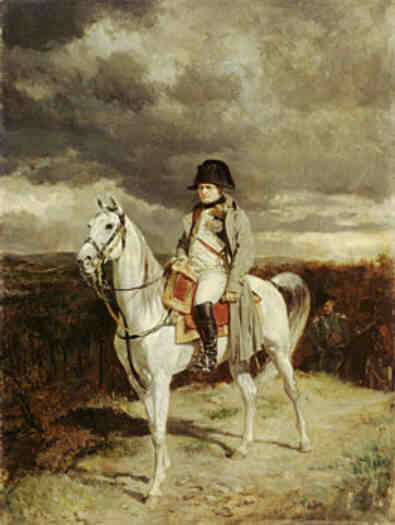
Le
Général Desaix et le Paysan (1867) La Campagne de France (1861) 1814 (1862, 32x24cm) [shown here >] _ After accompanying the French army in the Austro-Italian War of 1859, Meissonier abandoned the small Dutch 17th-century genre subjects for which he had become known and turned with even greater success to depicting events in the career of Napoléon I. In this small painting commissioned by the subject's nephew, Prince Napoléon, the emperor is portrayed in a forbidding landscape just after his last, hard-won victory in the 1814 French campaign, which was fought at Arcis-sur-Aube, near Troyes: 23'000 French troops withstood the onslaught of 90'000 Austrians, but were unable to capitalize on their victory. — 82 images at Bildindex |