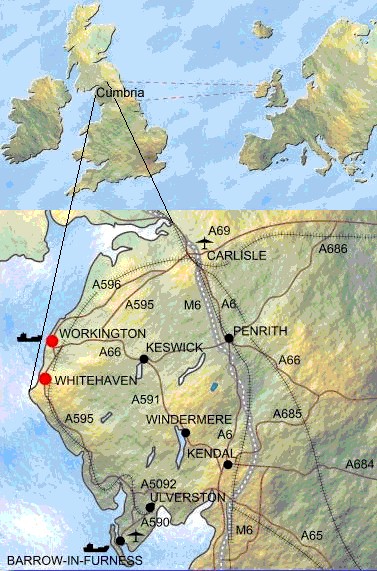
Some possibly helpful references which may give you a better idea of where Workington (or
even Cumbria) actually is:
Cumbria is in the far North-West of England, just south of the Scottish border. Some say
"Its so far north its almost in Scotland". As a matter of fact, it was once, but that was
quite a while ago now.
The Lake District is in Cumbria (most people know where the Lake
District is).
Workington is about 20 miles from Keswick (most people have been to Keswick).
Workington is about 15 miles from the Sellafield Nuclear Power
Plant (most people know where that is).
Any use? Probably not, but I doubt that it matters.
A Mundane History of Workington
(lifted from a leaflet found at the Tourist Information)
Workington is an ancient market and industrial town, situated on the coast of West Cumbria
at the mouth of the River Derwent where it flows into the Solway Firth.
During the Roman occupation of Britain, the town was the site of a Hadrianic fort which formed
part of the coastal defence system of the Roman Wall.
After the withdrawal of the Romans, it was in the 7th century AD that the Anglicans began to
make use of this stretch of the coast, and the name "Workington" is said to be derived
from "Weork" and "Wyre", an Anglican Chieftain.
It wasn't until the 18th Century that Workington expanded to become a major industrial town
and port, with the exploitation of local iron ore and coalfields. Iron and steel manufacturing
have always been a part of Workington's history. It was in Workington that Henry Bessemer first
introduced his revolutionary steel-making process. In more recent years, with the decline of the
steel industry and coal mining, the town is not the industrial hot spot it once was.
The original 18th century
parts of Workington still exist, and take the form of Portland Square, Ramsay Brow and Pow Street,
the latter of which is one of the main streets in the town centre.
The Curwens run throughout the history of Workington. The family were Lords of the Manor, and
were powerful before the Norman Conquest with a male line unbroken to the end of the 18th century.
They were masters not only in Workington, but over a large area of surrounding Cumbria. Curwen
Hall, the 14th century heredetary seat of the Curwens, still remains in Curwen Park opposite
Ramsay Brow. In 1568 the Hall was refuge for Mary Queen of Scots during her travel from Scotland
before her imprisonment and execution.
Workington is twinned with Stadt Selm in Germany, Val-de-Reuil in France, and has a civic link
with Curwensville in the USA.
An insiders view on Workington
(by me)
I guess Workington is a pretty typical town. Not a great deal there, but enough to get by from day to day. It does have the advantage over a city suburb in that it is kind of nice to be able to drive for 2 minutes and be out in the Lake District, rather than in another suburb. Having said that, it has the disadvantage of not being anywhere near a big city, the nearest one being Carlisle which is 36 miles away and not exactly huge.
Things to pass the time in Workington:
A bowling alley
A multiplex cinema
A sports centre
A pitch 'n' Putt course and driving range
Uhm...a McDonalds...
One nice thing is that it is on the coast, so it has a coastline. Workington doesn't have a beach, but it does have a bunch of green hills by the shore which are nice to walk on, even in winter. Provided you look the right way of course; Look west and you see the sea and on clear days the Isle of Man is visible. Look north and you can see south Scotland. However, look south and you can see industrial complexes down the coastline, look east and you'll see a scrapyard full of rusty metal. Lovely.