Roger Peters Copyright © 2002
|
The four volume set William Shakespeare's Sonnet Philosophy is now available. With the publication, some of the material that has been on the website for the last 3 or so years has been removed.
|
The Quaternary Investigation into the Evolution Toward the Uniqueness in Shakespeare
Number 1 © Jan-Mar 2003
Contents
The essays in QUIETUS will differ from those in JAQUES (which acknowledges proto-quaternary thinkers) and INQUEST (which inquires into the history of Shakespearean misrepresentation) by investigating advanced social and political systems and ideas in the light of the Sonnet philosophy and the dynamic of the plays.
The works of Shakespeare already exercise considerable influence in the social/political sphere. The universal interest in his plays and poems and their inclusion in curricula for study in many countries have ensured that the many moral issues he addresses have become part of the fabric of thought.
Never before though has there been an opportunity to apply to the social/political arena an understanding of Shakespeare based on the philosophy he articulated in his Sonnets, as the philosophy behind all his plays and poems. What before has been only intuited or suspected of the thinking behind the Sonnets, has now been published in the 4 Volumes William Shakespeare's Sonnet Philosophy. The recent discovery of the philosophy makes it possible to examine in greater depth the social and political situations that were in part influenced by Shakespeare's works.
Over the next few years, topics such as the American Declaration of Independence and the Constitution, Nature and the environment, Feminism and Gaia, will be considered. The idea is to see how Shakespeare's mythic philosophy can contribute to the current understanding in those areas.
The relationship of Shakespeare's philosophy to the American Declaration of Independence & the American Constitution
Thomas Jefferson�s reference to the �Laws of Nature� and to �Nature�s God�
in the first few lines of the Declaration of Independence (1776) and his insistence
on the religious and political freedoms guaranteed by the First
Amendment to the American Constitution (1791) ensured that pluralism
became the founding credo of the United States. Yet, despite the widespread
recognition of Jefferson as the spiritual father of the United States, the philosophic
basis of his framework for tolerance has not advanced much beyond
its original enigmatic expression.
These notes will suggest that the philosophy of Shakespeare�s Sonnets of 1609 not only provides a sound logical base for Jefferson�s pluralism, but that Shakespeare�s application of the philosophy in the social/political dynamic of his 40 plays and longer poems provides an opportunity to enrich the pluralistic dynamic. The notes will concentrate on correspondences between
the Sonnet philosophy and the Declaration of Independence and the Constitution.As Thomas Jefferson was responsible for the wording of the Declaration, it will discuss his understanding of the relation of Nature and God and his campaign to separate Church and State.
So the logical structure of the Sonnets will be compared with the political
structure heralded in the Declaration and legitimated in the Constitution. Then the mythic logic of the Sonnets will be used to identify elements in the
Declaration that could elevate it from being an abstract framework, with little
other than legislative definition in the American Constitution, to a wellspring
for an inclusive mythic logic based in Nature.
Shakespeare's natural philosophy of 1609
These four volumes demonstrate that in the period in which the New World
was discovered and colonised Shakespeare was formulating a philosophy in
his Sonnets of 1609 that set out to critique and correct the traditional attitude
toward biblical mythology. In particular he restores the logical priority of
Nature over mythology and the priority of the female over the male. And
in each of his plays and longer poems he demonstrates how to generate a
mythic expression consistent with the natural logic articulated in the Sonnets.
Although the four volumes are the first in 400 years of scholarship to
present the Sonnet philosophy, many students of Shakespeare have recognised
that his plays and poems are based primarily in Nature, rather than in biblical
mythology. Ironically, though, while commentators admit that Shakespeare�s
plays show no evidence of an adherence to traditional beliefs, many feel duty
bound to suggest he was at least a closet believer (if only in support of his
status as England�s national poet).
But both Shakespeare in his Sonnet philosophy and Jefferson in the
Declaration and Constitution wanted to move beyond the biblical politics of
a pre-global Euro-centric world. The plurality of the Sonnet philosophy,
which derives the logic of mythic expression from the dynamic of the natural
world, anticipated the advance toward plural global politics heralded in the
Declaration and guaranteed by the Constitution. This is despite the fact that
Jefferson, even though he would have been aware of the general regard for
Nature in the works of Shakespeare, was ignorant of the precisely formulated
philosophy of the Sonnets.
In Jefferson�s day the biblical paradigm was fast collapsing as a credible world-view under the philosophical critique of thinkers such as Spinoza, Locke, and Hume. Added to the logical attack was the theoretical critique
by social/political/scientific thinkers of the seventeenth and eighteenth
centuries. Their concern for the consequences of allowing a religion to be
instrumental in the politics of a state inspired a new attitude of secularisation
when the American colonies asserted independence from their European
forbears. The memory of Christian intolerance and even atrocities in Britain,
Europe and the Americas in the sixteenth and seventeenth centuries, and
the awareness, by those who wrote the Declaration and Constitution, of a new political order emerging in eighteenth century France created an opportunity
to institute a less irrational society.
The philosophy in the Sonnets
As this is one of a series of short essays to be incorporated in the four
volumes that detail Shakespeare�s philosophy, no more than an outline of
the basic elements of his natural logic will be given. It is sufficient to
remember that the Sonnet philosophy acknowledges the priority of Nature
over the sexual dynamic, and that the sexual dynamic entails the logical
requirement for humans to increase if they wish perpetuate themselves.
Then, once the logic of the increase dynamic within Nature is acknowledged,
it follows that the possibility of increase is prior to the dynamic of
understanding or truth and beauty
The relationships of the major elements of the Sonnet philosophy are represented diagrammatically in the complete template.
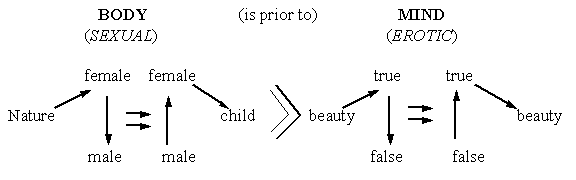
The Complete Template
The linear arrangement of the elements captures the logical entailment beginning with Nature as the given, through to the sexual dynamic and the dynamic of sensations and language. The word �beauty� on the right represents all sensations in the mind including idealised thoughts such the absolute
as God. In the Sonnet logic, Nature is the possibility that encompasses all
else, while the ideal as God is consequential on the development of the
human mind in Nature.
The Sonnets are unique in the way they reflexively lay out the natural logic of life. As well as articulating natural logic they simultaneously acknowledge their dependence as an expression on the priority of the body
over the mind. Shakespeare�s plays and longer poems have an unmatched
veracity and felicity because they are based in a philosophy that recognises
the sexual dynamic of human increase out of Nature is prior to the erotic
dynamic of the desires of the mind. Writing that expresses the logic of the
priority of Nature and the sexual dynamic over the inherent eroticism of
human understanding is potentially mythic.
...continued in Volume 4, William Shakespeare's Sonnet Philosophy
Roger Peters Copyright © 2002
Back to Top
JAQUES
INQUEST
QUIETUS
|