
science_what_is_light.htm
|
|
|
|
|
|
|
|
|
|
|
|
|
|
|
|
|
|
|
|
|
|
|
|
|
|
|
|
|
|
|
|
|
|
|
|
|
|
|
|
| COLOR | |||||||||||||||||||||||||||||||||||||||
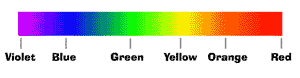
| Color is directly related to light. The reason that we view colors the way we do corresponds to light. When you view something, you perceive the object to be a certain color. This is because when light hits an object it is in the form of white light. White light contains all the colors Red, Orange, Yellow, Green, Blue, Indigo and Violet. When the light hits an object, all of the colors ae absorbed except for the color of the object itself (which is reflected). Once it is reflected it enters your eye which allows you to view the color of the object. If an object reflects all colors, than it is white If an object absorbs all colors, than it is black. | |||||||||||||||||||||||||||||||||||||||
| Visible Ligt Spectrum | |||||||||||||||||||||||||||||||||||||||
|
|||||||||||||||||||||||||||||||||||||||
| Image from http://www.gelighting.com/na/home/gela/students/ science_what_is_light.htm |
|||||||||||||||||||||||||||||||||||||||
| SPECTRUM | |||||||||||||||||||||||||||||||||||||||
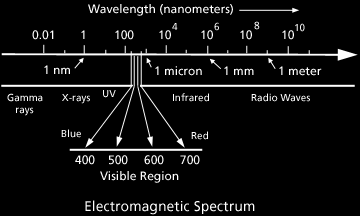
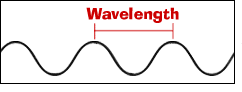
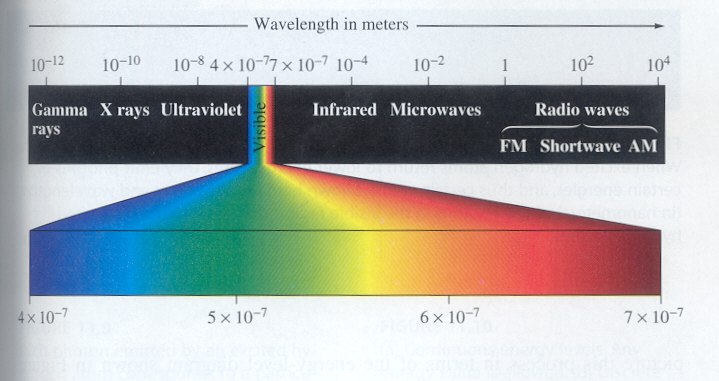
| The color spectrum is the visible portion of the Electromagnetic radiation spectrum (EM). The EM spectrum contains the radiation forms of Gamma Rays, X-rays, Ultraviolet rays (UV), Visible Light, Infrared (IR), and Radio Waves. The specturm is organized by wavelengths. A wavelength is the distance between two peaks of a wave (see right). The shorter the wavelength, the greater the energy. The longer the wavelength, the lower the energy. Low energies with long wavelengths cannot be detected by the human eye but can be detected by special sensors. High energies with short wavelengths cannot be detcted by the eye, but can be detected by x-ray film or other special devices. The radiation with the most energy is located at the far left of the spectrum. As you move from left to right across the specturm (from Gamma rays to Radio waves), you notice that the wavelength is increasing as the energy level is decreasing. | |||||||||||||||||||||||||||||||||||||||
|
|||||||||||||||||||||||||||||||||||||||
| Image from http://acept.la.asu.edu/PiN/rdg/color/color.shtml | |||||||||||||||||||||||||||||||||||||||
|
|||||||||||||||||||||||||||||||||||||||
| Image from http://www.gelighting.com/na/home/gela/students/science_what_is_light.htm | |||||||||||||||||||||||||||||||||||||||
| Visible Light spectrum | |||||||||||||||||||||||||||||||||||||||
|
|||||||||||||||||||||||||||||||||||||||
| Image from http://library.tedankara.k12.tr/chemistry/vol1/period/trans43.htm | |||||||||||||||||||||||||||||||||||||||
| The portion of this spectrum which is visible to the human eye is called the visible light spectrum. The section is between UV and IR waves located in the center of the spectrum. As well as the entire specturm the visible portion is also arranged by wavelengths. The colors go from violet, blue, green, yellow, orange, and red. Violet having the shortes wavelength and red having the longest. Each color has its own specific wavelength. To measure the wavelengths of light, scientists use nanometers. A nanometer is equal to one thousand millionths of a meter (10^-9m). The wavelengths of color range from 400-700nm. Radiation that has a wavelength distance of less than 400 or greater than 700 cannot be seen by an eye This is why only the visible light portion of the EM spectrum (from 400-700) can be seen. | |||||||||||||||||||||||||||||||||||||||
| Back to Chemx homepage | |||||||||||||||||||||||||||||||||||||||
| Basics | Black Lights | Halogen Lights | |||||||||||||||||||||||||||||||||||||
| Chemical Reactions & Light | |||||||||||||||||||||||||||||||||||||||
| Fluorescent Lights | |||||||||||||||||||||||||||||||||||||||