Home
Place of birth
Pythagoras' life
Theory
Source
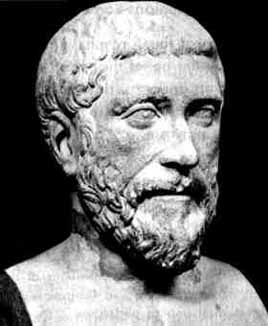
Pythagoras (560 to 480 B.C) was one of the world's greatest men; but he wrote nothing, and it is hard to say how much of the doctrine, Pythagorean, was due to the founder of the society and how much it development later. It is also hard to say how much of what we are told about the life of Pythagoras is trustworthy; for there are many masses of legends gathered around his name at one early date.
Pythagoreans believed that all relations could be summerised to number relations. This generalisation stemmed from observations in music, mathematics and astronomy.
Sometimes he is represented as a man of science, and sometimes as a preacher of mystic doctrines, and we, might be tempted to regard one or other of those characters as alone historical. Originally born on the isalnd of Samos, Pythagoras founded Kroton, (in southern Italy) a society of a religious community and a scientific school of Pythagorean. Of his actual work nothing is known to have exsisted. His school practised secrecy and communalism; making it hard to distinguish between the work of Pythagoras and that of his followers. He and his school made outstanding contributions to mathematics.
A body, such as his school, caused much jealousy and mistrust, and are told of many struggles as written in ancient text. Pythagoras himself had to flee from Kroton to Metapontion as a result of tyrant rule, where he then died.
Pythagoras and his Pythagoreans were not just great mathamaticians, but also great astronomers who developed some important ideas in astronomy...
Once ancient astronomers believed the earth was round, but the Pythagoreans used math to develop an idea that the sun and all the other planets were round, too, and that they went in circles around each other. Today, we know they were right, but back then, it was a different story.
Pythagoras also taught that the Earth was a sphere at the centre of the Universe. He also recognised that the orbit of the Moon was inclined to the equator of the Earth and he was one of the first to realise that Venus, an evening star was the same planet as Venus as a morning star. Since ancient greeks couldn�t just send a telescope to take pictures, like we can today, they could not prove they were right. An idea that you can�t prove is called a theory or a model. Without proof, people would doubt this theory for many years. Pythagoras did not come about himself but was a disciple of Anaximander, his astronomy was the result of Anaximander's tutordige.
It may be taken as certainty that Pythagoras himself, also discovered the ratios which determined the concordant intervals of the musical scale. The Pythagoreans noticed that vibrating strings produce harmonious tones when the ratios of the lengths of the strings are whole numbers, and that these ratios could be extended to other instruments.
Perhaps the most important discovery of this school was the fact that the diagonal of a square is not a rational multiple of its side. This result showed the existence of irrational numbers. Not only did this disturb Greek mathematics but the Pythagoreans' own belief that whole numbers and their ratios could account for geometrical properties was challenged by their own results. This discovery eventtually lead to the Pythagoras theory which showed that the world of nature could be described and defined mathamatically, but also has immense practical use in the design and construction of bulidings
Pythagoras was a great man whose deeds in the ancient world even now, affected that way we looked at the world. He will always be remembers as one of the greatest men who ever lived...
Copyright � 2001 Adrian and Kim Inc. All rights reserved.
