| ~Mani's History~ |
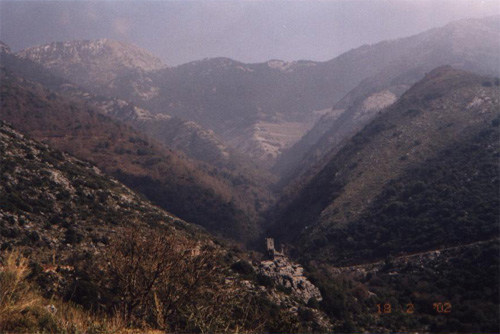 |
| An old tower on the way to Taygetus |
| From the administrative point of view we could consider the Mani�s form of government as a federal one, but with a wide jurisdiction of the federal areas. By 1715 those areas were called �kapetanies�. The people elected the local ruler and he was the leader of the gunmen of his district. All local rulers voted for their leader at the general meeting, whom they called �arhikapetanio� or �bas kapetanio�, and he was called �bey� later. A general meeting was also held when there were matters of war and defense, with the elder, the priests and high priests also taking part. |
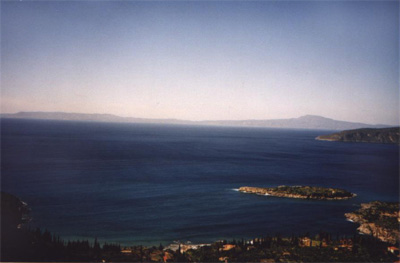 |
| A Proastio view |
| By every other way, every district was absolutely free to arrange their own matters. Matters of civil right were discussed through family councils or with the experts� help, which were the eldest with excellent past. The laws were very cruel on some matters that had to do with religion, war against the enemy, and family honor. For situations of murder and insult of the family honor, revenge was an established custom, a kind of inviolable law. |
 |
| The number of the �kapetanies� wasn�t verified. Spyridon Trikoupis says it was originally eight and then they became eleven. According to K. Paparigopoulos the �kapetanies� were four (Zarnatas, Zygou, Kakovoulion, Skoutariou), while Poukeville raises the number to twelve: Gianitsanika, Stauropigio, Androuvista, Zygos, Koutifari, Tzimova, Diros, Kakavoulia, Milia, Kastania, Trinasos, Marathonisi. |
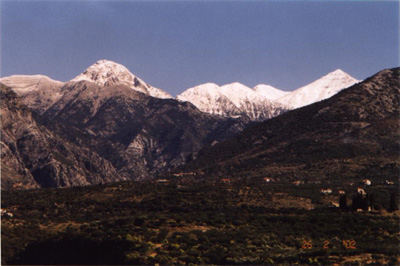
| Taygetus mountain |
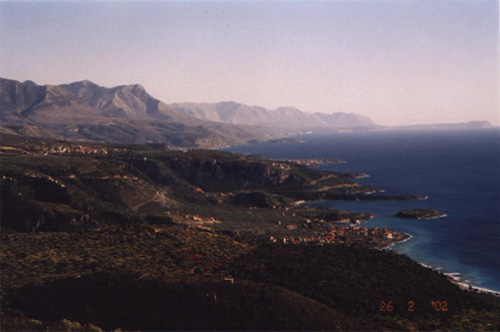 |
| Kardamily, Proastio and Stoupa |
| First Mani bey was appointed Janetos Koutifaris at 1776-1779. The Turks in order to bring dissension to the Mainoti changed the beys often, just like they did with the leaders of Moldavia and Vlahia. So, from time to time appointed beys were: M. Troupakis ( Mourtzinos) (1779-1782) who was hanged by the Turks like his predecessor Janetos Koutifaris, Janetos Grigorakis (1782-1798), Panagiotis Koumoundourakis (1792-1803), Antonios Grigorakis (1803-1808), Konstantinos Zervakis (1808-1810) who was murdered by the Turks at Constantinople, Theodoros Grigorakis (1810-1815), Petros Mavromihalis (1815-1821). |
 |
| The �kapetanies� were hereditary. The heir was the elder son. In many cases where he seemed to be incapable or made a fault, the leadership passed to the most capable and if the number of the male boys of a family reduced perceptible, it passed to families with more male members. |
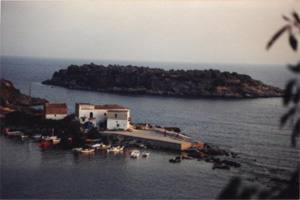
| Island Meropi |
| Next Page |