
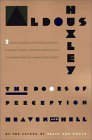
. . . of his creation -- the miracle, moment by moment of naked existence." In a letter to Chatto & Windus just after this mescaline experience, Huxley writes: "It is without any question the most extraordinary and significant experience available to human beings this side of the Beatific Vision; and it opens up a host of philosophical problems, throws intense light and raises all manner of questions in the fields of aesthetics, religion, theory of knowledge."
The story told in these pages was originally sparked by a 1960 mescaline trip that quite astonished Sasha. His description of that odyssey appears both here and in his "Twenty Years on a Never-Ending Quest" in Grinspoon and Bakalar's Psychedelic Reflections. In a nutshell, Sasha was knocked out by the realization that the simple mescaline molecule wasn't the source of his dramatically-enhanced consciousness, but it had nonetheless given him an "access code" to complex thoughts that were already in his mind.
Shulgin, who normally shuns public appearances, electrified a psychedelic conference at the university near Santa Barbara in the early '80s when he explained, at his wife's insistence, "What I Do and Why I Do It," coming close to tears at the end. He spoke then about the classic battle between life and death forces ("eros" and "thanatos," in more classical terms), and asserted that in this fight he would do as much as he could "as quickly as possible."
Although most of the second half of the book, synthesis routes, et al., may be largely unreadable to those untrained or uninterested in the vocabulary of chemistry, its distribution undoubtedly sets this volume widely apart from ordinary kinds of writing with thanks, no doubt, to present and future alchemists.
Shulgin's first important intervention had to do with his synthesis of a molecule called "DOM," which had been new to him and which eventually showed up a few years later as "STP." Now recalled in horror, or favor and gratitude in smaller circles, this compound some 200 times more powerful by weight than mescaline played a prominent role in psychedelic history, as 5,000 very powerful doses were distributed at the first Human Be-In in mid-'60s San Francisco.
In the first of his two short books about psychedelics -- The Doors of Perception -- Huxley remarked that the "untalented visionary may perceive an inner reality no less tremendous, beautiful and significant than the world beheld by Blake; but he lacks altogether the ability to express, in literary or plastic symbols, what he has seen."
In the Be-In case, many swallowers went on a three-day, wild odyssey that they hadn't anticipated, thus making sense of the idea that "This psychedelic thing might go too far," or at least further than some wanted to go.
(more to come)
(continued)
Contents Page

