
The Unanswered Questions
of
Huxley's Experiments
(Peter wrote this
when the above book
first appeared)
The Most Important Book
of That Century!
(Written during the
Colorado Rainbow Family Gathering
late last century)
I wish to whisper into your ear a thought that has been recurrent in my mind since I first read this book about eight months ago. That is that this massive volume, whose first printing is already sold out, might well be the most important document of the last century!
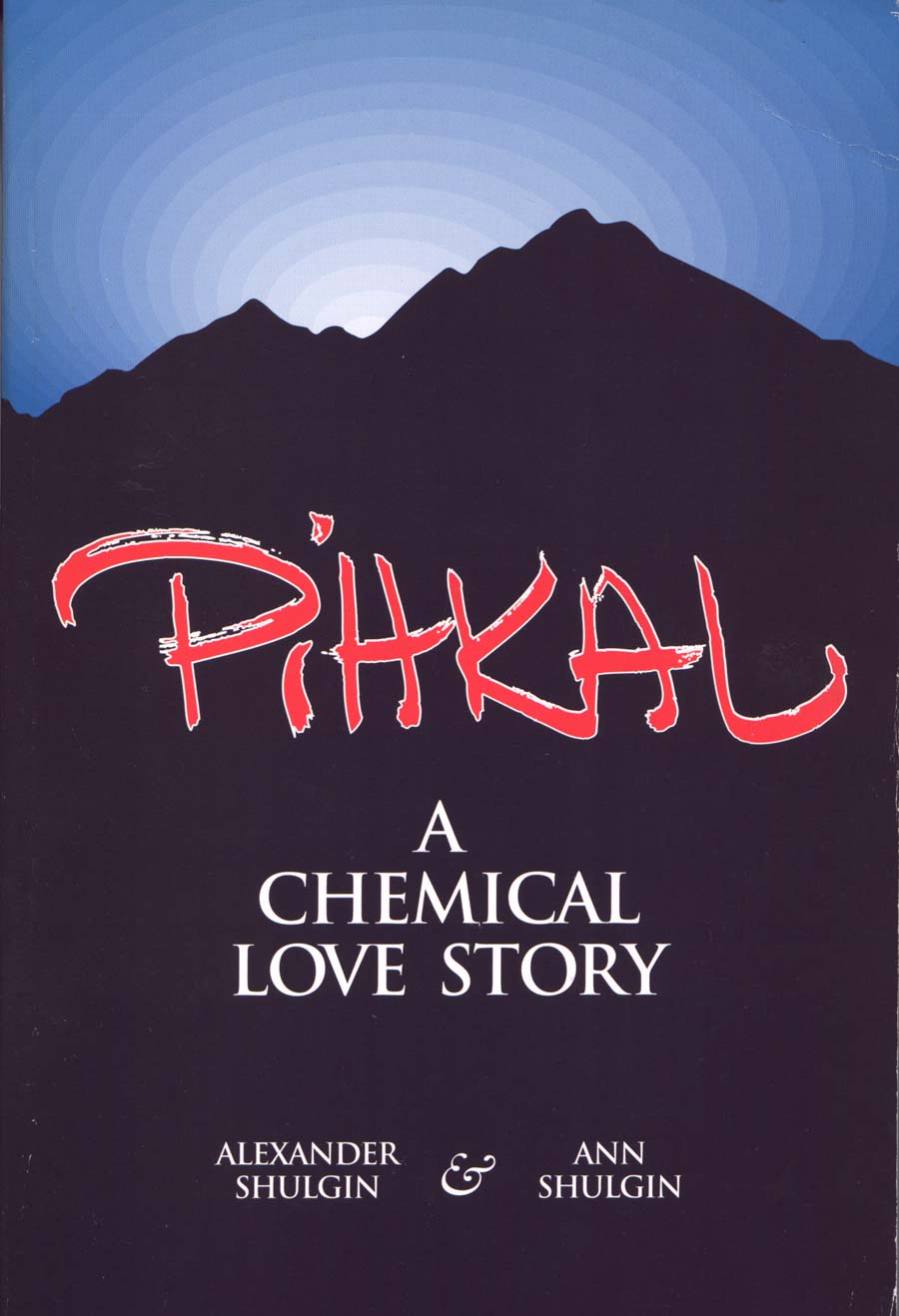
The first half of PIHKAL Phenethylamines I Have Known and Loved), by Alexander and Ann Shulgin (Transform Press), is a thinly-veiled biography of one of our greatest "white shamans," a chemist in this instance, and of his seduction by his second wife, Ann. The second half describes synthesis routes, dosage recommendations, and comments about the duration and qualities of 179 semi-synthetic molecules which have been both "known" and "loved" by seasoned psychenauts.
Well over a decade ago, I asked Sasha (a Russian nickname for Alexander) whether he ever intended to write a book about his astonishing psychedelic investigations. I had known by then that he had produced scores of papers for mostly chemical journals, that he had been a consultant for several government panels and for private interests like PharmChem, and that he taught courses on forensic toxicology at San Francisco State and U.C. Berkeley. His reply was that he hoped some day to produce a text relating to mescaline, which is what we have now.
The investigative technique used by Sasha is impeccably traditional. He has specialized in what are largely analogs of the mescaline molecule (the simplest of the "one-ring phenethylamines), all of which are fairly easy to synthesize, in contrast to the four-ring indolic psychedelics such as LSD, psilocybin, harmaline and ibogaine. After he has concocted one of these compounds that he suspects might produce significant mental activity, he tries a very small amount. He then tries it every other day, doubling the dosage, until an appropriately intensified experience appears to have been reached. After his return to "base-line consciousness," he then examines the specimen's effects once again to try and discover its promise.
(Continued on next page)
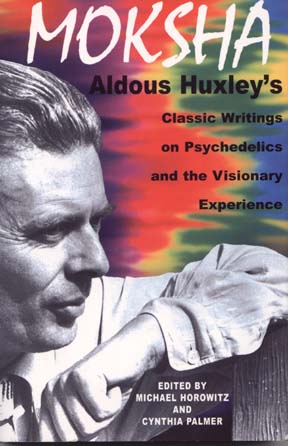
The main writings of Aldous Huxley about psychedelics and the visionary experience have now been gathered into a single volume -- entitled Moksha, Stonehill Press, edited by Michael Horowitz and Cynthia Palmer. Though well over a quarter century has passed since Huxley's death, this material resurrected from letters, talks and articles is timely today. For as the law and public reassess psychedelic questions via the door of medicine, nowhere will they find a more profound study of implications and of the questions raised.
In 1931, Aldous described his delight upon coming upon an unpromising looking, ponderous work by a German pharmacologist -- "a thick book, dense with matter and, in manner, a model of all that literary style should not be." He read this from cover to cover with a growing interest in "how the story of drug-taking constitutes one of the most curious and also, it seems to me, one of the most significant chapters in the natural history of human beings." But it wasn't until 22 years later, after he had published 39 books concerning human nature, that Huxley tried a psychedelic -- 400 mg. of mescaline sulfate, administered at about 11 am on May 6th, 1953 by a young Canadian psychiatrist named Humphry Osmond.
In one of several remembrances of Aldous appearing in this volume, Osmond comments that the finest praise one could receive came in Huxley's expression, "How absolutely incredible!" Well, after about an hour and a half into the experience, Aldous noticed he was "not looking now at an unusual flower arrangement. I was seeing what Adam had seen on the morning (Continued)

