 |
|
|
|
|
|
|
|
|
|
|
|
|
|
|
|
|
|
|
|
|
|
|
 |
|
|
|
April 19, 1943: Preparation of an 0.05% aqueous solution of
d-lysergic acid diethylamide tartrate.
4:20 P.M.: 0.05 cc (0.25 mg LSD) [250 micrograms] ingested orally. The solution is tasteless.
4:50 P.M.: no trace of any effect.
5:00 P.M.: slight dizziness, unrest, difficulty in concentration, visual disturbances, marked desire to laugh . . . |
|
|
|
|
|
Of all substances that excite the visionary powers of the mind, LSD is the most potent. It belongs to a class of substances that can be divided into two groups. One group occurs naturally, in the fungus ergot and in members of the woodrose and morning glory families. The other group is produced semi-synthetically, the most important member being LSD. Both groups exhibit a four-ring crystalline chemical structure. Unlike most of the psychoactive molecules, which are usually called amines, these LSD-type compounds are all amides.
In a curious circle of coincidence, knowledge about the psychoactivity of the natural group came along only after the synthesis of LSD by Dr. Albert Hofmann. He wrote the lab notes quoted above. Unlike most chemists, who even today work mainly with synthetics, Hofmann was drawn toward study of natural substances at the end of the 1920s. Under the supervision of Dr. Arthur Stoll, who isolated the first ergot alkaloid in a pure chemical form, Hofmann later synthesized a number of ergot analogues (closely related compounds) at Sandoz Pharmaceuticals in Basel, Switzerland. |
|
|
|
 |
|
|
Hofmann's laboratory syntheses of ergot analogues resulted in the construction of many new lysergic acid derivatives. Several turned out to be useful in medicine -- especially in obstetrics, geriatrics and the treatment of migraine headaches. The twenty-fifth compound in the series his team produced -- lab coded LSD-25 -- was expected on the basis of its molecular structure to be a circulatory and respiratory stimulant. Tested on animals in 1938, it made them restless and caused them to display strong "uterine-constricting" effects. These results were not of sufficient interest to the Sandoz staff. Further testing ceased. |
|
|
|
|
|
|
2 / 3 / 4 |
|
|
|
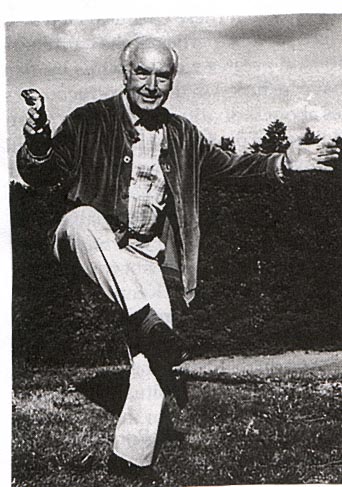
Albert Hofmann on the occasion of his 60th birthday, doing tai chi and holding a ling chi mushroom. |
|
|
|
|
|
Back to
Contents
Page |
|
|
 |
|
|
|
 |
|
|
|
|
|
|