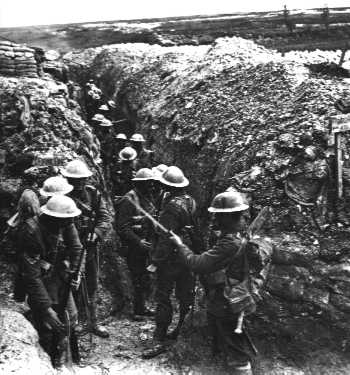
| A report on Martin Middlebrook's The First Day on the Somme New York: W.W. Norton and Company, Inc. 1972 Words just can't explain war. Words are lost in the memories of veterans, and as WWI becomes an unfortunate distant past, we are left with diaries and reports. The only links to this tragic war which introduced such weapons as Mustard Gas, machine guns, zeppelins, and tried-but failed-to glorify trench warfare. As propaganda refused to furninsh the people at home with true pictures of dead soldiers-unless it was the enemy's-and their boys stuck waist high in mud and snow, I can see why it would be difficult for the home-front to understand what the verterans were trying to tell of their experience. Pte G. Kidd from the 9th Devons had this to say when he returned home from the Somme: "When I was out of work, I had to go before a Means Test Panel. There was a very fat lady on the Panel, cuddling a Pekinese on her lap. She said, 'We've all got to pull our belts in a hole or two these days.' I was fed up and told her, 'Your words belie your appearance. That bloody dog's had more to eat today than I've had.' There was a lot of argument and it ended in a row. My chair went over; papers and ink-wells went flying and the dog was yapping and squealing. I was charged with common assualt and got three months in Wormwood Scrubs." (316) In Martin Middlebrook's The First Day on the Somme: 1 July, 1916, words like these fill the pages of this extraordinary piece of work. Middlebrook forms his thesis around the first hand accounts of the men on the Somme. Mainly he tells the reader about the preparations, the plan of attack and then moves on to "zero hour" when the attack was called. The bulk of this book is what happened to the British when they began to cross No Man's Land only to find a barrage of German bullets flying at them! He follows certain men like Bugler Bill Soar, Private Paddy Kennedy, Lieutenant Philip Howe and Lance Corporal Charles Matthews. He also considers the command of such noted fellows as Lieutenant-Colonel Reginald Bastard (2nd Lincolns), General Sir Henry Rawlinson (Fourth Army), General Douglas Haig (C-in-C BEF) and Lieutenant-General Sir Hubert Gough (calvary). Their choices and decisions form what really happened at the Somme. For example, when the 18th and 30th Division-made mainly from Liverpool and Manchester men-reached their objective by mid-day to late afternoon, their commander, Lieutenant-General Congreave asked Rawlinson if they should continue past Montauban; Rawlinson told them to stay put. The success of the British seemed to dim by their failures, unfortunately. They took many German prisoners, at least two objectives and all in all, one to two miles of ground. But "What had been the cost of this first hour? It is impoossible to say exactly but probably half of the 66,000 British soldiers who had attacked were already casualties-30,000 infantry killed or wounded in just sixty minutes!" (148) Middlebrook uses a plethora of first hand accounts from verterans to support how badly the battle was going. This time, the British will win the war, but at the cost of thousands in the battles. After reading this book, I found a new respect for the British soldier and saw how really silly it was to practice the 'art' of trench warfare. The author uses a very logical chapter sequence as he opens the book with a description of the men, then goes to the preparations, the plan, the western front and then zero hour. After discussing the battle he then proceeds to give an analysis, the aftermath and finally a post-war description of England. A land to hold heroes was the promise from David Lloyd George. "'...it took a hero to live in it. I'd never fight for my country again.' (Pte. F.W.A. Turner, Sherwood Foresters)" (316) The author's conclusion was one that I believe many would share. No matter what decisions were made, the Somme would have ended up the same. The date changed from 30 June to 1 July most likely would not have had an effect. If Rawlinson had let the 18th and 30th Divisions go ahead past Montauban, the Germans would have still pushed them back four months later. The only thing that seemed to have kept the British soldiers together on 1 July, 1916 was their support in their country, the presence of their pals and as one soldier put it: "'If we hadn't had our rum, we would have lost the war.' (Pte. G. Brownbridge, 13th Northumberland Fusiliers)" (160). This book was one of the best I've read in a long time. Middlebrook's use of detailed maps, exact quotes from interviewed veterans and pretty accurate accounts of the trek across No Man's Land made it a chilling read. His use of rhythms and lack of dullness made it easy for a non-military historian like myself to understand what really happened by the River Somme. Middlebrook chapter on the Aftermath is where I found my respect for the private soldier. Soldiers like Bill Soar and Paddy Kennedy, who stayed in France for the rest of the war-1918. There wasn't a backup army to relieve them. Every time they were ordered to go over the top, they had to follow orders. Click on the Union Jack to Download my short story on the Somme here. I'm pretty proud of it even though nobody will publish it! Picture courtesy of www.worldwar1.com |
| Over 60,000 British soldiers dead 1 July, 1916 Retreat back to the home trench |
 |
 |
 |