|
|
INSTITUT TADBIRAN AWAM NEGARA |
|
|
The Balanced Scorecard |
||
| A new
approach to strategic management was developed in the 1990's by
Robert Kaplan (Harvard
Business School) and David Norton (Balanced
Scorecard Collaborative). They called this the 'balanced
scorecard'. Recognizing some of the weaknesses and vagueness of
previous measurement approaches, the balanced scorecard provides a
clear prescription as to what companies should measure in order to
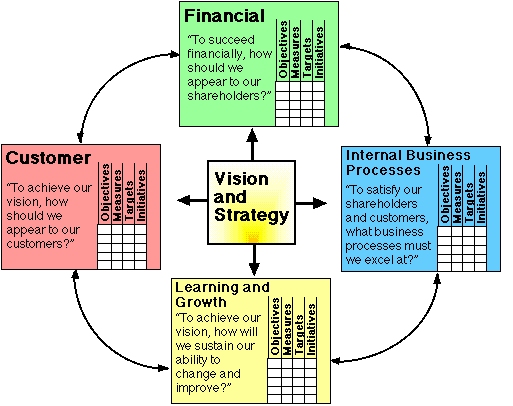
'balance' the financial perspective. Kaplan and Norton summarize the rationale for the Balanced Scorecard as follows: "The balanced scorecard retains traditional financial measures. But financial measures tell the story of past events, an adequate story for industrial age companies for which investments in long-term capabilities and customer relationships were not critical for success. These financial measures are inadequate, however, for guiding and evaluating the journey that information age companies must make to create future value through investment in customers, suppliers, employees, processes, technology, and innovation." The Balanced Scorecard suggests that we view the organization from four perspectives, and to develop metrics, collect data and analyze it relative to each of these perspectives:
It can be seen that these four perspectives relate directly to four of the (1996) Baldridge Criteria categories: Customer Focus (Category 7); Business Results (Category 6); Business Processes (Category 5) and Human Resources (Category 4). Customer focus and business results together made up half the total points in the 1996 Baldrige score. There is therefore a harmony between these two descriptions.
The Balanced Scorecard for Strategic ManagementThe balanced scorecard methodology extends the key concepts of Total Quality Management (TQM), including customer-defined quality, continuous improvement, employee empowerment, and -- primarily -- measurement-based management and feedback. FeedbackIn traditional industrial activity, "quality control" and "zero defects" were the watchwords. In order to shield the customer from receiving poor quality products, aggressive efforts were focused on inspection and testing at the end of the production line. The problem with this approach is that the true causes of defects could never be identified, and there would always be inefficiencies due to the rejection of defects. What Deming saw was that variation is created at every step in a production process, and the causes of variation need to be identified and fixed. If this can be done, then there is a way to reduce the defects and improve product quality indefinitely. To establish such a process, Deming emphasized that all business processes should be part of a system with feedback loops. The feedback data should be examined by managers to determine the causes of variation, what are the processes with significant problems, and then they can focus attention on fixing that subset of processes. Metrics |
||
|
Taken from The Balanced Scorecard Institute website |
||