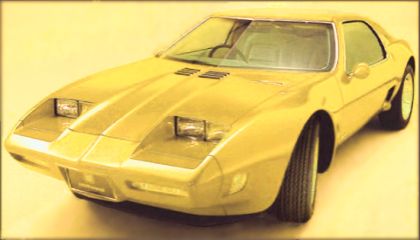
For one brief shining moment, General Motors honestly intended to build a mid-engine Corvette for public sale. The moment came in late 1977, just as "America's only true sports car" was about to celebrate its 25th anniversary. Those tantalizing exercises were owed to Zora Arkus-Duntov, fabled as chief Corvette engineer almost since the car's 1953 inception.
After conjuring the open-wheel CERV I and envelope-bodied CERV II (the letters stood for Chevrolet [or Corvette] Engineering Research Vehicle), Duntov turned to more passenger oriented designs, beginning with the Astro II of 1968. Like the previous year's Corvair based Astro I, this was a curvy, ground hugging two seat coupe with a lift-up rear engine cover/cockpit canopy. It was also a remnant of project XP-880, a mid-engine effort that Duntov hoped would appear in showrooms for 1968.
In 1970, Chevrolet obtained a licence for the Wankel RCE from NSU, for a cost of $50 million, at the direction of GM President Ed Cole, whose background was engineering. They began building a two-rotor and a four-rotor Corvette, in the highly desirable mid-engine format.
In September 13, 1973 a 266 ci two-rotor "Corvette" (XP-897GT) was shown in Frankfurt, Germany with a steel body. A four-rotor 390 ci mid-engined Corvette was shown at Paris, France on Oct. 4, 1973, as well as the two-rotor. And on Oct. 17 they are both shown at the London Auto Show.
Coded XP-897GT, this handsome little coupe had GM styling, but was built by the famed Pininfarina works in Italy to a GM design. It was to be a showcase for GM's then-imminent Wankel-type rotary engine. But the gas crisis hit and the rotary's thirst for fuel would be the death of the mid-engine Rotary Corvette.
Like the original XP-882, it was widely believed to be a precursor of the next generation Corvette. When displayed during 1973 with the prosaic title "Two-Rotor Car," the automotive press would again hail the advent of the mid-engine Corvette.
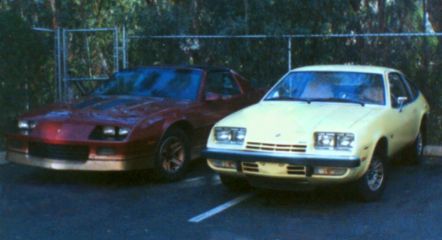
| Notice the lines of the XP-897GT in the 1975 Monza on the right. The square quad lights on the Monza would become more like Pininfarina designed in the 3rd generation Camaro, shown at left. |
|
The Camaro would also continue other designs from the XP program and the Monza with features like a steeply angled windshield and driveline torque-arm.
When introduced in 1975, Chevrolet would put their small-block V8 into the Monza. Motor Trend road tested the 262 V8 Monza alongside Ford's Mustang-II V8. Even with the littlest small-block Chevy ever sold, they chose the Monza as the "1975 Car of the Year". To add insult to injury, California destined V8 Monzas got the 350 V8 this year only, since the newly developed 262 did not yet meet CA smog requirements.
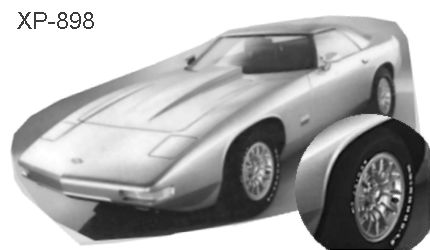
It looks a bit like post-1982 Corvettes, but the one-off XP-898 of 1973 was actually built on the chassis of Chevy's H-Body Vega. The wheel design made it to another offshoot of the Vega platform, the new Monza.
As the inset shows, the wheel pattern is identical on the 1975 Monza 2+2 coupe shown above. But they are actually a wheel cover with four chrome lug nuts protruding through. Even though this is a California model that came with the 350 V8 and Turbohydramatic 350 transmission, it has the Vega GT rallye wheels underneath. The wheel/tire size was not uncommon in its day, but is a limiting factor for acceleration.