GM Vehicles Computer Code Retrieval
Most General Motors Vehicles before OBD-II (some 1994, and 1995 up) have a
simple method for retrieving computer Trouble Codes.
You can retrieve the codes yourself with a paper clip or wire. Under the
dash, near the driver should be a connector like below; It may have a
plastic cap that should pull off.
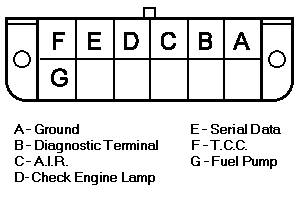
Insert a small wire from A (ground) to B (test) with the ignition key on,
but not running. This puts the ECM into diagnostic mode. The "Check Engine"
light will flash once, then twice ( * - * * ) to indicate a code 12. This means
the computer is in diagnostic mode. Each code will repeat 3 times.
After a code flashes 3 times, the next code will appear. When it returns to
the code 12, all trouble codes have been shown, and the sequence will repeat
unless you remove the wire or turn off the switch.
You can reset the computers trouble codes by removing the ECM fuse for at
least 30 seconds. Alternately, you can remove the battery cable for the
same time, but MAKE SURE YOU HAVE THE CODES FOR ANTI-THEFT RADIOS BEFORE
REMOVING BATTERY POWER.
Is your Car OBD-II Compliant?
All cars and light trucks built and sold in the United States after January 1, 1996
were required to be OBD-II (On-Board-Diagnostics) equipped. In general, this means
all 1996 model year cars and light trucks are compliant, even if built in late 1995.
Two factors will show if your vehicle is definitely OBD-II equipped:
- There will be an OBD-II connector as shown below, and
- There will be a note on a sticker or nameplate under the hood: "OBD-II compliant".
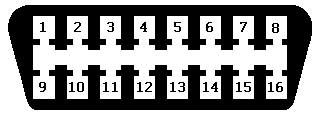 Pin 2 - J1850 Bus+
Pin 4 - Chassis Ground
Pin 5 - Signal Ground
Pin 6 - CAN High (J-2284)
Pin 7 - ISO 9141-2 K Line
Pin 10 - J1850 Bus
Pin 14 - CAN Low (J-2284)
Pin 15 - ISO 9141-2 L Line
Pin 16 - Battery Power
Some 1995 GM vehicles have the 16-pin connector but have accessible OBD-I codes.
Check the underhood emissions sticker to confirm, and if yours is OBD-I, the codes
are accessed by bridging terminals 5 and 6. If your vehicle is OBD-II compliant, a
scan tool or computer is required to access the codes.
What Communications Protocol does my vehicle use?
On 1996 and later vehicles, you can tell which protocol is used by examining the OBD II connector:
ISO 9141-2 -The connector should have pins 4, 5, 7, 15, and 16.
J1850 PWM -The connector should have pins 2, 4, 5, 10, and 16.
J1850 VPWM -The connector should have pins 2, 4, 5, and 16, but not 10.
Chrysler products and all European and most Asian imports use ISO 9141 circuitry.
Fords use SAE J1850 (PWM) 8 bits, no parity, 1 stop bit @ 41.6K bps.
GM vehicles use SAE J1850 (VPWM), 8 bits, no parity, 1 stop bit @ 10.4K bps
PWM = Pulse Width Modulation
VPWM = Variable Pulse Width Modulation
Home Page
Vehicles
Table of Contents
Tech
Software
Racing