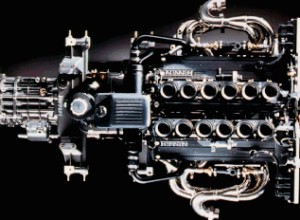
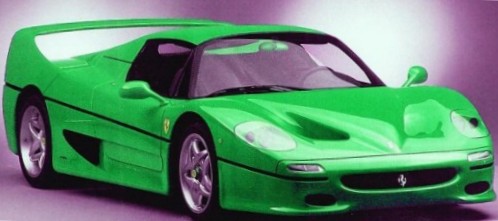
The F50 replaces the F40, and carries a 65 degree V12 rather than it's predecessors V8. The theoretically correct 60 degree V12 was changed from a perfectly balanced pair of in-line sixes, to an offset total of 5 degrees. This vastly improves its low speed performance and allows acceleration in 6th gear from as low as 1000 RPM.
The engine size is 4698.5cc with a bore and stroke of 85 and 69mm, and obtains its 520bhp at 8,500rpm (383kW) with 470Nm of torque on tap at 6,500rpm. The engine uses exotic metals such as Titanium alloy, Sperodial cast iron and Forged Aluminum, and only weighs 437 lbs. (198 kg.) With DOHC and 5 valves per cylinder it is fairly efficient, producing 111/bhp per liter and with a compression ratio of 11.3:1.
The car achieves 17 liters per 100 km and has a rubberized cloth fuel tank behind the central carbon fiber monocoque tub, which in itself is reminiscent of F1 car design. The carbon fiber frame weighs only 102 kg; the only metal used was light alloy for anchorage points on the engine frame, windshield, door hinges and parts of the suspension.
World renowned stylist Pininfarina’s Formula 1 look does its part to convince you of the cars origin, the radical styling from the giant air-dams at the front to the large rear wing which dominates the cars style and proving that beauty and function can coincide.
The F50 with a 0.36 coefficient of drag is low and sleek, so low in fact it was unable to conquer mere speed bumps. This dilemma was soon fixed by a hydraulic suspension system that at the flick of the switch will raise the car so you can clear small obstacles.
The 4 wheel cast iron disc brakes have no ABS or servo assistance but employ the precision and driver control of massive Brembo 32mm thick ventilated discs - Diameter: Font 355mm; Rear 335mm. The wheel hubs weigh 30% less than steel hubs at the expense of Titanium. The non-servo assisted rack and pinion steering turns from lock to lock in 3.3 turns with an overall turning circle of 12.6 m.
The F50’s seats will be made to measure for the owner (tailored for their client), the driver will also face the choice of colors: Classic Ferrari Red; Barchetta Red; Yellow; Black and Nurburging Grey. The fully electronic instrument panel displays the traditional round dials, yet they display on a liquid crystal 8 bit microcomputer inside the dash. To ignite the sophisticated V12 engine you must first turn the key and then press the ignition button, this is a tradition carried on from the F40 and GTO.
1996 Ferrari F50 Specifications
Base Price US $487,000
ENGINE
Engine Size . . . . . . . . . . . . 4698 cc (4.7 liters)
Design/Layout . . . . . . . . . . . Aluminum 60 Valve DOHC V12
Horsepower  . . . . . . . . . . . . 513 at 8500 RPM
Torque  . . . . . . . . . . . . . . 347 Foot Pounds at 6500 RPM
Bore  . . . . . . . . . . . . . . . 3.35 in. (85. mm.)
Stroke  . . . . . . . . . . . . . . 2.72 in. (69. mm.)
Compression . . . . . . . . . . . . 11.3:1

DRIVETRAIN
Layout  . . . . . . . . . . . . . . Mid-engine, transaxle driving rear wheels.
Transmission  . . . . . . . . . . . 6 forward gears, manual shift
Final drive ratio . . . . . . . . . 3.34:1
Front tires . . . . . . . . . . . . 245/35ZR-18
Rear tires  . . . . . . . . . . . . 335/30ZR-18

BODY SPECIFICATIONS
Overall Length  . . . . . . . . . . 176 in. (4480 mm)
Maximum Width . . . . . . . . . . . 78 in. (1990 mm)
Overall Height  . . . . . . . . . . 44 in. (1120 mm)
Track: Front  . . . . . . . . . . . 64 in. (1620 mm)
Track: Rear . . . . . . . . . . . . 63 in. (1600 mm)
Wheelbase . . . . . . . . . . . . . 102 in. (2580 mm)
Weight  . . . . . . . . . . . . . . 2,640 lbs. (1200 kg)

PERFORMANCE SPECIFICATIONS
~Maximum Speed  . . . . . . . . . . 202 mph (325 km/h)
Acceleration 0-60 . . . . . . . . . 3.7 sec.
1/4 Mile Elapsed Time . . . . . . . 11.4 sec @ 121 mph (est.)
Lateral Acceleration  . . . . . . . 1.03 G