Engine Spark Plug Diagnosis

You can tell a lot about an engines general condition by reading the spark plugs. They may be worn and need replacing, or reveal a myriad of possible engine problems.

With the engine cool enough so that you can work around the exhaust without burning yourself, remove one spark plug at a time placing it so you can tell which plug goes to which cylinder. This may help diagnose problems related to individual cylinders. Examine each plug as they are removed noting its color, and if it is wet looking allow it a few moments to see if it dries. If it is gas fouled, it will dry and emit a gasoline smell. If it is shiny and doesn't dry it is probably oil fouled.

As you remove each plug you may want to mark the ignition wire so you can reinstall it properly. Always grasp the plug wire by the boot, and give it a slight twist to free it from the plug, before pulling it free. Notice the general condition of the plug wires as you remove each one paying close attention to the metal connectors (you should feel resistance as it unplugs). Also look for corrosion on the connector which can cause misfire (or worse) and the shape of the connector itself.

Bend each wire in a fairly tight u-shaped arc looking for any cracks or brittleness. The best thing after that is to check the resistance of each wire with an ohmmeter. Allow 8,000 to 10,000 ohms per foot for OEM type wires; some high performance wires may be substantially less than this. Any wire over this amount would indicate to replace the set with a good quality pre-terminated set.

Back to the spark plugs; any plug requiring well more than the specified torque to remove may require you to assess the situation. Aluminum heads can and do seize to spark plugs, especially cadmium plated ones, which are light colored metal rather than blue/black steel. It is a good idea to apply anti-seize to the threads of any plug on aluminum heads, mandatory for cadmium plated ones. If you have one that cannot be removed at well more than the specified torque, it may release easier when hot. A shot of penetrating oil may do the trick or a combination of the two. Regardless of how big and durable a plug looks it can be broken off in the head!

Now that you have all the plugs out you need to inspect them in good light; daylight is best. Compare each plug to the others and note any different ones. A much darker or lighter plug may be wrong for the application, so don't just replace them with one you carried with you to the store. Always look up the application for spark plugs, and don't cross reference to different brands since the heat range may change slightly.

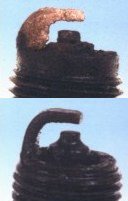
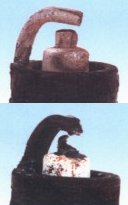
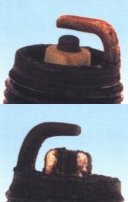
Compare your plugs to the ones in the chart below.

Normal Spark Plug
  NORMAL
Symptoms: Brown to grayish-tan color and slight electrode wear. Correct heat range for engine and operating conditions.
Recommend: When new spark plugs are installed, replace with plugs of the same heat range.
Normal Spark Plug


  • WORN
    Symptoms: Rounded electrodes with a small amount of deposits on firing end. Normal color. Hard starting in damp or cold weather and poor fuel economy.
    Recommend: Replace with new plugs of the same heat range. Follow the recommended maintenance schedule.

  • CARBON DEPOSITS
    Symptoms: Dry sooty deposits indicate a rich mixture or weak ignition. Causes misfiring, hard starting and hesitation.
    Recommend: Make sure plug has the correct heat range. Check for clogged air filter or problem in fuel or engine management systems. Also check for ignition system problems.

  • ASH DEPOSITS
    Symptoms: Light brown deposits encrusted on electrodes. Derived from oil or fuel additives. Excessive amounts may mask the spark, causing misfiring and hesitation during acceleration.
    Recommend: If excessive deposits accumulate over a short time install new valve guide seals. Also try changing gasoline brands.

  • OIL DEPOSITS
    Symptoms: Oily coating caused by poor oil control. Oil is leaking past worn valve guides or piston rings into the combustion chamber. Causes hard starting, misfiring and hesitation.
    Recommend: Correct the mechanical condition with necessary repairs and install new plugs.

  • TOO HOT
    Symptoms: Blistered, light colored insulator, eroded electrode, and minimal deposits.
    Recommend: Check for plug heat range, overadvanced ignition timing, lean fuel mixture and insufficient engine cooling.

  • PREIGNITION
    Symptoms: Melted electrodes. Insulators are white, but may be dirty due to misfiring or flying debris in the combustion chamber. Can lead to severe engine damage.
    Recommend: Check for the correct plug heat range, over advanced ignition timing, lean fuel mixture, insufficient engine cooling and lack of lubrication.

  • HIGH SPEED GLAZING
    Symptoms: Insulator has yellowish, glazed appearance. Combustion chamber temperatures have risen suddenly during hard acceleration. Normal deposits melt to form a conductive coating. Causes misfiring at high speeds.
    Recommend: Install new plugs. Consider using a colder plug if driving habits warrant.

  • DETONATION
    Symptoms: Insulators may be cracked or chipped. Improper gap setting techniques can also result in a fractured insulator tip. Can lead to piston damage.
    Recommend: Make sure fuel octane meets engine requirements. Avoid lugging the engine.


Home Page  Vehicles  Table of Contents  Tech  Software  Racing 
Hosted by www.Geocities.ws

1