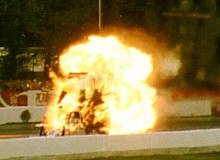
Blower Explosion- An often fiery explosion caused when the fuel mixture ignites in the intake tract before reaching the combustion chamber.
Breakout- Used only in handicap racing, the term breakout refers to a contestant running quicker than they "dialed in" (vehicle was quicker than predicted).
Burned Piston- When a cylinder runs lean (too much air in the air/fuel mixture) and excessive heat burns, or melts, the piston.
Burnout- Spinning the rear tires in water to heat and clean them prior to a run for better traction. A burnout precedes every pro run, but is not needed on street tires.
Christmas Tree- The tree is the prominent electronic starting device between the lanes on the starting line. It displays a calibrated light countdown for each driver.
Clutch Dust- Carbon dust created when the surface of the clutch discs wear as they slide together during the clutch-lockup process.
Clutch Lockup- The progression of clutch-disc engagement controlled by an air-timer management system or other system which allows just enough slippage to avoid tire spin.
Deep Staged- A driver is deep staged when after staging, they roll a few inches farther, which causes the pre-stage light to go out. In that position, the driver is closer to the finish but dangerously close to a foul start.
Dial In- Used in handicap racing, the dial-in is the number (often written in shoe polish on the car window) that indicates the elapsed time a driver thinks their car will run based on qualifying performance.
Diaper- A blanket made of ballistic and absorbent material, often kevlar, that surrounds the engines sump and serves as a containment device during engine explosions.
Displacement- In an engine, displacement is the total volume of air/fuel mixture that an engine theoretically is capable of drawing into all cylinders during one operating cycle.
Dropped Cylinder- When a cylinder ceases output either because it is too rich (too much fuel in the air/fuel mixture) preventing the spark plug(s) from firing, or other mechanical problems prevents a combustible mixture.
Elasped Time (ET)- An elapsed time, or e.t., is the time it takes a vehicle to travel from the starting line to the finish line.
Eliminations- After qualifying, vehicles race two at a time, resulting in one winner and one loser. The loser is eliminated from further competition.
Fuel Cars- The top professional classes of vehicles run on a fuel mixture of alcohol and nitromethane. These produce much more power, are much louder, and sometimes have much more spectacular blower explosions. If your sound system will go loud enough, you can hear what one sounds like (113k).
Fuel Injection- A high pressure fuel delivery system that replaces vacuum-operated carburetion.
Full Tree- Used in Group 2,3 and 4, (non-pro) for which a handicap starting system is used to equalize competition. The amber lights count down in .500 second intervals.
Guard Beam- A light beam to photocell connection located 16 inches past the stage beam that is used to prevent a competitor from gaining a unfair starting line advantage by blocking the stage beam with a low installed object, such as a sump, or a exhausts header pipe. If the guard beam is activated while the stage beam is still blocked, a foul light is triggered on the tree and the offender is automatically disqualified.
Groove- The center of the race track where the traction is often best.
Handicap Racing- A type of race where each contestant runs against a predetermined time, or "dial-in.". You may race against quicker or slower vehicles, with the starting time offset by the difference in your dial-in time.
Headers- Fine-tuned exhaust system that routes exhaust from the engine with long, individual tubes for each cylinder.
Hemi- A hemi engine has a hemispherically shaped cylinder-head combustion chamber, like a ball cut in half.
Holeshot- Reacting quicker to the Christmas Tree starting lights to win a race against a quicker opponent.
Hydraulic- When a cylinder fills with too much fuel, thus prohibiting compression by the cylinder and causing a mechanical malfunction, usually an explosive one.
Index- The expected performance for vehicles in a given class assigned by the sanctioning body. It allows various classes of cars in the same category to race against each other competitively.
Interval Times- Interval timers are part of a secondary timing system that records elapsed times, primarily for the racers' benefit, at 60, 330, 660 and 1,000 feet.
Methanol- Pure methyl alcohol produced by synthesis for use in Alcohol Dragsters and Alcohol Funny Cars.
Nitro Methane- An oxygen carrying fuel for drag racing. By carrying additional air into the engine, huge amounts of power can be generated.
Pre Staged- When a racer is approximately seven inches behind the start line and the yellow light on top of their side of the tree is glowing.
Pro Tree- The Christmas tree amber lights come on simultaneously when the starter activates them, and the green light comes on .400 second later. Used in Group 1 and 4 (Pro), which feature heads-up competition.
Reaction Time- The time it takes a driver to react to the green start light on the Christmas Tree, measured in thousandths of a second. The reaction time counter begins when the last amber light flashes on the Tree and stops when the vehicle clears the stage beam.
RPM- Revolutions per minute, or rpm, is a measure of engine speed as determined at the crankshaft.
Sixty Foot Time- The time it takes a vehicle to cover the first 60 feet of the race track. It is the most accurate measure of the launch from the start line.
Slider Clutch- A multi-disc clutch designed to slip until a predetermined rpm, thereby decreasing shock load to the drive wheels and possible tire spin.
Supercharger- The supercharger, or blower, is a crank-driven air/fuel compressor. It increases atmospheric pressure in the engine, resulting in added horsepower.
Wedge- An engine with a wedge combustion chamber, a chamber resembling a wedge in shape.
Weight Transfer- Weight transfer is critical to traction. Vehicles are set up to provide a desired weight transfer to the rear wheels. When the vehicle accelerates, the front wheels lift and the weight shifts to the rear wheels, making them less likely to spin.
Wheelie Bars- Bars with wheels at the rear of the vehicle used to prevent excessive front end lift.