All New C5 Corvette
Called the C5 because it is the fifth-generation Corvette, the new model
uses a structure that is four times as stiff as the C4 chassis. Its
natural frequency measures 23 hertz, among the stiffest cars in the world.
By using fewer, larger parts, the C5 is inherently more solid. Among the
items eliminated were 34 percent of the total number of parts in the C4.
A folded-steel backbone forms the heart of this frame. With a bottom plate
attached by 36 bolts turning it into an enclosed tube, and hydroformed
steel side rails, this structure provides immense torsional rigidity.
Featherweight pieces are everywhere on the frame. The steering column is
supported by a magnesium casting. The removable roof panel also uses
magnesium for its frame. The floor boards are a composite of fiberglass
and balsa wood which was found to have excellent noise reduction abilities.
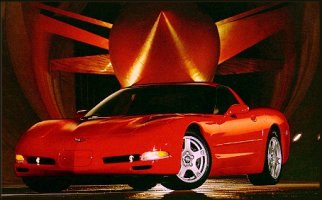 The new body boasts a phenomenal drag coefficient of 0.29 -- a useful
improvement over the previous 0.34 figure and the lowest figure of any
production car except GM's own EV1 Electric vehicle at 0.19 cd.
The new body boasts a phenomenal drag coefficient of 0.29 -- a useful
improvement over the previous 0.34 figure and the lowest figure of any
production car except GM's own EV1 Electric vehicle at 0.19 cd.
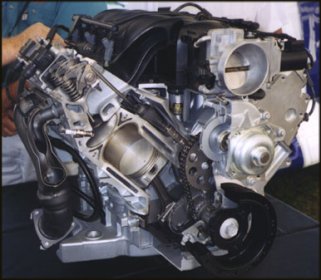
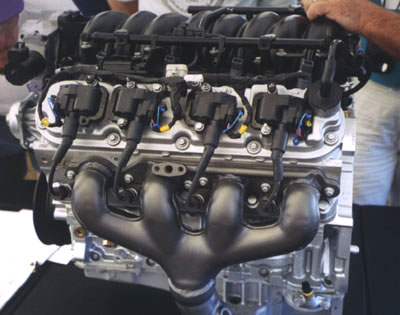
The new LS1 engine shares nothing but its 4.4-inch bore spacing with the
venerable 42 year old small block V8. It is lighter, more compact, and
less mechanically complex than other engines making this much power. It
has reduced frictional losses with roller lifters, and roller rocker arms.
Each cylinder is fired by its own coil timed by
computer and crankshaft triggered. Rather than cast iron manifolds, the
intake is a lightweight smooth finish, thermoplastic, and the exhaust is
double wall stainless steel. Engine output is fed to the rear wheels via
an all-new driveline that puts the transmission at the rear. A torque tube
that is five inches in diameter connects the engine rigidly to the new
rear-mounted transaxle.
The clutch is bolted to the engine's flywheel and turns an aluminum and
ceramic matrix driveshaft. The gearbox is a variation of the Borg-Warner
T56 used in the Camaro and Dodge Viper. For use in the C5, its guts are
reinforced with triple cone synchronizers in the lower gears and stuffed
into a new case that bolts to a Getrag limited-slip differential.
The two openings in the C5's front fascia feed cooling air via four-inch
ducts to the front brakes. Anti-lock control is provided by a Bosch ABS V
system that is integrated with the standard traction control system.
All this chassis hardware communicates with the pavement via Goodyear
Eagle F1 GS EMT (run-flat) tires. So you can tell when a tire loses
pressure, the C5 has a standard real-time pressure monitoring system
that is accurate to within one PSI.
You can eat up pavement very quickly and easily in this car without ever
breaking a sweat or sliding a tire. Exotic-car performance at a moderate
price. The least expensive production car tested at this writing that can
outperform the C5 in the quarter-mile is the Dodge Viper RT/10, which costs
$65,260. Chevrolet set the initial base price of the C5 not much higher
than the previous C4's $38,000 base price.
CHEVROLET CORVETTE C5 SPECS
Vehicle type:  front-engine, rear-wheel-drive, 2-passenger, 2-door targa
Base price:    $38,060

Major standard accessories: power steering, windows, driver's seat, and
     locks, A/C, cruise control, tilting steering wheel, rear defroster.

ENGINE
Type . . . . . . . . . . . V-8, aluminum block and heads
Bore x Stroke  . . . . . . 3.90 x 3.62 in, 99.0 x 92.0mm
Displacement . . . . . . . 346 cu in, 5665cc
Compression ratio  . . . . 10.1:1
Engine-control system  . . GM with sequential multipoint port fuel injection
Emissions controls . . . . 3-way catalytic converter, feedback air-fuel-ratio control,
                           auxiliary air pump
Valve gear . . . . . . . . OHV, 2 valves/cylinder, hydraulic roller lifters
Power (SAE net)  . . . . . 345 bhp @ 5600 rpm
Torque (SAE net) . . . . . 350 lb-ft @ 4400 rpm
Redline  . . . . . . . . . 6000 rpm

DRIVETRAIN
Transmission . . . . . . . 6-speed manual transaxle
Final-drive ratio  . . . . 3.42:1, limited slip
Gear  Ratio             MPH/1000 rpm         Max. speed in gears
I.    2.66 . . . . . . . . 8.4  . . . . . . . 50 mph (6000 rpm)
II.   1.78 . . . . . . . . 12.6 . . . . . . . 75 mph (6000 rpm)
III.  1.30 . . . . . . . . 17.2 . . . . . . . 103 mph (6000 rpm)
IV.   1.00 . . . . . . . . 22.4 . . . . . . . 134 mph (6000 rpm)
V.    0.74 . . . . . . . . 30.2 . . . . . . . 172 mph (5700 rpm)
VI.   0.50 . . . . . . . . 44.8 . . . . . . . 172 mph (3850 rpm)
RPM @ 60mph, top gear  . . 1350

DIMENSIONS AND CAPACITIES
Wheelbase  . . . . . . . . 104.5 in
Track, F/R . . . . . . . . 62.0/62.1 in
Length . . . . . . . . . . 179.7 in
Width  . . . . . . . . . . 73.6 in
Height . . . . . . . . . . 47.7 in
Ground clearance . . . . . 3.7 in
Curb weight  . . . . . . . 3240 lb
Weight distribution, F/R . 51/49%
Cargo Capacity, cu. ft . . 25.0
Fuel capacity  . . . . . . 19.1 gal
Oil capacity . . . . . . . 6.5 qt
Weight/power ratio, lb/hp. 9.3

CHASSIS/BODY
Rigid backbone type, full-length frame integral with body material of
glass-fiber reinforced plastic

INTERIOR
SAE volume - front seat . . . . 52 cu ft
             luggage space  . . 25 cu ft.

SUSPENSION
F: . . . . . .  ind, unequal-length control arms, transverse composite leaf
                spring, anti-roll bar
R: . . . . . .  ind, unequal-length control arms with a toe control link,
                transverse composite leaf spring, anti-roll bar

STEERING
Type . . . . . . . . . . . rack-and-pinion, speed sensitive, magnetic
                           variable effort, power-assist
Turns lock-to-lock . . . . 2.7
Turning circle . . . . . . 38.5 ft

BRAKES
F: . . . . . . . . . . . . 12.8 x 1.3-in vented disc
R: . . . . . . . . . . . . 12.0 x 1.0-in vented disc
Power assist . . . . . . . vacuum with anti-lock control

WHEELS AND TIRES
Wheel size . . . . . . . . F: 8.5 x 17 in, R: 9.5 x 18 in
Wheel type . . . . . . . . cast aluminum
Tires  . . . . . . . . . . Goodyear Eagle F1 GS EMT;
                           F: P245/45ZR-17, R: P275/40ZR-18
TEST RESULTS
ACCELERATION  Seconds
 Zero to 30 mph  . . . . . 2.0
 50 mph  . . . . . . . . . 3.8
 60 mph  . . . . . . . . . 4.7
 70 mph  . . . . . . . . . 6.0
 90 mph  . . . . . . . . . 9.5
 100 mph . . . . . . . . . 11.4
 120 mph . . . . . . . . . 16.8
 130 mph . . . . . . . . . 20.5
Standing 1/4-mile  . . . . 13.3 sec @ 107 mph
Top speed (approx.)  . . . 174 mph (280 kph)

HANDLING
Lateral  Acceleration, G . 0.94
Speed - 600 foot Slalom  . 68 mph (110 kph)
BRAKING
60-0 mph . . . . . . . . . 111 ft @ impending lockup
Fade . . . . . . . . . . . NONE

PROJECTED FUEL ECONOMY
EPA city driving . . . . . 18 mpg
EPA highway driving  . . . 28 mpg
Est. range, city/hwy . . . 344/535 miles
Home Page
Vehicles
Table of Contents
Tech
Software
Racing