
Public Service Alliance of Canada
Environment Component
Local 20147
Menu
Main
Archive
Local Executive
The Shop Stewards
Component By-Laws 1-12
Component By-Laws 13-16
Local By-Laws
Education
FAQ
Links
Updated June 5th, 2003
Letter to Dad from Ryan
Eulogy by Randy
From Murray McPherson, President of the Environment Component, Local 20147
The meeting between the Environmental Component, DFO and the Treasury Board on the reclassification of Fishery Officers was held on March 10th, 2003.
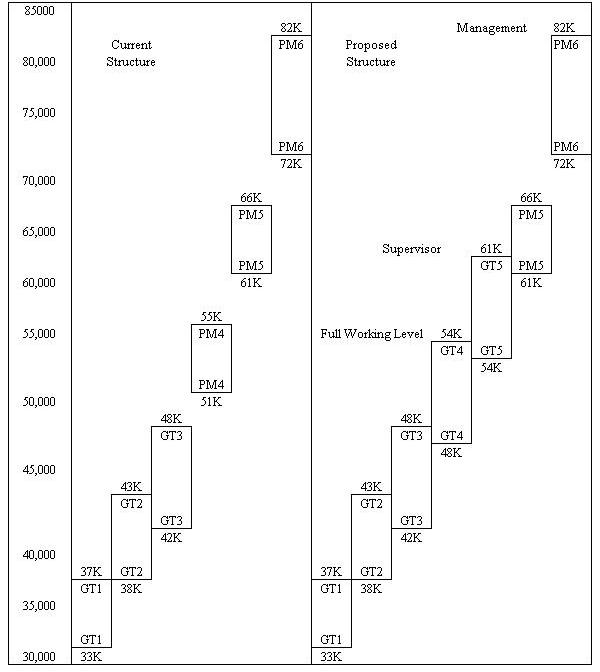
DFO and the Treasury Board presented a proposed structure that will affect the careers of the field working Fishery Officers, from the GT-01 to the PM-04 levels.
They outlined a timetable (that you will find at the end of this document) that addresses the timing of the transition of the new Conservation and Protection structure. If all work is concluded, DFO plans on the implementation by the end of July 2003.
There are outstanding issues such as the effective date for retro pay and concerns on changes to the FOCPP timeline.
Generally, the outcome of the meeting did not provide the results the Fishery Officer Committee and the Fishery Officers across Canada had expressed (GT-05 level).
The Department and Treasury Board in consultation with the committee will try and finalize the new GT-03, GT-04 and GT-05 work descriptions that were prepared by DFO. These were given to us on March 9th, 2003 for review and to comment on. That the committee was disappointed in the proposed work description and associated levels is an understatement as there were many concerns.
We are going to continue to strive to achieve the goal we have set. We will continue the consultation with DFO and the Treasury Board on the reclassification on all the issues. There will be a number of follow up meetings between the Treasury Board and Bill Pynn and Elaine Massey. The FOUMCC committee will be in constant communication with Bill Pynn and is scheduled to meet in Ottawa for conclusion of this process in June.
It is the committees intent to continue discussion with DFO and the Treasury Board to bring the most positive results as possible for the Fishery Officers.
Link to DFO Proposal Fishery Officer Classification Structure
| Obtain your comments on the proposed National Model Work Descriptions | March 31st |
| DFO Functional Management sign-off on new Organizational Structure and National Model Work Descriptions | April 15th |
| Interdepartment Classification Committee Review | April 30th |
| Union/Managemant consultation on implementation plans for Transition: How to �roll-over� to the new Organizational structure? Transition: What retroactivity would be considered? Ongoing: What criteria will be used for promotion within the Career Progression Program after the new Organizational Structure in in place? |
Begin now and complete by May 30th |
| Feedback from Fishery Officers on the total package | June 15th |
| Finalizing costing and obtain TBS approvals | June 30th |
| Implementation of new Organizational Structure | Begin in July |
Updated March 2nd, 2003
From Murray McPherson, President of the Environment Component, Local 20147
The Annual General meeting was held in Vancouver on February 26th, 2003. Elections of the Executive Officers were held and the results were as follows: Murray McPherson, President; George McElwee, 2nd Vice President; Megan Adam, 3rd Vice President; Murray Gilchrist, Secretary; Frank Snelgrove, Treasurer; Monqiue Bakker, Health and Safety; and Perry Powers, Health and Safety. I wish to thank the Executive for running again and congratulate them on their success. I would like to welcome the addition of Megan Adam, from RHQ Vancouver, and Perry Powers, from Chilliwack, to the Executive of Local 20147.
We have a lot of interesting items this year, the most important being the collective bargaining as the contracts come to an end in June and August. Our Local has two members on the bargaining team; Tom Hopkins and George McElwee. We will keep our members informed and updated of events as quickly as possible. Anyone with any questions or issues please contact George or Tom.
Terms and Work force adjustment: As many members know, and for those that don't know, there are discussions around the over spending of DFO in the Pacific Region. There are rumours of lay-offs and comments about workforce adjustment. You will find the wording for work force adjustment in the collective agreement book that each member was provided by DFO. For questions or clarifications, please contact your Shop Stewards or Executive.
Updated February 11th, 2003
From Murray McPherson, President of the Environment Component, Local 20147
This update includes a comment on the Fishery Officer reclassification meeting which will take place in Ottawa, on March 10th, 2003, the next annual general meeting and election of officers to be held February 26th, 2003, and a bargaining update.
The next scheduled meeting of the FOUMCC is March 10th, 2003 and will be the most important meeting to date. At this meeting, we expect to be given a clear classification and point rating for the GT3 Fishery Officer Work Description. There may be a nescessity for further meetings to resolve DFO structural problems, implementations, etc. But it is very important to come away from this meeting with the classification we know we deserve and a true understanding of exactly who supports us (DFO, TBS, HR, Union). Bill Pynn, the national president of the Environment Component will be present at the annual general meeting in Vancouver and Bill and I will give any further updates we recieve between now and the meeting.
Event: General Membership Meeting, Election of Officers
When: February 26, 2003
Where: Simon Fraser University, 515 West Hastings Street, Vancouver, BC
Room: 1420 C Segal Centre
Time: 4:00 p.m. to 5:30 p.m., Meet and Greet 5:30 p.m. to 7:30 p.m.
General Membership Meeting
All members are invited to come and meet their union executives and shop stewards. Please come with any questions you have on employment status, grievances, health and safety or any other employer/employee issues. We will be glad to provide you with information and solutions pertaining to these topics. Mr. William Pynn, National President of the Environment Component and Mr. Nick Humphries, Regional Executive President for the Pacific/Yukon regions will also be on hand to answer questions and meet with members.
Bargaining Update
Busy year on the horizon
PSAC will be very busy on the collective bargaining front in 2003. All in all, PSAC will be concluding collective agreements, negotiating them, or at least serving notice to bargain, for a total of 144 units covering nearly 90% of the members.
All four of the Treasury Board agreements expire in 2003, as do the contracts for the Canadian Customs and Revenue Agency and Parks Canada. The agreement with Canadian Food Inspection Agency expired December 31, 2002, and that bargaining process is underway. In addition, there are a total of 30 other national units expiring in 2003, including most of the Parliamentary Units, several agreements in the Museums and Arts category, and many Public Service Staff Relations Act Part II separate employer agreements including Social Sciences and Humanities Research Council, Office of Auditor General, Canadian Security Intelligence Service and National Capital Commission. The Government of Nunavut agreement also expires in 2003, and the Government of Yukon agreement expired December 31, 2002. Several airports are currently bargaining or have agreements expiring in 2003, including the Toronto airport agreement with the largest membership. Another 38 agreements negotiated regionally will expire in 2003.
The PSAC negotiations section has been working hard to prepare for 2003. A series of research reports on collective bargaining issues will be released under the "Issues" banner. A quarterly publication on economic indicators is also being published under the "Trends" banner. These are being distributed to encourage discussions of bargaining issues among members and their participation in the input process.
Updated January 26th, 2003
From Murray McPherson, President of the Environment Component, Local 20147
Reclassification of Fishery Officers has taken a long time to bring us to the point we're at today. The Union is trying to make sure that this is not a short term fix but a long term solution for the benefit of all Fishery Officers.
What's it take to rate us properly?
If it looks like a duck and quacks like a duck, then it is a ...?
Why is it so hard to rate a Fishery Officer? Is it someone just doesn't like us? I think all Fishery Officers believe that there is a lack of support from the upper levels of DFO. We are always there to have every new (usually dumb) idea passed on to us, which will be one more "other" duty to overflow our plate. We have so far fought a battle that is one sided as DFO just doesn't care; they appease and nothing is resolved. They just don't get it. Well you can lead a horse to water but you can't make it drink. I believe that action, in the most professional manner that we know how, is the answer. We are professionals and we are good at our jobs and now I think it is time to prove it. We know the law, we know the system, we know how to organize a case for a fight; we are now going to organize a case that will move a mountain called classification.
It doesn't matter what it takes to rate our job, we only ask that our work be rated truthfully and with a system that gives fair value and ratings to our job, not a standard so old that Noah was the captain last time. The idea that there are concerns about the org chart and structure are bullshit. We deserve to be classified where we rate out, not where we fit in a chart that DFO can't sort out. If DFO and the rest of the crew up there can't do their jobs, then that is their fault, not ours, and I for one am tired of paying or in this case not getting recognition, classification and pay for their inabilities.
I feel that if we do not get the rating we all know, through UCS, all documents and work descriptions, an antiquated bench mark scoring system and plain common sense, a classification that is based on truth, then once again we have been screwed.
The FOUMCC is scheduled to meet in Ottawa on March 10th 2003 and this will be a decisive meeting. I have called a meeting of the group of six, we will discuss a plan, then I will present it to the FOUMCC. I will hope for and frankly I will expect 100% support from all Fishery Officers. I want a plan in place that if the results on March 10 are not what we deserve then it will go into action immediately on the 10th.
Updated December 1st, 2002
From Murray McPherson, President of the Environment Component, Local 20147
I have two items for Fishery Officers today:
#1: Reclassification � As I stated earlier, there is a meeting of the committee on December 12th, in Ottawa, to clear up minor points and issues. On January 13th, the FOUMCC will be presented with a proposal from Treasury Board, DFO and HR. We will then have time to consider to proposal and hopefully be able to present something to all Fishery Officers after these meetings. At this time, we are all on schedule as laid out by all parties concerned. So, in English, what I am saying is that we are on schedule and I am still very optimistic that we will have a resolve and that all Fishery Officers will be happy with the results. I wish to state that I felt UCS would never die so I guess this is just a word of caution that the battle is not over we are satisfied. Try to have a good and merry Christmas and let�s hope a happy new year.
Of course, nothing ever goes smoothly, as it seems that we may achieve recognition and classification that we rightly deserve but it seems that upper management in DFO will never be supportive or give us the respect that I think Fishery Officers deserve. We may be deemed professional to a higher level by other agencies but no matter how hard we work or how much we take on in our everyday tasks with continuing budget problems, equipment problems and general staffing problems, we can never resolve the issue of management.
#2: Once again I want to bring your attention to the opinion of Fishery Officers by Mr. Chris Dragseth. This is the reason that your union and local have requested no participation by Fishery Officers on the Fishery Officer Progression Planning Committee. I, personally and professionally, am offended that this is the opinion management holds of Fishery Officers. The following is an excerpt from the �Optimizing the Conservation and Protection Leadership within Fishers and Oceans � Pacific Region� document, by Chris Dragseth:
What approaches to career successions planning would best enhance leadership capacity within the Conservation and Protection program for the Pacific Region?
Why should this question be addressed? The Department�s Senior Management within the Pacific Region (e.g. Regional Director General, Branch Directors, Area Directors, and myself) are concerned that the leadership capacity within the Conservation and Protection program has not kept pace with the challenges confronting the Department. Accordingly, the future leadership within the Fishery Officer cadre may not be capable of effectively leading the Conversation and Protection program into the 21st century.
The basis of the following perspective comes from my observations of staff, as an Area Director, and more recently as the Director of Conservation and Protection. I have observed a resistance to change and limited buy-in to the Department�s vision and strategic direction. In carrying out their duties, there appears to be a general resistance by Fishery Officers to look beyond their own program. This seems to have led to a breakdown in teamwork, as many Fishery Officers within the C&P program do not freely work co-operatively with other programs. The finding of the Government of Canada�s Public Service Employee Survey 1999 (1999) hinted at this perspective. In the survey Pacific Region�s Fishery Officers (104 respondents) either agreed �a lot� (4%) or �somewhat� (62%) to the statement �For my current job or career development, I need to learn more about good teamwork skills.�
Another observation that I have made relates to the accepting responsibility. Rather than taking responsibility for finding solutions to problems, the C&P field leadership tend to �manage up�, by moving decisions to more senior levels which are more appropriately dealt with at lower levels in the organization. Further compounding this problem are low staff and a culture that does not strongly respect the supervisory reporting relationships.
Updated October 23rd, 2002
From Murray McPherson, President of the Environment Component, Local 20147
This is an update on the visit from the Treasury Board to the Pacific region to obtain a better understanding of the work duties performed by Fishery Officers.
Suffice to say, that the treasury board people went in pairs to three locations (Kamloops, mid-Vancouver Island and the lower Fraser) for two days and nights, Wednesday, October 16th and Thursday, October 17th. I met with them on their arrival for introductions and then again on Friday 18th for a debriefing.
They were impressed by the professionalism and enthusiasm of all the Fishery Officers they dealt with, and this I think is what we would expect and I personally want to thank all the officers that were involved.
Comments included:
These are a few of the comments made and it makes me personally feel that this group has a better understanding of the role of a Fishery Officer. Because 3 of the 6 that were in the Pacific region are the ones that will be doing our work description classification, I believe that this part will be addressed with understanding.
To give you an idea of the timetable, they are to have their report ready for the next meeting of the Union, Treasury Board, DFO and HR, November 15th, in Ottawa. Once this group meets, then the FOUMCC committee will meet to discuss the report on November 25th in Ottawa. After this meeting, I will request a statement from Bill Pynn, the National President.
At this time, we have no intention of changing our course of action that we�ve been following since April of this year. This means no CTO, voluntary participation, etc.
As a final note, I want to thank all the Officers in Canada, especially the one�s who represented all of the Officers so professionally during their involvement in escorting the Treasury Board and DFO staff on these field trips. This was a Canada wide effort and you should all be applauded. I have set a goal of where I feel the minimum where GT3s should be classified and I plan to stay at this until we receive the respect and classification we deserve. Let�s stay united and keep the faith.
Updated October 1st, 2002
First topic is the scholarship application date has been extended to October 31st, 2002 and applications are to be sent to Tom Hopkins or Frank Snelgrove.
Secondly, PCMC is a voluntary committee for GT3s and PM4s, but may not be voluntary for PM5s. Any Fishery Officers told to attend PCMC meetings, please contact Murray McPherson.
Perry Powers has agreed to act as one of our health and safety executives until our next election of officers at February's annual general meeting.
Because of his heavy workload for the Union on grievances, George McElwee has been moved from health and safety and appointed to 2nd Vice President until elections in February.
We require a member for the EO position, which deals with minorities, woman's issues, etc. Any interested members, please contact Murray McPherson.
It's that time again to prepare for collective bargaining. Would all members with issues that they would like raised at the collective bargaining, please forward these to Tom Hopkins.
For Fishery Officers, my read on the work schedule for GT 03's: and PM 04's:
Article 25 - Hours of Work -
25.04 (a) Except as provided for in clause 25.09, the normal work week shall be thirty-seven and one-half (37 1/2) hours exclusive of lunch periods, comprising five (5) days of seven and one-half (7 1/2) hours each, Monday to Friday. The work day shall be scheduled to fall within a nine (9)-hour period between the hours of 6:00 a.m. and 6:00 p.m., unless otherwise agreed in consultation between the Alliance and the Employer at the appropriate level.
My Read we work Mon - Fri Each day 7 1/2 hours between 6 am to 6pm
This brings us to 25.09 rotating or irregular basis:
25.09For employees who work on a rotating or irregular basis:
(a) Normal hours of work shall be scheduled so that employees work:
(i) an average of thirty-seven and one-half (37 1/2) hours per week and an average of five (5) days per week,
and
(ii) seven and one-half (7 1/2) hours per day.
My Read We work 5 consecutive days in the week, Sun -Sat at 7 1/2 hrs a day
Terms and Conditions Governing the Administration of Variable Hours of Work
25.10 The terms and conditions governing the administration of variable hours of work implemented pursuant to paragraphs 25.04(b), 25.06, and 25.09(g) are specified in clauses 25.10 to 25.13. This Agreement is modified by these provisions to the extent specified herein.
My read 25.04 (b) the employer can vary the hours in 25.04 (a) only between 6am and 6pm and may vary the days of the week.
25.06 if the employee agrees they can change the work day to more than 7 1/2 hrs so the employee finishes the week in less than 5 days. Day is still Between 6am and 6pm
25.09 Still no change to hours of 6am to 6pm
25.12
(a) The scheduled hours of work of any day, may exceed or be less than seven and one-half (7 1/2) hours; starting and finishing times, meal breaks and rest periods shall be determined according to operational requirements as determined by the Employer and the daily hours of work shall be consecutive.
(b) Such schedules shall provide an average of thirty-seven and one-half (37 1/2) hours of work per week over the life of the schedule.
(i) The maximum life of a schedule for shift workers shall be six (6) months.
(ii) The maximum life of a schedule for Day workers shall be twenty-eight (28) days, except when the normal weekly and daily hours of work are varied by the Employer to allow for summer and winter hours in accordance with clause 25.04(b), in which case the life of a schedule shall be one (1) year.
(c) Whenever an employee changes his or her variable hours or no longer works variable hours, all appropriate adjustments will be made.
No where does it say the employer can change the hours of work outside the 6am to 6pm
25.13 For greater certainty, the following provisions of this Agreement shall be administered as provided herein:
... (h) Overtime shall be compensated for all work performed on regular working days or on days of rest at time and three-quarter (1 3/4).
I understand that a Fishery Officer (GT-03) can sometime work different shifts; i.e., 0600-1400, 0830-1630 and 1400-2200. These shifts include 7 1/2 hours of work per day with a meal break of 30 minutes. At times, Fishery Officers are required to work week-ends depending on operational requirements and this is reflected in their shift schedule which is for a period of time not exceeding 56 days.
In reviewing the relevant provisions of the collective agreement in conjunction with the above stated information, a GT-03 Fishery Officers would be covered by
Article 25.09 - For employees who work on a rotating or irregular basis. As provided for under Article 25.09, the employee works on average 37 1/2 hours per week and an average of 5 days per week and 7 1/2 hours per day. For obvious reasons, the GT-03 Fishery Officer would not be considered as working normal hours of work as provided for under Article 25.04 because the Fishery Officer does not work 37 1/2 hours a week from Monday to Friday and the hours of work do not necessarily fall between 6AM to 6PM as required by the provision.
The GT-03 Fishery Officer would also not be considered as working under the Terms and Conditions Governing the Administration of Variable Hours of Work because the GT-03's hours of work as outlined above is 7 1/2 hours per day. Article 25.12 states that the : "The scheduled hours of work of any day, may exceed or be less than seven and one-half (7 1/2) hours; starting and finishing times, meal breaks and rest periods shall be determined according to operational requirements as determined by the Employer and the daily hours of work shall be consecutive." An example of a typical employee who would fall under Variable Hours of Work would be a Weather Observer (EG) who usually has a schedule which requires them to work approximately 4 days a week at 10-12 hours per day at regular pay. There shift schedule have a maximum life of up to 6 months. In order for a Fishery Officer to fall under the Terms and Conditions Governing the Administration of Variable Hours of Work as provided for in the Technical Services Agreement, the Fishery Officer would have a work schedule of up to 6 months maximum, with hours of work which could be as follows: 1) 5 days a week at 10 hours a day with appropriate days of rest; or, 2) 4 days a week at 12 hours a day with appropriate days of rest. The important fact being here that the daily regular hours are more or less than 7 1/2 hours.
As for the PM-04 Field Supervisors, again their work schedules would need to be reviewed in accordance with the Provisions of their collective agreement, e.g., Program and Administrative Services. The relevant provisions would also fall under Article 25 - Hours of Work-. Without listing all the relevant provisions of the collective agreement, I refer you to Article 25.13 and 25.17 (Rotating or irregular Hours) and 25.22 to 25. 23 (Variable Hours of Work). In brief, if the PM-04 Field Supervisor Work Schedule meets the provisions of Article 25.13 and 25.17, then the employee would be considered as working on a Rotating or Irregular basis and not Variable Hours of Work where one can access overtime compensation at the rate of 1 3/4. I have include below Article 25.13 and 25.17 for your ease of reference:
25.13 When, because of the operational requirements, hours of work are scheduled for employees on a rotating or irregular basis, they shall be scheduled so that employees, over a period of not more than fifty-six (56) calendar days:
(a) on a weekly basis, work an average of thirty-seven and one-half (37 1/2) hours and an average of five (5) days;
(b) work seven and one-half (7 1/2) consecutive hours per day, exclusive of a one-half (1/2) hour meal period;
(c) obtain an average of two (2) days of rest per week;
(d) obtain at least two (2) consecutive days of rest at any one time, except when days of rest are separated by a designated paid holiday which is not worked; the consecutive days of rest may be in separate calendar weeks.
25.16 The Employer shall set up a master shift schedule for a fifty-six (56) day period, posted fifteen (15) days in advance, which will cover the normal requirements of the work area.
25.17 Except as provided for in clauses 25.22 and 25.23, the standard shift schedule is:
(a) 12 midnight to 8 a.m.; 8 a.m. to 4 p.m.; 4 p.m. to 12 midnight;
or alternatively
(b) 11 p.m. to 7 a.m.; 7 a.m. to 3 p.m.; 3 p.m. to 11 p.m.
Therefore, if the Field Supervisor works on average 37 1/2 hours per week and 7 1/2 hours per day. The Field Supervisor will be subject to the provisions for Rotating and Irregular Hours.
However, if the Field Supervisor is working more than 7 1/2 hours per day and is working other shift hours than those provided for under Article 25.17 the employee may very well fall under Variable Hours of Work. See 25.11(b) below
25.11 (b) In no case shall the hours under clause 25.06 extend before 6 am or beyond 9 pm or alter the Monday to Friday work week orthe 7 1/2 consecutive hours work day.
So I believe we work:
12 midnight to 8 a.m.; 8 a.m. to 4 p.m.; 4 p.m. to 12 midnight;
or alternatively (11 p.m. to 7 a.m.; 7 a.m. to 3 p.m.; 3 p.m. to 11 p.m.
or under variable hours between 6am and 9pm
Below is an opinion from Ottawa that I agree with.
In closing, as mentioned previously, a general determination concerning GT-03 Fishery Officers and PM-04 Field Supervisors Working Hours cannot be made.
Each and every employee's work schedule must be reviewed in order to determine if they are in fact working Variable Hours of Work or Rotating and Irregular Hours of Work.
However, having said that, in my review of previous Work Schedules of Fishery Officers I have determined that they are working Rotating and Irregular Hours and not Variable Hours of Work.
Update on reclassification
There was a meeting with 6 Fishery Officers, Dennis Brock DFO, Lise Sincennes DFO Director of Classification, Elaine Massie from the Environment Component and Margaret Jaekl PSAC Classification and Equal Pay Officer. We all worked as a unit to get the proper wording for the GT 03 work description. It was a tough and frustrating process but also one where there was tremendous cooperation and professionalism on the part of DFO and the Union.
How did we do? Well we will be sending the WD out shortly for GT03�s to look at but I believe it is a great job. I want to thank all the teams for the effort they put into this process.
Now for those that don�t know TBS and DFO sent out a team of investigators to SWNS (south west Nova Scotia.) and the GT03 Fishery Officers took them on a work trip for two days. This was a well organized trip set up ahead of time by the Fishery Officers where they travelled with the officers and got a great insight into our jobs�.not a drive around by supervisors�
When they come to BC we have asked for the opportunity to do the same�.
Here are some comments I received from last weeks TB and DFO-HR field tour in SWNS. I thought you might like to read them.
1 - For Your Information... Just a quick first look at our internal view of how the Treasury Board classification review team saw our efforts to demonstrate our requirement for a new classification standard and sub-group.
2 - Why am I not surprised? But certainly elated! Hats Off to all of you that have made this a resounding success. You a have done all you can do, so now its up to them.
3 - From: Clarke, Alan J (Yarmouth)
4 - I would like to take this opportunity to thank all those involved with the recent visit by members of the TBS and HR DFO Ottawa to look into the role of Fishery Officers and how it is reflected in their present classification.I attended the briefing this am and all the comments from this group were extremely positive, you are to be commended on your display of professionalism,teamwork and knowledge and how you conveyed this to the visitors.This was our chance as F/Os to finally demonstrate our importance and where the F/O fits in the organisation. Thank you very much for your efforts to make this a positive move toward a classification that truly and fairly reflects the everyday role you play in the DFO structure. I would also like to convey to you the positive support and comments by our Area and Regional management members and their support to our cause.
Updated September 8th, 2002
The latest on Reclassification of Fishery Officers.
First of all, I want to reiterate that we will continue with our course of only working overtime for cash and no CTO. We will also continue to withhold all voluntary participation on committees. The reason for this continued action is that we have been trying for over 15 years to get proper classification of fishery officers and it is my belief that we are finally getting some positive results. We have struggled too hard to quit now and because nothing worked in the past and we are finally getting some action, we need to continue working with the plan that is getting results.
At the last meeting, in July, the Union was given a timetable from Management with goals to be achieved by set dates. One of the goals is a complete review of the work description and development of a new point ratings benchmark for Fishery Officers. It is our opinion that these goals set by Management can and will be met by the Union. To this end, I have been contacted to go to Ottawa approximately September 18th-20th, as part of the committee to meet with DFO, Treasury Board and HR to work on our work description and point rating. This is one of the major hurdles in the opinion of the Union and after these meetings, the Union will have a truer sense of Management's sincerity. We will then give all the members in Canada an update of our progress and the next steps on this timetable.
Once again, I want to thank all Fishery Officers in Canada for their continued support and much appreciation to your spouses and families.
Updated August 19th, 2002
From Murray McPherson, President of the Environment Component, Local 20147
Update on the reclassification of Fishery Officers. As you�ve all seen, there was a joint communiqu� released by DFO and the environment component. On August 8th, there was a meeting in New Brunswick, of myself and 12 fishery officers from the Maritimes where we discussed the joint communiqu�.
At this meeting, we were given an explanation of the fishery officer classification feasibility study with a corresponding time table, and the Union will continue to monitor the agreed upon time table to assure that all dates are met. We will continue to keep all fishery officers updated, so that no rumors can interfere with the goals of your FOUMCC.
At this time, I would like to make it clear that in the rest of Canada there are no officers working for CTO and that in BC/.Yukon, we are still on the course of not working for CTO. It is the opinion of the Union that the pressure and the unity of the fishery officers is getting the results that we have strived for. As each of the agreed to dates pass, and the goals are achieved at each stage, we will then reexamine our approach on some issues.
For clarification, the Union FOUMCC committee along with the National president will be selecting the fishery officers that will be sitting on the committees. We are of the opinion at this time that HR, DFO and the treasury board are giving this the utmost attention and working diligently with the Union every step of the way.
I wish to express my thanks once again to all the fishery officers and their families for their support as I realize this is very stressful, but I assure you that we are putting in all of our effort to resolve this once and for all. The ultimate goal is to have fishery officers classified at the appropriate deserved level, which will ultimately benefit the officers and their families.
From Murray McPherson, President of the Environment Component, Local 20147
An update on the activities of your component and local. A date of August 6th has been set for the follow up meeting to the July 2nd meeting, between the component, HR, DFO and the Treasury Board. I hope to have a summary of this meeting to be put on the web on my return August 15th. On this date, there is also a second meeting to discuss the BEIs and I wish to assure everyone that at this BEI meeting, there will be no final decisions made. I have discussed this very thoroughly with our component president Bill Pynn and have been assured that all suggestions from this meeting will be discussed with our members here in the pacific region. We are striving to resolve this issue and I hope all Officers realize the enormous effect that this is having on all members.
Following is a letter from Bill Pynn, National President of the Environment Component, to clarify the Union's position in the letter that was posted last week in response to the Public Service Commission of July 4th, 2002.
I wish to respond to your letter of July 16, 2002.
I must first clear up some possible misunderstandings. The Public Service Commission (PSC) has written to the ADM of Human Resources for DFO, Mr. George Da Pont on July 4th, 2002. In this letter the PSC has stated that
they wish to:
The commission has directed that the recourse branch initiate an investigation to review all selection processes conducted to staff PM 4 (Field supervisors) and PM5 positions (Conservation supervisors) across Canada.
To this effect, we would ask that the department identify all processes concerning the staffing of the above named positions for which there were no appeals and for which the administration of the behavioral event interview
(BEI) was a selection tool.
We would further ask that the department implement the following corrective measures already used in those cases where there were allowed appeals, that is to apply the new marking scheme tot he BEI results and to prepare new
eligibility lists.
This action initiated by the PSC was what I was addressing in my letter to the PSC. These actions are also alarming to us as they are to you. As I stated in my letter :
This measure has the effect of reviving expired eligibility lists, re-marking candidates on the basis of an assessment that is over two years old, and has the potential to prejudice incumbents to positions for which no appeals were filed under section 21 of the PSEA. In our view, this approach is unlawful; it is contrary to the Public Service Employment Act and Regulations, is wholly inconsistent with merit, and cannot be in the best interests of the public
service at large.
As such should the PSC or DFO affect any change to any competition which was not appealed we would have to look at filing a complaint on these action with the PSC.
We wish to assure you that everything that we are able to do is being done on behalf of the membership. As you are aware there are still a large number of appeals unresolved and both the PSC and DFO seem to be continuing with actions that do not lead to a quick and acceptable conclusion.
Our advise to DFO has not changed since they initially advised us of their intentions to conduct these competitions in the fall of 1999.
We will continue to strive to protect the rights of all of our members.
William Pynn
From Murray McPherson, President of the Environment Component, Local 20147
The latest news, July 4th, 2002, from Francoise Huneault, the Deputy Registrar to George Da Pont, ADM of Human Resources.
The commission has directed that the recourse branch initiate an investigation to review all selection processes conducted to staff PM 4 (Field supervisors) and PM5 positions (Conservation supervisors) across Canada.
To this effect, we would ask that the department identify all processes concerning the staffing of the above named positions for which there were no appeals and for which the administration of the behavioral event interview (BEI) was a selection tool.
We would further ask that the department implement the following corrective measures already used in those cases where there were allowed appeals, that is to apply the new marking scheme tot he BEI results and to prepare new eligibility lists.
Finally, the department should inform the registrar's office, attention of the deputy registrar, jurisdiction, of the list of processes and of the impact of these corrections on the processes.
An investigator will then review these submissions, inform the affected employees, and give them the opportunity to be heard.
You will note that we are copying this letter to the unions involved in the selection process.
The following is a response from the President of the Environment Component, Bill Pynn, to the above letter.
From Murray McPherson, President of the Environment Component, Local 20147
To all Fishery Officers,
This is to bring you up to date on the actions of the Fishery Officers across Canada and the meeting held in Ottawa July 2nd. All officers have withdrawn service from voluntary work and committees, are filing grievances when required to perform duties not in their work description and are still refusing to work for CTO.
Is this working? Yes. Since the April 8th FOUMCC meeting and the subsequent actions of Fishery Officers across Canada, Management in Ottawa has approached Bill Pynn (National President of the Environment Component) and requested a meeting to deal with the problem of classification of Fishery Officers and Fishery Officers being in separate tables.
Here is an update on the meeting that was held in Ottawa, July 2nd, with Bill Pynn, George Da Pont (Assistant Deputy Minister of Human Resources), Pat Chamut (DFO) and a classification officer from PSAC.
At this meeting, it was explained to the Union that DFO and HR have already had meetings with the Treasury Board to brainstorm ideas. The object of these meetings was to determine the rules for classification, who has to be involved in the negotiations, which steps are legal, etc. In other words, these meetings were to work out the "bugs" so that everybody would know the rules and the steps involved once a plan of attack was agreed upon.
At the July 2nd meeting, George Da Pont, who was the main spokesperson, stated that these concerns were also the concerns of the Minister and Deputy Minister of Fisheries. There were four different proposals presented by Management, and the second proposal is the one which the Union and Management have decided to work with. I will not try to explain the details at this time but will once the details are worked out at the next meeting. The next meeting will be the end of July or the first of August and after this meeting, we will be able to present a clearer view of our goals and objectives and the time frame for attempted resolution of the classification and unification of Fishery Officers at one table.
What is the Fishery Officers next step? Stay united and continue with the plan of action we have been following since April 8th. I want to make it clear that we will continue to refuse to work for CTO and will file grievances. At this time, I will be placing some grievances in abeyance once they reach the second level. This will be to show a sign of good faith on the Unions part. If at the next meeting at the end of July, the Union does not feel that there is a genuine effort on the part of Management to truly work with the Union to resolve this problem, then we will simply take the grievances out of abeyance and continue.
We feel for the first time that we have a true shot at achieving our goals, but because of the past history of our dealings with DFO, we remain skeptical. Therefore, because of the fact that our actions are working, we are not going to back off any actions until at least after the next meeting. I wish to state that Management in the pacific region has been telling the hierarchy of DFO that the officers in the pacific region will work for CTO. I think it's time to set the record straight and state the rumors of different offices having officers work for CTO is just that, a rumor.
If there are officers that feel they don't want to be part of the Fishery Officers fight for a proper, deserved and earned classification, then I truly feel you will have to live with your own conscience because I am sure that once we accomplish our goal, you will gladly take the upgrade (that you didn't fight for) as quickly as all of us officers who are making the sacrifice and did fight for it.
This action we're involved in is really striking home and getting results and I sincerely wish to thank all the Fishery Officers and their families for the sacrifices they've made during the events since April 8th.
From Murray McPherson, President of the Environment Component, Local 20147
Okay, to continue with our grievances. Many Ffficers have recieved letters with all sorts of wording and statements regarding their grievances. The last part of the letter always states "therefore the grievance is denied" or similar wording. Once you recieve notification that your grievance has been denied, especially when I am hearing that they are being denied without even having a hearing (not that I expected management would give you one), then the next step is to file the Grievance Transmittal Form, raising it to the second level.
To reiterate, once you have recieved your work description org. chart and point rating, then transmit your article 55/57 to the second level. The reasoning behind this is that we do not believe it reflects the work performed by Fishery Officers. Any questions, please contact your rep or Murray McPherson.
For our next grievance, we are requesting that all Fishery Officers in Canada file the Force Continuum Training Grievance. Management has stated that it is part of our work description and therefore we believe that for advancement and career development, it is a training tool to which all Fishery Officers are entitled.
I will give you an update on other grievances in the rest of Canada and all the ATIP information once we recieve it. Remember, we're professional and we will remain professional through this entire ordeal. I truly have faith that we will recieve proper recognition and upgrades for Fishery Officers.
From Murray McPherson, President of the Environment Component, Local 20147
Latest update. First of all, here is a quote from the letter sent May 20,2002 by George Da Pont, ADM of HR, and Pat Chamut, ADM of Fisheries Management.
Following Treasury Board's announcement, on May 8, 2002, the PA, EC and FS
groups have been proposed as initial candidates for classification reform.
This is subject to final confirmation with departments and the applicable
unions.
For the Conservation and Protection program, this would mean that the supervisory positions currently classified in the PM group would be dealt with as part of the PA Group and the officer positions currently classified in the GT group would not be initially addressed. The Department of Fisheries and Oceans recognizes that this is not an acceptable situation. DFO and Treasury Board Secretariat have agreed to discuss the matter with the union to ensure that all groups involved in this department's Conservation and Protection field operations are dealt with in a manner that is equitable and fair, and ensures operational effectiveness.
It seems that there might be a glimmer of hope that DFO is on our side but I urge all Fishery Officers to continue the course we have set. I think the total reversal of support that DFO displayed at the April FOUMCC meeting clearly shows that we need more than words, we need action. As shown in the bold paragraph above, once again we are being given lip service. I therefore believe that we continue with our actions until such time there is a truly acceptable show of support from DFO.
We need 100% support from all Fishery Officers. I don't believe that once we obtain our upgrade those not in support at this time will turn down the raise. I believe this is the pursuit of something that even management believes we are entitled to through reclassification and the fact that they say they don't have the money is irrelevant. Reclassification is based on the work you do and the point rating you receive for this work, not whether or not there are funds available.
Some points brought up are:
Now, this will explain the grievances in abeyance. We have a complete, accurate work description that we have just updated with management and now we pull the grievances out of abeyance and take these two Ottawa to have our jobs reclassified. We need the acting grievance because our argument has been that we have been acting at a higher classification and therefore want backpay.
I hope to have an update by early next week. Keep the faith and remember we are all in this together.
With the death of UCS, one of the excuses used by DFO management for reclassification of fishery officers has died also. Management has repeatedly said that fishery officers are not properly classified, but that UCS would resolve this situation. It now appears, in my professional opinion, that with this excuse no longer valid, they have no choice but to support the fishery officers in their reclassification. This brings us to the following information supplied to the locals from the Environment Component in Ottawa. We are asking all GT3 fishery officers to file two grievances with the following wording shown under classification grievance and acting pay grievance as soon as they receive their work descriptions that they have requested from management. These are filed as individual grievances and given to your supervisors. If you have requested your work description and have still not received it, then we recommend that you file a grievance stating you have not received the documents requested in a timely manner. Blank grievance forms are on the front page. Please notify Murray McPherson when you file the grievance.
I have been asked questions regarding refusal to work for situations that fishery officers believe unsafe.
Before you do a refusal to work, read section 128 (1) of the
Canada Labour Code Part 2. If the task does not have to be performed immediately and there is time to work on corrective measures to fix or eliminate the danger, then there is a process called �Internal Complaint Resolution Process� under section 127.1 (1) of the code. If you read this section and follow it verbatim, there should be no problems in getting these issues resolved. It is my opinion that in section 127.1 (2) �as soon as possible� is approximately 10 days, at which time section 127.1 (3) would then take effect. This is a process of cooperation between management and the employee and at all steps of the process, the employee or the union health and safety officer have to agree or they can file a formal complaint. If you have any questions, please contact Murray McPherson.
There will be further updates after the area representatives have had a conference call this week.
From Murray McPherson, President of the Environment Component, Local 20147
The contacts for each area are below:
At the top of the page, you will find the grievance form and the wording for grievances. When filling out the grievance form, the bargaining agent is PSAC, Environment Component, Local 20147 and the representative is your Shop Steward. If you do not have a Shop Steward, put down Murray McPherson. Please notify the contact in your area when you file a grievance.
The following was sent to me from a fellow fishery officer.
I think it is important that all the FO brothers and sisters understand the full ramifications of the issues at hand.
Firstly in reference to your last UMCC meeting "...Chamut stated that to do reclass would cost lots of money approximately $4 Million. DFO doesn't have money and can't get it from Treasury Board." - Well read below - it appears other civil servants (Immigration) are being recognized for their service with an upgrade - with virtually three times the number of people. How did they achieve this goal - grievance campaigns held since 1998. During this time Fishery Officers continued to work in good faith with the "promises of UCS" while others in the Dept. sought and achieved upgrades. Now GT officers are told that they are working under the same job description with the same duties as 1993 (With some additions as a result of grievance) - that UCS is just a new format.
The attached email gives officers clear direction on their course of actions.
-----Original Message-----
From: Richard, Carole (Ottawa) Sent: Thursday, April 25, 2002 9:59 AM
You are right in that there are two different work descriptions. The WD used to evaluate the position grieved was written in the GE format. Since then, management developed the UCS model and the GT-03 level was confirmed, as the UCS version is simply a rewrite of the previous version in a format which meets UCS requirements. The duties and responsibilities are the same, as confirmed by management. Hope this helps.
Carole Richard A/Chief, Organization & Classification (613)990-0051 fax (613)990-5014
THE EFFORTS OF THE MEMBERS PAY OFF AT CIC Approximately 1,800 employees, mainly including PM-02 officers, have obtained a classification upgrade further to a national review of their duties. PM-02 positions were upgraded to the PM-03 level. Many CR-04 members, i.e. approximately 250, were also upgraded to the CR-05 level. These include the members working in Telecentres and various assistants within a few regions. These successes, which many will find mitigated, are undeniably due to the remarkable efforts made by our members in the past few years and their recent contributions to the process established within CIC. This once again demonstrated that union and collective membership action, when constant and coordinated, provides results.
We would be remiss not to mention the contributions of the Immigration Advisory Committee and of various classification grievance campaigns held since 1998, the excellent contribution of members during the CIC reviews of duties, the specific input of the members who met in early February to take part in the PM-02 job description validation exercise and the clear message sent to the employer in the responses to the national Public Service Employee Survey and provided through various other less perceptible means. Within each of the exercises mentioned, the members demonstrated their determination and their combativeness to the employer and to managers. It was mostly shown that they would not accept to be continually treated as second-rate employees and to be rewarded only with messages of appreciation and recognition plaques.
The results announced must also be carefully examined and objectively analysed in order to ensure that the descriptions accurately reflect the duties and that the factor ratings reflect the true value according to the applicable standard.
Here are some of the activities that are being pursued in the rest of Canda:
ATIPs
Grievances
From Murray McPherson, President of the Environment Component, Local 20147
Here is a letter from a fellow fishery officer that will give you an insight into the support we are receiving from management.
Murray and Peter,
I was out at the Pacific Region Middle Managers Forum at the Hotel Grand Pacific ( nice place ) and as I was speaking with Maureen Patterson at the registration desk on Wednesday, April 17. A person wearing the name tag Chris Dragseth, came out of the conference floor and went over to speak with Robert Martinolich. He was raving that he had just recieved a quote from the RCMP as to the cost of instructors, per week, per instructor, of $5000.00 for Force Continuum or Firearms training. His statement took me by surprise, due to the disdain in his voice and his actions of pretending to shoot himself in the head while he said it, was most disconcerting coming from a person in the higher ranks of C&P. He said, of the Fishery Officers, " How childish are they? They are nothing but spoiled children. When are they going to grow up?" Martinolich then indicated he should keep his voice down.
That very evening I spoke with John Lewis an Area Chief of C&P, and I expressed my concerns about the lack of support after the Deputy Minister, the Associate Deputy Minister and others across the Regions have been assuring us they were going to address the classification issue and resolve the separation for the past year or more. That stated support was renegged upon at the Ottawa level on April 8th. I had a discussion with John, albeit under the influence of a fair measure of barley hops, in which I pointed out now it seemed as if all Fishery Officers, including the volunteer Force Continuum staff and firearms range safety and instructors, normally the training instructors being the ones that go the extra mile on a regular basis and bend over backwards and forwards, are wanting to make a statement and demonstrate what it is we do, on a volunteer basis, that we are not compensated for by removing this voluntary service. My question, referring to Mr. Dragseth's statement, was why Dragseth sees it as his job to forego the support we are looking for and try to screw even those people who are the ones that have traditionally given the most of their personal time and effort for this outfit.
I have sent Mr. Dragseth this very question, but I certainly don't expect a reply to come this far East, given his exhibited attitude and stated general disdain for Fishery Officers within his own region.
I have found this to be greatly demoralizing and typical of the field notion of how our lords and masters view us in the field.
Sincerely, and for your information,
Jeffrey Irwin
I want to start out by thanking all the fishery officers and especially the force continuum officers. This was a very hard decision for them to make. They were the first officers asked to withdraw their voluntary services and they were concerned that they would be the only ones and be left out to dry. I had to assure them that 90% of the force continuum officers across Canada have resigned. I also had to assure them that all true fishery officers would applaud them for their actions and support them by withdrawing their own "voluntary" services.
What is voluntary? Attendance at force continuum is not voluntary. The union believes being an instructor at force continuum is voluntary. The first step for all officers is to politely and professionally withdraw their services from all activities that they believe are voluntary. If they're is confusion over what might be voluntary, please send me an email or phone me and I will get the unions perspective for you. What we need is if you are asked to do something, ask for it in writing, then proceed with the task to the best of your professional ability, informing your supervisor that you will be filing a grievance, then please contact me and we will commence the process.
Update, the force continuum officers are receiving written instructions to return to their role as instructors in force continuum. We will now be asking these officers to contact me to file grievances.
I am getting questions regarding many issues. For example, the classification issue. I previously sent to all officers what happened at the national FOUMCC meeting in Ottawa on April 8th, 2002. I also sent the email from the national office and the address for the press release.
With the lack of support and with new information, we have found that there is confusion in Ottawa as to what job description we work under. After having requested our work descriptions, we have been informed in some offices in BC that we will be receiving this information from Ottawa directly. On the East Coast, they have been advised that all work descriptions will come from Ottawa.
Officers in BC who requested their work description in 1999, received the UCS work description. When verifying whether we working under the 1993 work description or the UCS work description, they received an email from Dennis Brock confirming it was the UCS work description. During the last year, officers on the East Coast that requested their work description received the 1993 work descriptions. This is the reason that we need all fishery officers to request their work description.
I apologize to those that don�t understand everything we are doing, but those officers helping understand the route we�re taking. Now, some officers will question every step we take, but it�s hard to find the time to gather all the information for this fight and put it out to all officers as it requires long explanations if you are not part of the group gathering the data. We are working for the betterment of the officers, but if you have concerns, please call or email me.
There are suggestions that we as fishery officers have a conference call or some type of gathering to discuss different officer�s points of view. I find this interesting because we have an annual general meeting on April 25th in Nanaimo, and we have put out a notice to find interest from anyone that would like to call in on a conference call at this meeting, as we were trying to set up a phone line. So far, one reply.
One other item I will address is overtime. Overtime, section 29.04a for GT�s and 28.08 for PM�s states all overtime is cash unless agreed to by the employee. At this time, we classify CTO as voluntary. I have been asked about CIS and I believe it is a voluntary group. I have personal concerns because this group is set up to support fishery officers and others. The national office at this time wishes to maintain this as a voluntary group.
I hope this explains the rationale for the work description request and withdrawal of voluntary services. We need the support of all fishery officers. Next week, I will be on another national conference call and I will provide the information to you and any other updates as they come in.
One other note, the Public Service Survey. I believe this is something that all fishery officers need to reply to.
-Tim Surette
AREA DIRECTOR/DIRECTEUR DU SECTEUR
SOUTHWEST NOVA SCOTIA/SUD-OUEST DE LA NOUVELLE ECOSSE
I would like to echo the comments that Jack has made. The people from Treasury Board and HR commented that this was the "most profession group of enforcement officers that they have ever reviewed and that all they talked to had extreme pride in what they were doing ". They indicated that the Area and Region should be proud of having the most professional " TEAM" of enforcement officers that they had ever seen. They stressed the fact of professionalism and teamwork. Some of them have been doing these field trip assessments for over 25 years.
Not any surprise to us you all carried yourselves in your normal professional manner and you were able to portray and demonstrate your professionalism over a very short two day period. You have set a high bench mark for the rest of the Country to meet. Congratulations to all for your usual splendid job performance. Thank You
-J . A. LOWE
RVP Scotia Fundy.
Updated July 24th, 2002
Updated July 15th, 2002
Bill Pynn's Response to the BEI letter.
Updated July 3rd, 2002
Updated June 5th, 2002
Updated May 22th, 2002
Updated May 13th, 2002
I wish to start by thanking all the fishery officers across Canada for their continued support in our fight for the proper recognition and classification of fishery officers.
Updated May 6th, 2002
"Destiny is not a matter of change, it is a matter of choice; it is not a thing to be waited for, it is a thing to be achieved."
- William Jennings Bryan
All grievances dealing with work we believe not in our work description. This includes force continuum, selling licenses, etc. Any questions, contact Murray McPherson.
To: Basi, Jasmir Subject: RE: C&P - Request for Evaluation of GT-03 Fishery Officer//C&PIf employees are not satisfied with the content, their option is to put in a staff relations grievance.
Updated April 28th, 2002
Updated April 20th, 2002
�You are here? You know Arthur, being here is a lot like being lost�
-The Tick.
I hope you are starting to realize the issues at hand. If management doesn�t even know what work description we�re under then it�s pretty hard to believe their statement that they�re still working on getting us re-classified.Work Description Request Form
Scholarship Application Form
You are the  person to visit since March 7th 2000
 Email to [email protected]