| Factory Pantera Wheels (1971-1974) (and Tires as Delivered) By Chuck Melton |
| No topic seems to be more hotly debated than Pantera wheels. Perhaps this is because it relates to both aesthetics and performance. No single modification has a greater effect on the handling of the car than the wheel and tire combination. It can also be the easiest change made to the car, unless of course, the wrong parts are used. First let me say that what I present is my opinion. There are so many variations and details that can, and rightfully should, be included, that this topic will never be finished. Where to begin ? I�ll repeat the famous quote, �Begin at the beginning, and continue until the end, then stop.� (Alice in Wonderland) Except, I believe there will never be an end. The beginning is clear. What did the DeTomaso factory produce ? Not a short or simple answer, really. |
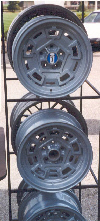
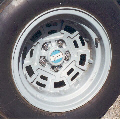
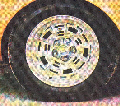
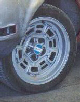
| The differences in factory wheels are often described as the (rare) 1-slot, 2-slot, or even the (rarest) 3-slot variety. Examine the image with two wheels. You will notice the design contains (from the outer edge inward) the rim lip, rim, the edge where the center face meets the rim, the area that contains both the 5 �vents� roughly in the shape of a rectangle, and the slots, or elongated holes, between the vents, followed by a pentagram, the lug nut recess, ending with the hub. In the second image, you will see the 10� Campy with the �rib� between the vent, and the rim. These are the terms I will use in this, and future articles, to describe the outside face of a wheel. There are differences on the inside too ! |
 |
 |
 |
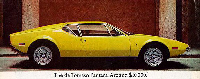
| The prototype: In the images that I have seen, the prototype is wearing what is commonly referred to as 3-slot wheels. The following image is from �Automobile Quarterly�, Volume 8, Number 4, dated Summer, 1970. This is an excellent hardbound book, which everyone should obtain. The article is written just prior to the New York Auto Show. I believe this is how the car appeared at its New York debut. |
 |
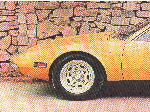 |
| On the prototype the tire can be seen as a Dunlop, reported as 185/70 VR 15 front, and 215/70 VR 15 rear, I suspect the wheels were 7� wide in the front, and 8� wide in the rear, as delivered on the future production cars. |
| In an early factory brochure, the wheels seen, manufactured by Campagnolo, are made from magnesium alloy, and are the single slot (or 1-slot) version. |
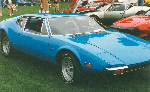
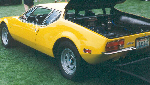
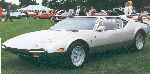
| The early cars, commonly referred to a �Push Buttons�, named for their different door handles, wore these single slot wheels, as seen below. DeTomaso made running changes throughout the production life, and at some point after the introduction of the square door handle cars in 1971 the wheels changed to the 2 slot variety. |
 |
 |
 |
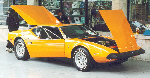
| The first cars came with either the Michelin XWX or Pirelli CN-73 steel-belted radials in 185/70-15 on the front, and either 215 or 225/70-15 on the rear. The Arriva (a bias-ply tire) was developed especially for the Pantera by Goodyear and was released to coincide with the L-model. I believe the sizes were G-60-15 and H-60-15 (an antiquated sizing designation no longer in use, but the rear tires work out to 255/60-15, and the fronts are about 205/60-15.) Following the demise of the importation of the Pantera to the USA, European L-models were issued with the old 185/70 and 225/70 radials, while the GTS wore the P-7 in 225/50 and 285/50. Of course, you could order your Pantera with any tires you wanted, so it wasn't uncommon to see GTS cars with Arrivas, and L-models with P-7's. (Quoted from Mike Drew) An example of an original car, still with the Arriva tires. |
 |
| There are several variants of these 2-slot wheels. I refer you to the excellent article on this topic written by Mike Drew, which can be found at: http://www.asajay.com/wheels.html. He describes in detail the differences in the wheels showing 4 of the 6 major variants now known to exist. Also included is how to decode the date of manufacture. Mike Drew has plans to update this article to include the new variants recently identified and to include the 10� wheels. Contact him at [email protected]. |
 |
 |
 |
 |
|